
What Is a Warehouse Management System? A Plain-English Guide
What is a warehouse management system? In plain English, a WMS is the software that controls how stock moves through your warehouse — from receiving to dispatch — and keeps the count honest. This guide teaches the core functions, then helps you decide between a full off-the-shelf WMS, an ERP module, and a right-sized owned system built to fit your warehouse.
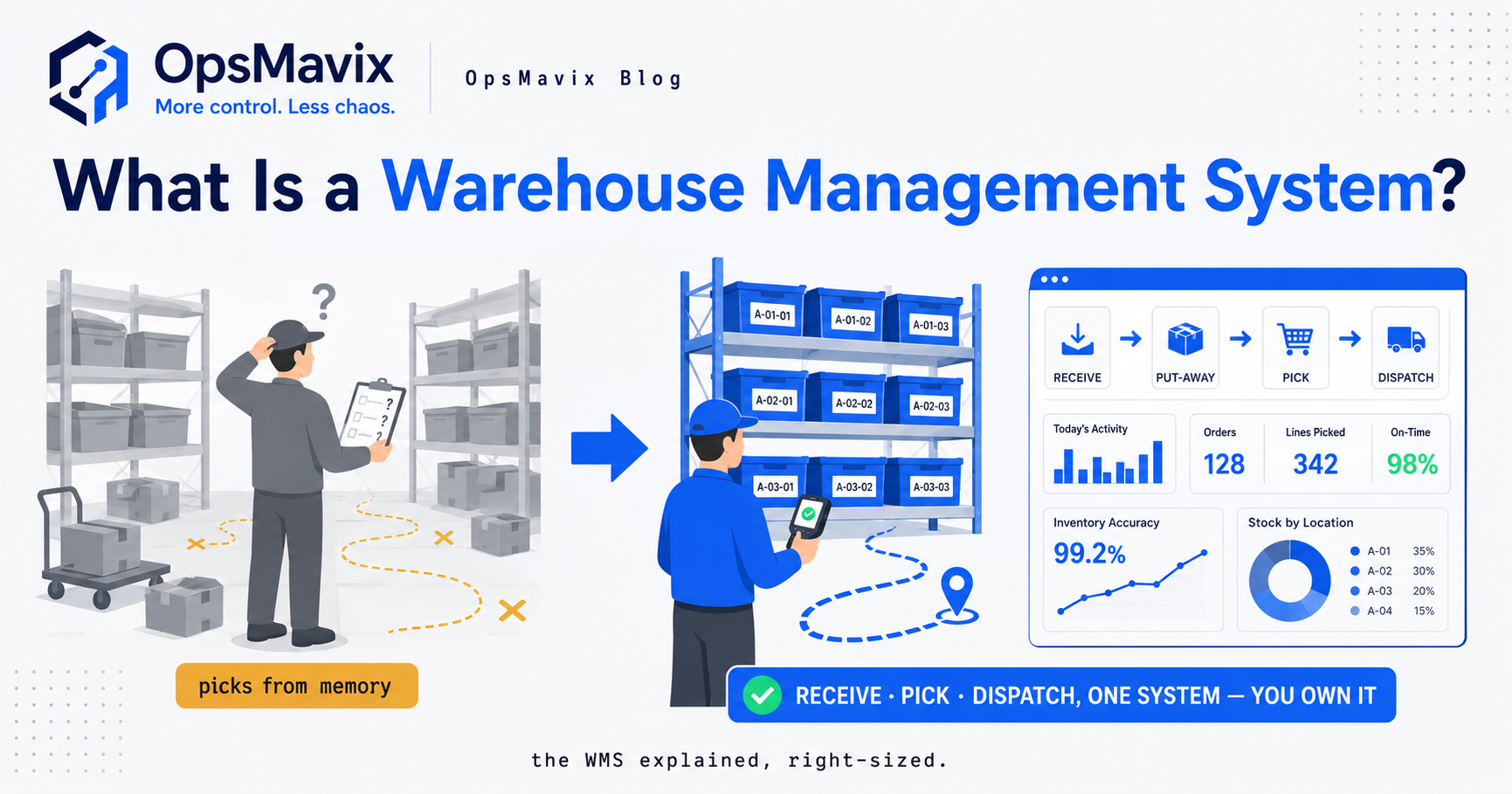
A warehouse management system, or WMS, is the software that controls how stock physically moves through your warehouse — from the moment a delivery arrives at the dock to the moment a picked order leaves for a customer — and keeps a truthful, real-time record of where every item is and how much of it you actually have. Put simply: it tells your team what to receive, where to put it, where to find it again, and how to get it out the door accurately, then updates the count automatically at every step so the number on the screen matches the number on the shelf.
Most businesses don’t wake up wanting one. They want to stop a specific kind of pain. The picker who walks the length of the building to a bin that turns out to be empty. The order that ships short, or ships the wrong item, and comes back as a return and a refund and an apology. The stocktake that never quite reconciles. The reorder placed off a count that was already wrong. A warehouse management system exists to kill those failures at the root, because they all trace back to the same thing — nobody actually knowing, at any given second, what is where.
Quick summary: Warehouses running on manual tracking average only around 63 to 65% inventory accuracy, the typical operation runs a 1 to 3% pick error rate, and a single picking error can shave up to 13% off the profitability of that order, according to Cin7. The gap between a guessed count and a controlled one is not a rounding error. It is one of the most fixable costs in the whole operation.
Contents
- What a Warehouse Management System Actually Is
- The Core Functions of a WMS
- How a WMS Differs From Inventory Software and From an ERP
- Signs You’ve Outgrown Spreadsheets
- Spreadsheets vs Off-the-Shelf WMS vs Right-Sized Owned System
- Do You Actually Need a Full WMS?
- A Worked Example: The £11,000 Warehouse Leak
- FAQ
- How OpsMavix Can Help
- Sources
What a Warehouse Management System Actually Is {#what-it-is}
Strip away the jargon and a WMS is a control layer that sits over the physical space where you store and move stock. An inventory count tells you how much you have. A warehouse management system tells you where it is and directs the work of moving it — receiving, storing, finding, picking, packing and shipping — while keeping the count accurate as a by-product of doing that work properly.
The distinction matters. A spreadsheet can hold a quantity. It cannot tell a picker the fastest route across four aisles, cannot stop them picking the wrong batch, and cannot update itself the instant a box is scanned onto a pallet. A WMS is built for the floor, not the office. It assumes stock has a physical address, that people and goods move around, and that the count is only trustworthy if it is captured at the exact moment something changes hands — usually by a scan.
That is the whole idea in one line: a WMS makes the warehouse legible. A room full of stock and a crew of busy people becomes a system where the location of everything is known, the next task is clear, and the record updates itself.
The Core Functions of a WMS {#core-functions}
A warehouse management system earns its keep across a handful of concrete jobs. These are the functions almost every WMS shares, whatever the badge on the box.
- Receiving. When a delivery arrives, the WMS checks it against the expected purchase order, flags shortages or over-deliveries, and records the new stock the moment it is scanned in — so goods are countable the second they hit the dock, not whenever someone gets round to keying them.
- Put-away. It directs where incoming stock should go, based on rules you set — fast movers near the dispatch area, heavy items low down, batch or expiry grouping where it matters — instead of leaving it to whoever is free and wherever there’s a gap.
- Locations and bins. Every storage position has an address. The system knows that SKU 4471 lives in aisle C, bay 12, level 2, and how many are there. This is the backbone everything else stands on.
- Picking. It generates pick lists and routes, tells the picker exactly where to go and what to take, and confirms the right item and quantity by scan. This is where most errors are born and most efficiency is won.
- Packing and dispatch. It verifies the packed order against what was ordered, produces labels and paperwork, and records the goods leaving — decrementing the count and closing the loop.
- Stock accuracy and cycle counting. Rather than one dreaded annual stocktake, a WMS supports rolling cycle counts that reconcile expected against actual by location, catching drift while it is small.
- Barcode and scanning. Handheld or wearable scanners capture every movement at the point it happens. This is what makes the count real-time instead of a snapshot that was already out of date when it was taken.
- Reporting. It surfaces what actually happened — picks per hour, error rates, ageing stock, dead locations — so you manage the warehouse on evidence instead of gut feel.
Get these right and most of the daily firefighting simply stops. Notice, though, that this is a specific and finite list. It is not a hundred modules. That fact is central to the buying decision further down.
How a WMS Differs From Inventory Software and From an ERP {#vs-inventory-erp}
These three get blurred together constantly, and the confusion costs people money. Here is the clean version.
Inventory software answers how much do I have, and where across my sites and channels. It is a count and a value. It is brilliant for keeping stock levels honest across a shop, a website and a stockroom, for reorder points, and for stopping overselling. What it generally does not do is direct the physical work inside a single building — put-away logic, pick routing, bin-level location, scan-confirmed movements. If your problem is “the number is wrong,” inventory software is often the answer, and an inventory automation system may be all you ever need.
A warehouse management system answers where exactly is it in this building, and how do I move it efficiently and accurately. It is operational. It cares about aisles, bins, pick paths, and the person holding the scanner. You reach for a WMS when the building itself has become the bottleneck — when the count is only part of the pain and the real cost is people walking miles, picking wrong, and losing stock inside their own four walls.
An ERP answers how does the whole business run — finance, purchasing, sales, HR, and usually an inventory or warehouse module bolted in. That module can do WMS-type work, but it is one room in a mansion: you buy the mansion, pay for it forever, and use a handful of rooms. For when the warehouse question turns into a whole-operations question, logistics management software covers the wider flow.
The practical takeaway: don’t buy a WMS to fix a counting problem, and don’t buy an ERP to fix a warehouse problem. Match the tool to the actual leak.
Signs You’ve Outgrown Spreadsheets {#outgrown}
Spreadsheets are a genuinely fine warehouse system right up until they aren’t. The tipping point is usually not a single dramatic failure but an accumulation. If several of these ring true, the spreadsheet has quietly become the bottleneck:
- Pickers regularly walk to a location and find it empty or wrong, because the sheet and the shelf disagree.
- You have more than one aisle or storage area and no reliable, bin-level record of what sits where.
- Two people can’t safely update stock at the same time without one overwriting the other.
- Onboarding a new warehouse hire takes weeks, because the knowledge lives in people’s heads, not the system.
- Order errors, shorts and wrong-item returns are creeping up as volume grows.
- Your stocktake overwrites the count instead of reconciling it, so you never learn where the loss is.
- You are keying the same movement into two or three places — the sheet, the accounts, the courier.
The through-line is that a spreadsheet describes stock but cannot direct work or capture movement automatically. Past one aisle and a couple of people, that gap turns into daily error. That is the moment the market starts selling you things, and where you need to think clearly.
Spreadsheets vs Off-the-Shelf WMS vs Right-Sized Owned System {#comparison}
When the warehouse starts hurting, the market offers two answers and quietly hides the third. Answer one: buy an off-the-shelf WMS or switch on the warehouse module in an ERP. Answer two: keep muddling through on spreadsheets a while longer. The third answer — a right-sized system you own, built around how your warehouse actually works — is the one nobody is incentivised to sell you, and it is frequently the correct one.
Be fair to each. Spreadsheets are free and immediate. Off-the-shelf WMS platforms are genuinely powerful and, if your operation is fairly standard, may fit you well straight out of the box. A right-sized owned system wins when your warehouse has real specifics the generic tools handle awkwardly, and when you would rather own the thing than rent it forever.
| Factor | Spreadsheets / no system | Off-the-shelf WMS or ERP module | Right-sized owned system |
|---|---|---|---|
| Fit to your warehouse | Manual, breaks past one aisle | You bend to the tool’s assumptions | Built around how you actually move stock |
| Bin-level locations | Not really possible | Yes, generic model | Modelled to your exact layout |
| Scan-confirmed picking | None | Yes, standard | Yes, shaped to your flow |
| Odd processes (kitting, batch, returns) | By hand | Often awkward or extra modules | First-class if they matter to you |
| Reporting | Rebuilt by hand each time | Fixed to vendor templates | The specific reports you run on |
| Cost model | Cheap but leaks money | Per-seat / per-module, forever | Build once, then you own it |
| Time to value | Immediate but fragile | Weeks to months, consultant-led | Scoped to the leak you actually have |
| Ceiling | Hit at aisle two | Walls where it assumed a different business | Extend it because you own the code |
| Data ownership | Yours, but scattered | Lives in the vendor’s platform | Your database, your rules |
The honest read: there is no universally right answer, only a right-sized one. If a cheap WMS app fits your operation, use it and don’t overspend to look sophisticated. The question is only worth escalating when the generic tool becomes a wall.
Do You Actually Need a Full WMS? {#need}
Here is the part the vendors skip. A full warehouse management system is a serious commitment, and plenty of businesses that think they need one actually need something smaller and sharper.
Ask what is really hurting. If the pain is “my count is wrong across shop, web and stockroom,” that is an inventory problem, and inventory software or an inventory automation system is likely the right, cheaper answer. If the pain is “my building is chaos — people can’t find stock, picking is slow, errors are climbing,” that is a genuine warehouse-control problem, and some form of WMS capability is warranted.
But warranted does not mean the biggest platform on the market. Most growing UK warehouses use a fraction of a full WMS. They need honest bin locations, scan-confirmed picking, sane put-away, and cycle counts that reconcile — not the yard-management, labour-forecasting and slotting-algorithm modules they will pay for and never switch on. A right-sized owned system delivers exactly the control you use, built around your layout, then gets out of the way. For the off-the-shelf options, see the best warehouse management system software; for the smaller-operation view, a warehouse management system for small business.
The test is simple. If a standard tool covers your real needs at a fair price, buy it. If you keep hitting “it almost does what we need, but…”, that gap is the signal a right-sized build will pay for itself. Where warehouse control also reaches back into how you make things, manufacturing production tracking is where the two disciplines meet.
A Worked Example: The £11,000 Warehouse Leak {#worked-example}
Numbers make it concrete. The figures below are illustrative — not a claim about a specific client — but the shape is one warehouse managers recognise on sight.
The business. A UK wholesale distributor of plumbing and heating parts. Turnover around £2.4 million a year, roughly 3,200 active SKUs, two aisles of racking plus a bulk area, and four warehouse staff. Orders come in from trade counter, phone and a growing website — around 90 order lines a day.
The pain. Stock lives on a shared spreadsheet with no bin locations. New hires learn where things are by walking the floor with a veteran for a fortnight. Pickers routinely hunt for stock the sheet says is there, and the operation runs at roughly the industry-standard 2% pick error rate. Each wrong pick means a return, a re-ship, an apology, and time nobody has. The annual stocktake overwrites the numbers rather than reconciling them, so the true shrink is unknown.
The over-buy temptation. A vendor pitches a full tier-one WMS at several thousand pounds a month plus a five-figure implementation and months of rollout — a platform built for national fulfilment centres, most of which this distributor would never switch on.
The right-sized fix. Instead: bin-level locations mapped to the actual racking, scan-confirmed put-away and picking on cheap handhelds, pick routes that stop the miles of walking, and rolling cycle counts that reconcile instead of overwrite. Built once, owned outright, shaped to this warehouse’s exact layout and two channels.
The outcome. With scan-confirmed picking, error rates fall toward the sub-1% range good operations reach. Given manual tracking sits around 63 to 65% accuracy against 99%+ for controlled warehouses (Cin7), the honest count also surfaces ageing and shrink for the first time. Add up the lost picker hours, the returns and re-ships from a 2% error rate on 90 lines a day, and the dead cash in stock nobody could locate, and a distributor this size can reasonably carry an £11,000-a-year warehouse leak — recurring until the floor becomes legible. The right-sized build pays for itself well inside its first year.
FAQ {#faq}
What is a warehouse management system?
A warehouse management system, or WMS, is software that controls how stock moves through a warehouse — receiving, put-away, storage, picking, packing and dispatch — and keeps a real-time, location-level record of what you have and where it is. Unlike a simple stock count, it directs the physical work on the floor and confirms each movement by scan, so the record on screen matches the shelf.
What is the difference between a WMS and inventory software?
Inventory software answers how much do I have and where across my sites and channels — it is a count and a value, ideal for stopping overselling and driving reorders. A WMS answers where exactly is it in this building and how do I move it accurately — it deals in bins, pick routes and scan-confirmed movements inside a single warehouse. If your problem is a wrong number, inventory software often solves it. If your problem is a chaotic building, you need warehouse control.
Do I need a full WMS or is that overkill?
For many growing UK businesses, a full tier-one WMS is overkill. It is a large, general platform with modules built for national fulfilment centres, and most smaller warehouses use only a slice while paying for all of it. If your real need is honest bin locations, scan-confirmed picking and cycle counts that reconcile, a right-sized owned system usually delivers exactly that — cheaper, faster to go live, and shaped to your layout — without renting a platform far bigger than your operation.
How does a WMS improve picking accuracy?
By replacing memory and paper with direction and confirmation. The system tells the picker precisely where to go and what to take, then verifies the item and quantity by scan before it can be marked picked. That closes the two biggest sources of error — going to the wrong place and grabbing the wrong thing. With manual operations averaging a 1 to 3% pick error rate and each error costing real money in returns and re-ships, this is where most of the payback lives.
Can a small warehouse justify a WMS?
Often yes, but rarely the biggest one. The trigger is not size, it is specificity: more than one aisle, several people updating stock, climbing order errors, or new hires taking weeks to learn the floor. When those appear, some warehouse-control capability pays for itself. The mistake is jumping straight to an enterprise platform. A right-sized owned system gives a small warehouse the exact control it needs and nothing it doesn’t.
How OpsMavix Can Help {#how-opsmavix-can-help}
OpsMavix builds right-sized, owned operations systems for growing UK warehouses and distributors — businesses that have outgrown a spreadsheet but have no reason to rent a full enterprise WMS or ERP they’d use a fraction of. Instead of selling you a bloated platform, we map how stock actually moves through your building — where pickers waste miles, where errors are born, where the count drifts and where cash sits ageing in locations nobody can find — and build the specific system that closes those leaks: bin-level locations, scan-confirmed put-away and picking, cycle counts that reconcile instead of hide the loss, and reporting you run the floor on, owned outright by you and extended as you grow. It’s the practical layer between spreadsheets that have run out of road and an enterprise WMS that’s overkill. If your warehouse is costing you picker hours, order errors and stock you can’t locate, start by finding out exactly where it leaks: Book a Free Operations Leak Audit
Sources {#sources}
- Cin7 — manual tracking averages 63–65% inventory accuracy; 1–3% pick error rate; a single picking error can shave up to 13% off an order’s profitability; automated picking cuts errors up to 70%: https://www.cin7.com/blog/wms-picking-accuracy/
- Logistics UK — UK online retail sales reached £128.6 billion in 2025 (29% of total retail sales); UK logistics processes 4.4 billion online orders annually; labour productivity up 25–40% with automation: https://logisticsuk.org/warehouse-automation-in-the-uk/
- Descartes / Finale Inventory — warehouse KPI benchmarks: customers average 99.88% stock-take accuracy; best-in-class operations ship 99.56%+ of orders without cancellation: https://www.finaleinventory.com/blog/warehouse-management/top-5-kpis-for-warehouse-performance/