
Logistics Management Software: What It Covers and the Right-Sized Way UK Businesses Buy It
Logistics management software coordinates how goods move — planning loads, booking carriers, tracking deliveries and checking freight cost. This guide explains what it actually covers, where SMBs get oversold, and the right-sized, owned way to get delivery visibility without renting an enterprise suite.
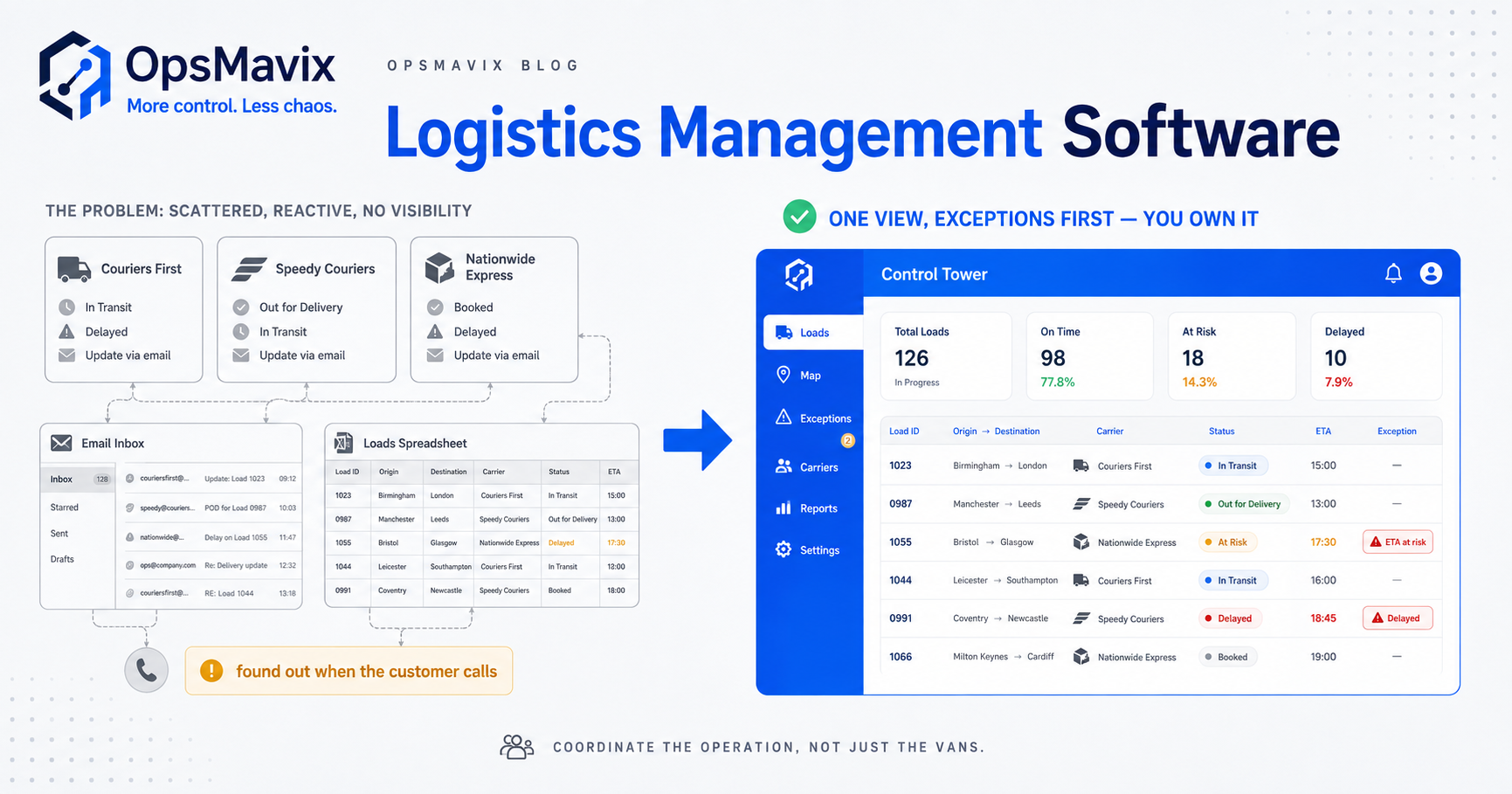
Logistics management software is the layer that plans, moves and tracks the physical flow of goods — deciding what goes on which van or carrier, booking the movement, following it to the door, and checking you were charged what you agreed. It sits between your orders and your customers’ doorsteps, turning “we’ve got 40 things to ship today” into “here’s the plan, here’s where each one is, and here’s what it cost.” For a growing UK product business, the confusion isn’t what logistics software does. It’s how much of it you actually need — because most of what’s marketed to you is built for shippers a hundred times your size.
Quick summary: Logistics is not a niche back-office concern — it’s a huge slice of the UK economy. The sector contributes around £175 billion in gross value added each year and accounts for roughly 8% of total UK employment (Logistics UK, Logistics Report). When a cost line is that big, the difference between “we can see it” and “we’re guessing” is real money — and for most SMBs the fix is visibility, not a bigger platform.
Contents
- What logistics management software actually is
- The core modules (and which ones you need)
- Where logistics sits in the wider supply chain
- The oversell problem: enterprise suite vs a real SMB
- Full logistics/SCM platform vs right-sized owned system (comparison table)
- A worked example: a wholesaler’s Thursday deliveries
- Signs you need visibility, not a bigger suite
- The right-sized, owned alternative
- What logistics software does not replace
- FAQ
What logistics management software actually is
Strip away the vendor language and logistics management software does four jobs:
- Plan the movement — group confirmed orders into loads or drops, decide what goes on your own vehicles and what goes to a carrier, and sequence the runs.
- Book and execute — raise the delivery, produce the paperwork and labels, and hand off to a driver or courier.
- Track it — know where each delivery is and whether it landed, with proof of delivery captured against the order.
- Reconcile the cost — check the carrier’s invoice matches the job you booked and the goods that actually shipped.
The engine underneath most of this is a transportation management system (TMS). Gartner defines a TMS as software that supports “multimodal sourcing, planning and execution of the physical transport of goods across the supply chain,” letting a shipper select the appropriate route and carrier, do freight rating across modes, and “manage freight bills and payments” (Gartner). That’s the enterprise definition. Everything a vendor adds on top — dashboards, analytics, network optimisation — is a variation on those four jobs.
The important thing to hold onto: logistics management software is a coordination layer, not the thing that physically moves goods. It doesn’t drive the van or fly the parcel. It decides, books, watches and checks. That distinction is why an SMB rarely needs the heavy version — you need the decisions and the visibility, not an aerospace-grade routing algorithm.
The core modules (and which ones you need)
“Logistics management software” is an umbrella term. Under it sits a menu of modules, and no business needs all of them:
- Order-to-load planning — turning a pile of confirmed orders into an efficient set of drops or loads.
- Route optimisation — sequencing stops to cut miles and time. Matters most if you run your own fleet; largely irrelevant if couriers do the moving.
- Carrier management — a rate book of your couriers and hauliers, choosing the best fit per job, and booking from one place.
- Freight rating — knowing the cost of a movement before you commit to it.
- Delivery tracking and proof of delivery (POD) — live status, ETAs, and a signature or photo on arrival, tied back to the order.
- Fleet and driver management — vehicle allocation, driver runs and compliance, for own-fleet operators.
- Freight audit and pay — matching carrier invoices to booked jobs so overcharges get caught, not paid.
- Returns and reverse logistics — moving goods back when a delivery fails or a customer returns something.
An enterprise vendor sells the whole menu as a bundle, because that’s how the licence is priced. A right-sized system picks the two or three modules your operation actually runs on — usually order-to-load planning, carrier management with tracking, and freight-cost checks — and skips the rest until you genuinely grow into them.
Where logistics sits in the wider supply chain
It helps to see the boundary. Your supply chain is the whole journey of a product: sourcing materials, making or buying stock, storing it, and getting it to the customer. Logistics is the movement piece of that journey — inbound (suppliers to you) and outbound (you to the customer).
Logistics software only earns its keep when it’s connected to the processes either side of it. A delivery plan is only as good as the stock availability behind it, and a delivery only counts as done when the order status updates and the customer can see it. Logistics visibility that lives on an island — a standalone courier dashboard nobody else in the business can see — recreates the exact silo you were trying to remove.
That’s why we treat logistics as one thread inside a connected operation, not a bolt-on. If you want the wider frame, the supply chain management software pillar covers how the buy-make-store-move pieces fit together, and multi-site operators should read multi-location inventory management — because you can’t plan a movement well if you don’t know which site the stock is actually in.
The oversell problem: enterprise suite vs a real SMB
Here’s the trap. Almost all logistics software marketing is aimed at large shippers moving thousands of loads a day across modes and borders. The screenshots show carrier networks with hundreds of integrations, network-design simulations, and multi-country freight optimisation. It’s genuinely impressive software — for a business that has those problems.
Most growing UK product businesses do not have those problems. A wholesaler running two of its own vans and two national couriers, moving a few dozen drops a day, does not have a routing-algorithm problem. It has a “where’s the Thursday delivery and did the courier overcharge us?” problem. Those are completely different budgets.
Buy the enterprise suite anyway and three things happen. You pay a recurring per-user or per-load licence for capacity you’ll never touch. You spend months on an implementation to configure features you don’t use. And your delivery data ends up living inside a vendor’s platform that you rent access to — the moment you stop paying, the visibility goes with it. You solved a £3,000-a-year visibility leak by signing up to a five-figure annual rent. That’s the oversell.
Full logistics/SCM platform vs right-sized owned system
The honest comparison isn’t “expensive vs cheap.” It’s “capacity you’ll never use vs a system that fits what you actually do.”
| Dimension | Full logistics / SCM platform | Right-sized owned system |
|---|---|---|
| Built for | Large shippers, multi-modal, cross-border, high volume | SMBs with own vans and/or a handful of couriers |
| Carrier network | Hundreds of pre-built integrations | Your actual 2–5 couriers, connected properly |
| Route optimisation | Deep, algorithmic, multi-constraint | Practical drop sequencing — good-enough routing |
| Modules | The whole menu, bundled | Only the 2–3 you run on |
| Setup | Months, specialist implementation | Weeks |
| Cost model | Recurring licence per user/load, often five-figure/yr | One build, owned — no per-seat rent |
| Data ownership | Vendor’s platform; access ends when payment does | Yours, on infrastructure you control |
| Fits your volume | You pay for capacity you never use | Fits today; extends when you grow |
| What you’re buying | A platform to rent | An outcome you keep |
Neither column is “wrong.” If you’re moving thousands of loads across borders, the left column is correct and you should buy it. The point is that the left column is sold to businesses that belong in the right column — and that mismatch is where the money leaks.
A worked example: a wholesaler’s Thursday deliveries
Take a Midlands wholesaler shipping around 40 orders a day: two of its own vans for local drops, two national couriers for everything else.
Before — the spreadsheet-and-inbox version. Orders confirm in the order system. A dispatcher exports them to a spreadsheet, eyeballs which go on the vans and which go to couriers, and books the courier ones in each courier’s separate portal. Tracking numbers get pasted back into the spreadsheet — when there’s time. When a customer rings asking “where’s my order?”, the office checks the spreadsheet, then the courier portal, then phones the driver. Two courier invoices arrive at month-end; nobody checks them line by line against what actually shipped, so overcharges slip through unnoticed.
The leak, quantified. Say 3 of the 40 daily drops trigger a “where is it?” call, each costing about 10 minutes to chase across three places. That’s 30 minutes a day, roughly 2.5 hours a week — on admin that produces nothing. Add the occasional re-delivery from a missed slot and the freight overcharges nobody catches, and the operation is quietly bleeding time and cash every single week. And it all depends on one experienced dispatcher; when they’re off, Thursday falls over.
After — a right-sized owned system. Confirmed orders flow straight into a dispatch view. Own-van drops get sequenced into two sensible runs; courier drops get booked and their tracking pulled back automatically. Every order carries a live status the office — and the customer — can see, so the “where is it?” call gets answered in seconds instead of chased across three tabs. Proof of delivery lands against the order. Carrier invoices get matched to booked jobs, so overcharges get flagged rather than paid. The dispatcher’s morning goes from 90 minutes of copy-paste to 20 minutes of checking exceptions.
Nothing here required an enterprise TMS. It required the four jobs — plan, book, track, reconcile — connected to the orders that already exist. That’s the whole game.
Signs you need visibility, not a bigger suite
You’re ready for a right-sized logistics layer — and almost certainly not ready for an enterprise suite — when most of these ring true:
- You get regular “where’s my delivery?” calls, and answering them means checking three places.
- Tracking numbers live in a spreadsheet, a courier portal, or someone’s head.
- Nobody reliably checks carrier invoices against what actually shipped.
- Dispatch planning is one experienced person plus a spreadsheet, and it falls over when they’re off.
- You can’t quickly tell your on-time delivery rate for last month.
- Failed deliveries and re-deliveries happen more than they should, and you can’t see why.
Every one of those is a visibility gap, not a capability gap. The fix is a connected layer around the couriers and vans you already use — not a platform with features you’ll never switch on.
The right-sized, owned alternative
The right-sized approach isn’t a smaller enterprise suite. It’s a system built around your actual logistics, owned by you, connected to the orders and stock you already track. Concretely:
- One dispatch view fed by confirmed orders, showing what needs to move today.
- Your couriers, not hundreds — the 2–5 you actually use, booked from one place, tracking pulled back automatically.
- Own-fleet runs sequenced sensibly, without paying for optimisation you’ll never use.
- Live status and POD on every order, visible to whoever answers the phone.
- Freight-cost checks so carrier invoices get matched, not rubber-stamped.
- It’s yours. No per-seat licence that grows with headcount; no vendor holding your delivery data hostage.
This connects naturally to the rest of the operation. If you run a wider operations control system, logistics becomes one thread inside it rather than a separate dashboard. And if the couriers doing your moving are actually third-party fulfilment partners, 3PL inventory management software covers how to keep stock and status straight across a partner you don’t run yourself. The goal is one thread from order to doorstep — not another login to check.
What logistics software does not replace
One honest caveat, because it matters. A right-sized logistics layer coordinates your operation around carriers and couriers — it does not replace them. It doesn’t become your courier’s own scanning-and-network system, and it isn’t a full carrier TMS with its own line-haul network. If you genuinely move freight at a scale that needs multi-modal network optimisation across borders, buy the enterprise tool built for that — that’s the correct decision at that scale.
The reason to be clear about this is that the leak most SMBs feel isn’t a lack of carrier capability. Road carries the overwhelming majority of UK domestic freight, and the inefficiency baked into it is measurable: in 2025, GB-registered HGVs ran empty for 31% of their vehicle kilometres — 5,897 million kilometres of empty running — with an average haul of 105 kilometres (DfT road freight statistics). Empty miles and poor sequencing are money leaving the business on every run. But for a business moving a few dozen drops a day, the fix for your version of that leak is visibility over the vans and couriers you already use — not a heavier platform.
For a growing UK product business, the leak is rarely one big number. It’s the sum of small ones: chased deliveries, missed slots, re-deliveries, unspotted freight overcharges, and a dispatch process that lives in one person’s head. Individually trivial; together, thousands of pounds a year. You can’t fix what you can’t see — which is exactly why visibility, not a bigger platform, is the first move.
FAQ
What is logistics management software?
It’s software that plans, books, tracks and reconciles the movement of goods — deciding what goes on which vehicle or carrier, raising the delivery, following it with live tracking and proof of delivery, and checking the freight invoice matches the job. The core engine is a transportation management system (TMS), which handles route and carrier selection, freight rating and freight payment (Gartner).
Is logistics management software the same as a TMS?
Broadly, the TMS is the heart of it. “Logistics management software” is sometimes used more loosely to include warehouse and inventory functions, but the transport engine — planning movements, choosing carriers, tracking deliveries, managing freight cost — is the TMS. Most SMBs need the coordination those functions provide, not the enterprise scale they’re usually sold at.
Do small businesses need a full logistics platform?
Usually not. Enterprise logistics and supply-chain suites are built for large, multi-modal, cross-border shippers and priced accordingly. A business moving a few dozen drops a day with a handful of couriers needs visibility — one dispatch view, live tracking and freight-cost checks — which a right-sized, owned system delivers without enterprise cost, months of setup, or renting access to your own data.
Will logistics software replace my courier or carrier?
No, and be wary of anyone who implies otherwise. A right-sized system coordinates your operation around the carriers and couriers you use — booking them, tracking them, and checking their invoices. It doesn’t become your courier’s own network system. It removes the admin and blind spots between your orders and their deliveries.
How much does the right-sized approach cost?
It depends on volume and whether you run your own fleet, but the meaningful comparison isn’t the software price — it’s the cost of staying blind: chased deliveries, re-deliveries and unchecked freight invoices, which routinely add up to thousands of pounds a year. A right-sized owned system is a one-off build you keep, priced in pounds, rather than a per-seat recurring licence that grows with your headcount.
How OpsMavix Can Help
OpsMavix builds right-sized, owned operations systems for growing UK product businesses that are too messy for spreadsheets but not ready for — or being oversold — a full enterprise platform. For logistics, that means one dispatch view fed by your real orders, your actual couriers booked from one place with tracking pulled back automatically, proof of delivery against every order, and freight-cost checks so you stop rubber-stamping invoices — all connected to the stock and orders you already run, not bolted on as another dashboard. We’re not a logistics-suite or TMS vendor and we don’t sell generic code; we sell the outcome — a delivery process you can see end to end — and we back delivery with a guarantee. If you want to know where your order-to-doorstep flow is leaking before committing to anything, start there. Book a Free Operations Leak Audit.