
Warehouse Management System for Small Business: Right-Sizing It
A warehouse management system for a small business is the layer that tells you what stock you really hold, where it sits, and what's already promised. But most small firms don't need an enterprise WMS or another per-seat subscription. They need a right-sized, owned system built for a business too messy for spreadsheets, not ready for a full ERP.
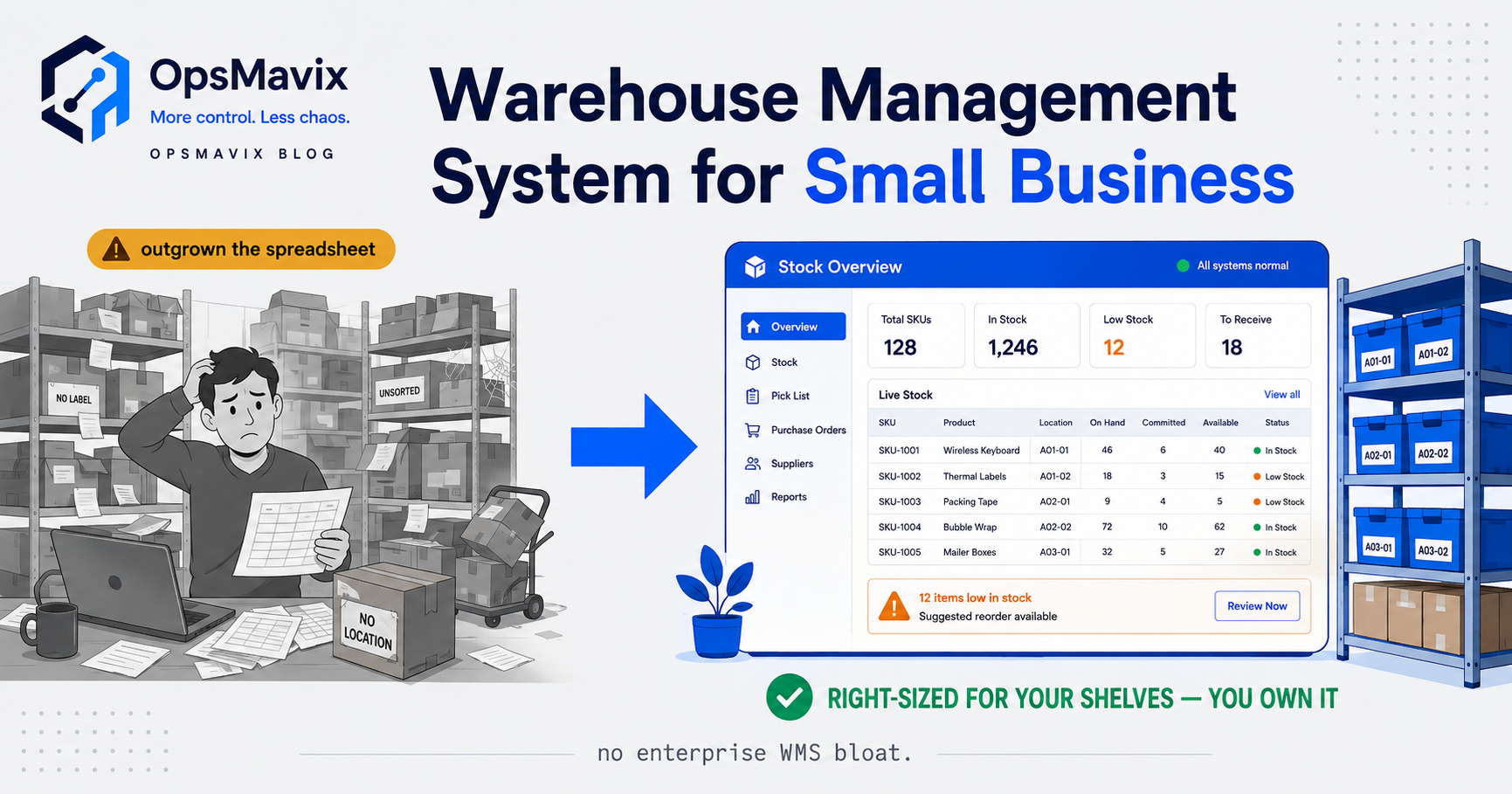
A warehouse management system (WMS) for a small business is the layer that answers three questions at any moment: what stock do you actually hold, where does each item physically sit, and how much of it is already promised to orders you haven’t shipped yet. At enterprise scale that’s a sprawling platform with conveyor integrations and labour-optimisation engines. At small-business scale it’s something far leaner — the difference between picking against a live figure and picking against a memory of what the shelf looked like last week.
Most small firms don’t discover they need one until the spreadsheet quietly stops matching the shelves. It holds together at low volume: a few dozen SKUs, one location, one person who “just knows” where everything is. Then you add lines, add a second storage area, add a member of staff who doesn’t carry the map in their head, and the gap between the recorded count and the real count starts costing you orders. That gap is the moment a small business outgrows spreadsheets — and it’s also the moment the software industry tries to sell you ten times more system than you need.
Quick summary: Human error remains a factor in roughly 43% of warehouses worldwide, according to inventory figures compiled by Meteor Space. For a small operation, that error rarely comes from careless people — it comes from asking people to hold accurate stock in their heads and reconcile it by hand. A right-sized system removes the manual step without burying you under an enterprise platform you’ll use 10% of.
Contents
Signs You’ve Outgrown Spreadsheets {#outgrown}
A spreadsheet is a record, not a system. It tells you what someone typed, not what’s on the shelf right now. For a while those two things stay close enough. The signs you’ve drifted apart are specific and worth naming, because most owners feel the pain long before they attribute it to the tool.
- You count stock more than once to trust it. If a physical recount is the only way you believe a number, the number isn’t doing its job.
- Two people can promise the same unit. Someone confirms an order off the sheet while someone else is picking that same item for a different order. The sheet didn’t know.
- “Where is it?” is a person, not a lookup. If finding stock depends on one member of staff being in that day, your warehouse map lives in their head, not your system.
- Reconciliation is a weekly event. You spend an evening every week making the sheet agree with reality, which means for most of the week it doesn’t.
- You reorder on a feeling. Purchasing decisions get made off a count you don’t fully trust, so you over-buy the lines you think are thin and run out of the ones you think are deep.
None of these is a crisis on its own. Together they’re a tax — paid in cancelled orders, dead stock, and the hours your best people spend being a human database instead of running the operation. If purchasing is where the pain shows up most, the mechanics of tying stock levels to reordering are covered in purchase order inventory management; the point here is that the spreadsheet is no longer the right container for any of it.
What a Small Business Actually Needs {#actually-needs}
The enterprise WMS solves problems you don’t have. Slotting optimisation, wave picking, labour-management analytics, automated conveyor routing — these earn their keep in a 200,000-square-foot distribution centre moving tens of thousands of lines a day. In a small unit with one or two storage areas, they’re weight. You pay for the complexity in licence fees, in a six-month implementation, and in a system so feature-dense your team avoids it.
What a small business actually needs is narrower and far more valuable at your scale:
- One live stock figure per SKU that every person and every sales channel reads from, so nobody promises what’s already gone.
- A location for every item — even if “location” just means aisle, bay, shelf — so finding stock doesn’t depend on one person’s memory.
- A pick that updates stock the moment it happens, not at the end of the day when someone types it up.
- A reorder trigger that tells you what to buy before you hit zero, based on a count you can trust.
- A view of what’s promised versus what’s free, so available-to-sell is a real number and not a guess.
That’s the whole job at small scale. Everything the enterprise platform adds on top is answering questions a business your size doesn’t ask yet. Right-sizing means buying the five things above and refusing to pay for the other ninety-five.
Why per-seat SaaS quietly works against you
The common alternative to enterprise bloat is a per-user subscription WMS, and it looks cheap until you grow into it. The pricing model is the problem: you pay monthly, per seat, forever, and the cost rises exactly as you add the warehouse and office staff who need access. The people you hire to handle more volume are the same people who inflate your software bill. You’re renting the tool that runs your own operation, and the rent goes up with your headcount rather than down with your maturity. For a fuller breakdown of where subscription tooling stops making sense as an operation scales, operations management software walks through the own-versus-rent maths.
The Features That Matter at Small Scale {#features}
Not every WMS feature is worth the same to a small firm. Here’s how the headline capabilities actually rank when you’re running one or two locations rather than a distribution network.
Live stock accuracy
This is the entire point. If your system knows what you hold within a unit or two at all times, most of the downstream pain disappears. Accuracy is a bigger prize than most owners realise: the average US retail business runs at only 66% inventory accuracy by Meteor Space’s figures, which means a third of the recorded stock is wrong at any given moment. A small business that gets to 98% has an advantage its competitors are paying consultants to chase.
Location and bin management
A place for everything, and the system knowing the place. At small scale this doesn’t need to be sophisticated. It needs to exist. Assigning each SKU a location and having the system tell a picker where to go turns a new hire into a productive picker on day one, instead of shadowing your longest-serving staff member for a fortnight.
Barcode or scan-based picking
The single biggest reducer of human error. A scan confirms the picker has the right item before it goes in the box, which is where most mis-picks are caught or missed. It doesn’t require a warehouse-grade handset — a phone camera and the right software will do at your volume.
Available-to-promise
Free stock is not the same as physical stock. The number that matters when you take an order is what’s genuinely uncommitted. A right-sized system subtracts what’s already allocated so the figure your sales team quotes is real. If you sell into trade accounts with their own order rhythms, this is where warehouse accuracy meets order handling — the two are inseparable in a wholesale order management system, because a promise to a wholesale buyer is only as good as the stock figure behind it.
What you can safely skip
Labour analytics, slotting algorithms, wave and zone picking, yard management, and automated replenishment across multiple distribution centres. Not because they’re bad — because at your scale they optimise a problem you don’t have yet, and every one of them is a line item and a training burden.
The Cost Reality of a WMS {#cost}
“How much does a WMS cost” has three very different answers. The honest version depends entirely on which of three roads you take.
- Enterprise WMS: typically tens of thousands of pounds in licensing before you count the implementation partner, the integrations, and the internal time to configure it. Built for warehouses far larger than yours. The sticker is only the start; the real cost is the platform team it assumes you have.
- Per-seat SaaS: low to enter, from tens of pounds per user per month, but it never stops and it scales with your headcount. Model it over three to five years and the “cheap” option often overtakes a one-off build — while you own nothing at the end and remain exposed to price rises and forced migrations.
- Right-sized owned system: a defined one-off build cost for exactly the capability you need, after which the system is yours. No per-seat meter, no feature bloat, and it’s shaped to how your warehouse actually runs rather than how a generic vendor assumes it does.
The trap most small firms fall into is treating the monthly SaaS number as cheap because it’s small this month. Multiply it by every seat you’ll add, then by sixty months, and compare that to a system you own outright. The arithmetic frequently favours ownership well before year three — and ownership is the only one of the three where your bill goes down as you mature rather than up.
The Right-Sized Owned Alternative {#right-sized}
There’s a third option between a spreadsheet and an enterprise platform, and it’s the one almost nobody sells you. A right-sized owned system is built to do the five jobs that matter — live stock, locations, scan picking, available-to-promise, reorder triggers — and nothing you won’t use. Because it’s yours, it maps to your real workflow instead of forcing your warehouse to bend to a vendor’s template.
The advantages compound over time:
- It fits your operation, not the average of everyone’s. Your picking flow, your location naming, your reorder logic — encoded as you actually work.
- The cost is a one-off, not a meter. You pay to build it, then you run it. Growth doesn’t inflate a subscription.
- It connects to what you already run. A right-sized build sits alongside your accounting, your sales channels, and your buying — the same single-figure discipline that underpins good multi-channel inventory management applies here, one live stock pool feeding everything.
- You own the data and the roadmap. No forced migrations, no sunset emails, no feature removed because it didn’t suit the vendor’s other customers.
This is the layer OpsMavix builds: a practical operations system for businesses too messy for spreadsheets and not ready — or not willing — to carry a full ERP. It’s the same discipline behind an inventory automation system, pointed specifically at the four walls of your warehouse.
A Worked Example: Marlow Tool & Fixings {#worked-example}
Consider a small UK wholesaler — call it Marlow Tool & Fixings, a Berkshire fasteners and fixings distributor turning over around £1.4m a year across roughly 900 SKUs, two storage bays, and three warehouse staff. The numbers here are illustrative, but the shape will be familiar to anyone running a small stock operation.
The pain. Stock lived in a shared spreadsheet updated at the end of each day. By mid-afternoon the recorded counts were already stale, and pickers routinely walked to a bay to find the item wasn’t there. Two staff had promised the same batch of anchor bolts to two trade accounts inside the same hour. Every Friday, an hour of the owner’s evening went on reconciling the sheet against a physical count. Reorders were guesswork, so fast lines ran dry while slow ones tied up cash on the shelf.
The over-buy that nearly happened. A vendor quoted an enterprise-grade WMS with slotting optimisation and labour analytics at a five-figure licence plus a multi-month implementation. It would have solved problems Marlow didn’t have while the real problem — a stock figure nobody trusted — sat untouched under all that machinery.
The right-sized fix. Instead, Marlow built a lean owned system doing five things: one live stock figure per SKU, a location on every item, scan-based picking on a phone, an available-to-promise number that subtracted allocated orders, and a reorder alert per line. No slotting engine, no labour dashboard, no per-seat bill.
The outcome. Double-promised stock stopped, because available-to-promise was now a real figure the whole team read from. New staff picked accurately from day one against on-screen locations. The Friday reconciliation evening disappeared. This matters more than it sounds: an estimated 35% of facilities run ongoing mis-pick rates of one percent or more, per Warehouse OS, and the same source notes fewer than one in five small e-commerce firms even measure their mis-picks. Marlow moved from not measuring to catching errors at the scan — the cheapest possible place to catch them.
FAQ {#faq}
Does a small business really need a warehouse management system?
If you hold physical stock across more than one location or shelf, employ anyone who isn’t you to pick it, or reorder on counts you don’t fully trust, then yes — but not the enterprise kind. You need the five core functions (live stock, locations, scan picking, available-to-promise, reorder triggers) and none of the distribution-centre machinery. The mistake is assuming “WMS” means the big platform. Right-sized, it can be a lean system that just makes your counts true.
How is a WMS different from inventory management software?
Inventory management tells you how much of something you own in total. A WMS adds the where and the physical flow — which bay an item sits in, how it moves from receiving to pick to dispatch, and what’s promised versus free. For a small business the two collapse into one right-sized system; you don’t need separate tools, you need one layer that knows both the quantity and the location.
Is per-user SaaS or an owned system cheaper for a small warehouse?
Per-seat SaaS is cheaper to start and more expensive to grow into, because the bill rises with every warehouse and office user you add and never ends. An owned build is a one-off cost that doesn’t meter your headcount. Model both over three to five years: ownership frequently wins before year three, and at the end you own the system rather than renting it indefinitely.
What features can a small business safely skip?
Slotting optimisation, wave and zone picking, labour-management analytics, yard management, and multi-DC automated replenishment. These optimise problems that appear at distribution-centre scale. Paying for them at small scale buys complexity, a longer implementation, and a system your team avoids — with no return until you’re many times larger.
How long does a right-sized warehouse system take to deliver?
Far less than an enterprise WMS, which typically runs months of configuration and consultancy. Because a right-sized owned build targets only the functions you’ll actually use, scope is smaller and delivery is measured in weeks rather than quarters. The exact timeline depends on how many locations, channels, and integrations are in play — which is what an Operations Leak Audit exists to scope.
Comparison: Spreadsheets vs Enterprise WMS vs Right-Sized Owned {#comparison}
| Factor | Spreadsheets | Enterprise WMS / per-seat SaaS | Right-sized owned system |
|---|---|---|---|
| Stock accuracy | Stale by mid-afternoon; trusted only after a recount | Live and accurate, but far more capability than a small firm uses | Live figure covering exactly the SKUs and bays you run |
| Cost model | “Free” but paid in reconciliation hours and lost orders | Five-figure licences or per-seat fees that rise with headcount | One-off build cost; no per-seat meter |
| Fit to your workflow | Whatever one person set up in a hurry | Your warehouse bends to the vendor’s template | Built around how you actually pick and store |
| Location tracking | Lives in someone’s head | Full bin/slotting engine you’ll use a fraction of | Aisle/bay/shelf lookup, sized to your space |
| Picking errors | Caught late or never | Caught at scan, inside a heavy platform | Caught at scan, in a lean tool staff actually use |
| Time to deliver | Immediate, but never reliable | Months of implementation and consultancy | Weeks, scoped to the functions you’ll use |
| Scaling behaviour | Breaks as volume and staff grow | Cost climbs with every seat added | Cost stays flat; system grows with you |
| Ownership | You own a fragile file | You rent; forced migrations and price rises | You own the system, data, and roadmap |
| Best suited to | Sub-100 SKUs, one person, low volume | 200,000 sq ft distribution operations | Small UK firms past spreadsheets, short of full ERP |
How OpsMavix Can Help {#how-we-help}
We build the right-sized layer, not the enterprise platform. OpsMavix helps growing UK businesses replace the spreadsheet-and-memory approach with an owned operations system that does exactly the jobs a small warehouse needs — live stock, locations, scan picking, available-to-promise, and reorder triggers — and skips the distribution-centre machinery you’d never use.
You own what we build. There’s no per-seat meter that punishes you for hiring, no six-month implementation, and no vendor deciding your roadmap. The system maps to how your warehouse actually runs, connects to the accounting and sales channels you already use, and grows with you instead of billing you more for growing. If your business is too messy for spreadsheets but not ready for a full ERP, that’s precisely the gap we’re built for.
Start with a free audit. We’ll walk your stock and picking flow, find where accuracy and time are leaking, and show you what a right-sized system would actually cover — before you spend a penny on the wrong-sized one.
Sources {#sources}
- Meteor Space — human error a factor in ~43% of warehouses worldwide and average US retail inventory accuracy of only 66%: https://www.meteorspace.com/2025/01/16/important-inventory-management-statistics-you-should-know/
- Warehouse OS — an estimated 35% of facilities run ongoing mis-pick rates of 1% or more, and fewer than one in five small e-commerce firms measure mis-picks: https://warehouseos.com/the-cost-of-picking-mistakes-for-small-businesses/
- Office for National Statistics — online sales reached 29.4% of all retailing in Great Britain in June 2026: https://www.ons.gov.uk/businessindustryandtrade/retailindustry/bulletins/retailsales/june2026