
Multi-Channel Inventory Management: How to Run One Stock Pool Across Every Channel
Multi-channel inventory management is the practice of running every sales channel — your website, marketplaces, retail and wholesale — off one live stock figure instead of separate counts you reconcile by hand. This guide shows UK product businesses how to close the double-sell window without buying a bloated platform you'll never fully use.
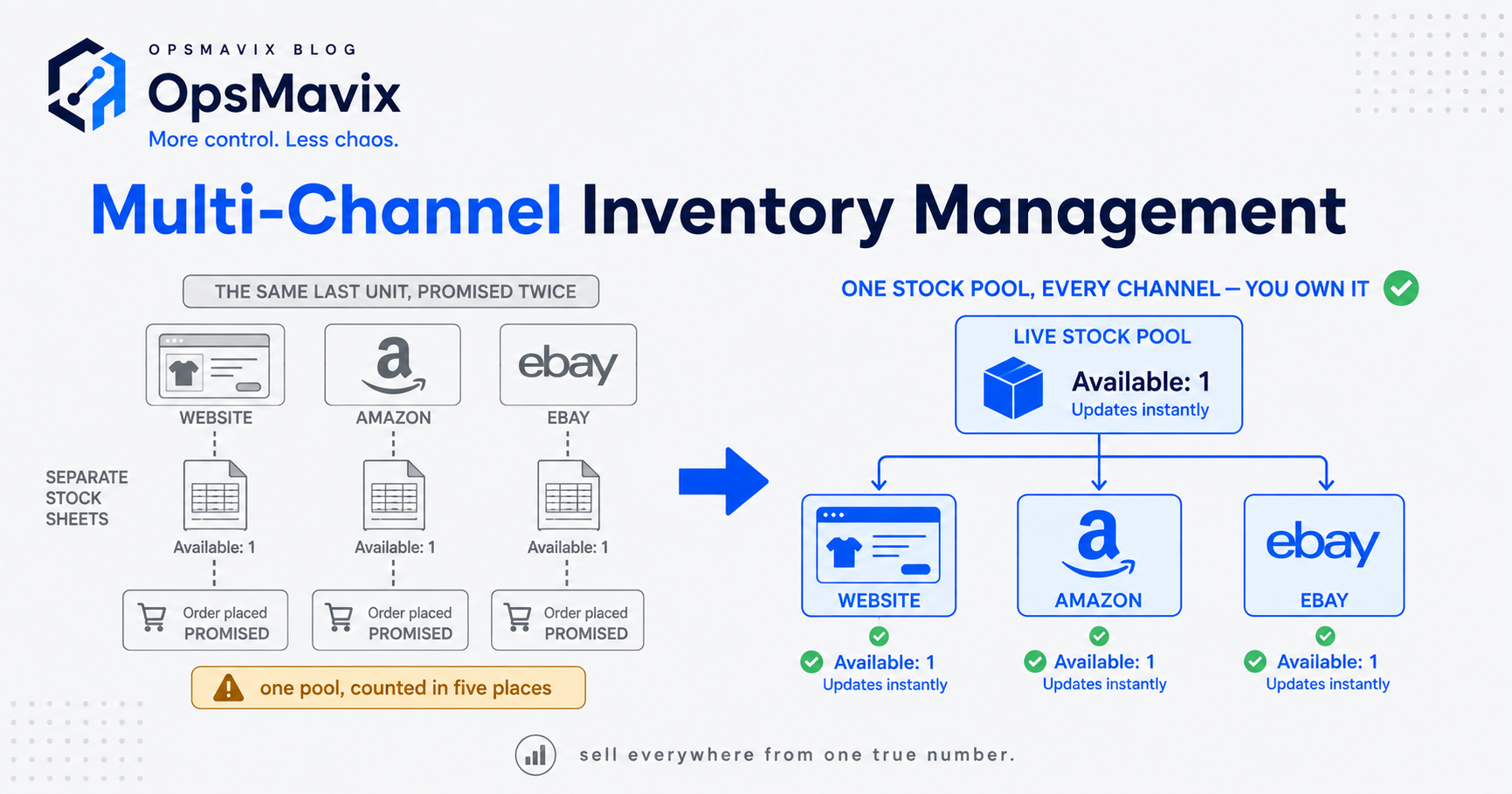
Multi-channel inventory management is the practice of running every place you sell — your own website, Amazon, eBay, Etsy, a retail counter, a wholesale account — off one live stock figure rather than separate counts you top up by hand. The moment you sell in more than one place, you have a choice: either every channel reads from the same shelf, or each channel quietly promises stock the others have already sold. Most growing UK businesses discover which they chose the hard way, on a busy weekend, when two buyers on two platforms both grab the last unit before either platform knows the other exists.
The problem almost never announces itself early. With low volume and two channels, manual updates hold together. Then a third channel opens, a listing goes viral, a wholesale order lands mid-promotion, and the spreadsheet that was “basically fine” starts describing stock as it was twenty minutes ago instead of as it is right now. This is a timing problem before it’s an inventory problem, and timing problems are solved by architecture, not by working faster.
Quick summary: Online now accounts for 29.4% of all retail sales in Great Britain as of June 2026 — the highest share since April 2021, according to the Office for National Statistics. When roughly three in ten sales run through digital channels that sit alongside your physical and wholesale ones, the gaps between those channels stop being a minor annoyance and start becoming your biggest source of cancelled orders and dead stock.
Contents
- Why Multi-Channel Inventory Breaks
- The Single Stock Pool Principle
- Where Multi-Channel Sync Still Leaks
- Generic Platform vs Right-Sized Owned System
- A Worked Example: The £2,400 Weekend
- What “Right-Sized” Actually Means Here
- How to Get Multi-Channel Inventory Management Right
- FAQ
- How OpsMavix Can Help
- Sources
Why Multi-Channel Inventory Breaks
Multi-channel inventory doesn’t break because anyone is careless. It breaks because each channel is designed to believe it owns the stock.
Say you hold 4 units of a popular SKU. Your Shopify store shows 4. Amazon shows 4. eBay shows 4. Your wholesale portal shows 4. That’s 16 units of promised availability against 4 real ones. None of the channels is lying — they simply have no way of knowing a sale happened somewhere else until something tells them. In the window between a sale on one channel and the update reaching the others, the number on every other channel is fiction.
The faster you sell, the wider that fiction grows. A slow-moving line survives a manual process because sales are spaced far enough apart that you can update between them. Your bestsellers don’t, because velocity and oversell risk are the same curve. The SKUs that make you the most money are exactly the ones most likely to be sold twice.
Shopify’s own guidance on multichannel retailing puts the operational risk plainly: without systems syncing data across channels, “it’s likely that you’ll run out of products and have inaccurate inventory valuation, which often leads to lost customers or over or under-buying stock” (Shopify). The damage isn’t only the cancelled order in front of you. It’s the reorder decisions you make off a stock figure that was never right.
There’s a second, sneakier failure mode: your inventory value drifts. When four channels each carry their own approximate count, your true “how much do I actually own” number becomes a guess. You over-buy the lines you think are thin and under-buy the ones you think are deep. Overselling is the visible symptom; distorted purchasing is the expensive one nobody attributes to the same root cause.
The Single Stock Pool Principle
The single most effective move in multi-channel inventory management is to stop each channel counting independently. You hold one master quantity per SKU, and every channel — website, marketplace, retail till, wholesale portal — reads from and writes to that one number.
When a unit sells anywhere, the master count drops immediately and every channel is pushed the new figure. Sell the last unit on eBay, and your website, Amazon and wholesale portal all reflect zero before the next buyer can add it to a basket. This is what people mean by a “single source of truth,” and it’s the difference between four systems arguing and one system deciding.
A useful mental model: stop thinking about “Amazon stock” and “website stock” as separate piles. It’s one pile with several shop windows. The windows all look onto the same shelf. Nobody’s shelf runs out of sync with itself.
This principle scales past the obvious channels, too. If you hold stock in more than one place — a main warehouse plus a shop, or your own site plus a fulfilment partner — the same logic applies to locations as well as channels. Getting that right is its own discipline; if part of your operation spans sites, it’s worth understanding multi-location inventory management as the companion to channel sync. And if any of your stock is held with a fulfilment partner, the single-pool rule still holds — it just has to reach into your 3PL inventory management software so the partner’s counts feed the same master figure.
The single stock pool is also the foundation of not overselling in the first place. If you only fix one thing this quarter, fix this — the deeper mechanics of closing the double-sell window are covered in how to prevent overselling, but they all sit downstream of getting the shared pool right first.
Where Multi-Channel Sync Still Leaks
A shared pool is necessary but not sufficient. Even with one master count, multi-channel setups leak in predictable places. Knowing them is half the battle.
- Scheduled sync instead of real-time. A feed that refreshes every 15 minutes leaves a rolling 15-minute window where the last unit is visible everywhere at once. On slow movers this never bites. On bestsellers during a promotion, that window is where the double-sale lives. Event-driven sync — where the sale itself triggers the update — closes it.
- Bundles and multi-packs. A 3-pack listing and the single share the same physical units. If selling the bundle doesn’t decrement the components (and vice versa), each sells its own phantom stock under a different name. This is one of the most common multi-channel oversell traps and almost nobody spots it until it fires.
- Marketplace display lag you don’t control. You can push a new figure to Amazon or eBay instantly; they may take minutes to redraw the listing. You can’t fix their clock, so you protect the gap with a small safety buffer on fast movers rather than relying on zero appearing everywhere in the same second.
- Returns re-entering the pool too early. A return that quietly adds a unit back before it’s inspected creates availability that isn’t actually sellable yet — and sells it.
- Wholesale orders that bypass the system. A large order taken over email or on a call, then keyed in later, is a manual sync by another name. Between the handshake and the keystroke, every channel is over-promising.
None of these need a bloated platform to solve. They need rules that match how you actually sell — which is precisely where generic tools start to strain.
Generic Platform vs Right-Sized Owned System
When multi-channel inventory becomes painful, the market pushes one answer: buy a big platform. Sometimes that’s right. Often it’s selling you a supertanker to cross a river. Here’s the honest comparison.
| Consideration | Generic multichannel platform / ERP | Right-sized owned system |
|---|---|---|
| Fit | You bend your process to the tool’s assumptions | The tool is shaped to how you already pick, pack and reorder |
| Scope | Hundreds of features, you use a fraction | Only the channels, rules and reports you actually run |
| Cost model | Ongoing per-seat / per-order licence fees, forever | Build cost, then you own it — no rented core |
| Bundle & kit logic | Works if your kitting matches their model | Modelled to your exact bundles and multi-packs |
| Odd channels (wholesale, trade, B2B) | Often bolted on awkwardly or unsupported | First-class if they matter to your revenue |
| Onboarding | Weeks to months, consultant-led | Scoped to the leak you actually have |
| Ceiling | You hit walls where the tool assumed a different business | You extend it because you own the code |
| Data ownership | Your operational data lives in their platform | Your data, your database, your rules |
The point isn’t that generic platforms are bad. If overselling is your only real problem and your workflow is completely standard, an off-the-shelf connector may be all you ever need — start there and don’t overspend. The point is that “big platform” is not automatically “grown-up,” and the businesses that get burned are the ones who bought the supertanker, used 15% of it, paid for 100% of it every month, and still couldn’t model their own trade pricing.
For the spectrum between a single connector and a full platform, it helps to understand what an operations control system does — one place where stock, orders, purchasing and reporting live, shaped to your business rather than a vendor’s assumptions about it.
A Worked Example: The £2,400 Weekend
Numbers make this concrete. These figures are illustrative, not a claim about any specific client — but the shape is one operators recognise instantly.
A UK homeware business sells across four channels: its own Shopify store, Amazon, eBay and a small wholesale portal for independent shops. Average order value is £48. Its top 20 SKUs drive most of the revenue, and each is stocked thin — 3 to 8 units at a time — because cash is tight and the lines turn fast.
Stock is “synced” via a spreadsheet the team updates after each order, plus a twice-daily export to the marketplaces. On a normal weekday this holds. Then a bank-holiday promotion hits.
Over one weekend, 6 of those top-20 SKUs sell out on one channel while still showing available on the others. Because the export runs twice a day, the gap is hours, not minutes. The result:
- 9 orders land for units that no longer exist — 5 on Amazon, 3 on eBay, 1 wholesale.
- Each has to be cancelled and refunded. Direct refund value: 9 × £48 = £432.
- Support time to apologise, refund and firefight: roughly 4 hours across the weekend.
- 2 Amazon cancellations ding the account’s order-defect metrics, suppressing Buy Box visibility on the business’s single best line for the following fortnight.
- The wholesale customer — an independent shop that was going to reorder monthly — quietly stops.
The £432 in refunds is the only number that shows up in the accounts. The real cost is the suppressed ranking (conservatively a few hundred pounds in lost sales over the next two weeks), the lost wholesale relationship (a recurring order, not a one-off), and the four hours the founder spent firefighting instead of buying stock. Add it up honestly and the “small glitch” clears £2,000–£2,400 for a single weekend — and it will recur every promotion until the architecture changes.
The fix costs almost nothing structurally: one master count per SKU, real-time (event-driven) sync instead of twice-daily exports, and a safety buffer of 1–2 units on the thin, fast-moving top 20. No new platform. No monthly licence. Just closing the window where a stale number can be sold twice.
What “Right-Sized” Actually Means Here
“Right-sized” isn’t a polite word for “cheap and limited.” It means the system carries exactly the weight your operation puts on it — no more, no less.
For a two-channel seller with 200 SKUs, right-sized might genuinely be a good connector plus disciplined buffers. For a business running website, three marketplaces, a retail counter and trade pricing across two warehouses, right-sized is a single owned system where all of that logic lives in one place and answers to your rules. The mistake is assuming the second business needs a generic ERP. It usually needs the specific 20% of an ERP that touches its actual channels — built once, owned outright, extended when it grows.
The UK context sharpens this. UK online retail sales reached £127.41 billion in 2024, up 3.4% on the prior year, with over 62 million ecommerce users in the market (Charle). That’s a large, mature market where the channels are stable and well understood — which means the smart move is rarely “buy the biggest thing available.” It’s “own the right-sized system that fits how you sell, and keep the margin you’d otherwise rent back to a platform every month.”
Ownership matters for a reason that isn’t obvious until you need it: when your business changes — a new marketplace, a new bundle structure, a trade-pricing tier — an owned system gets extended, while a rented platform makes you wait for a feature request or bend your process to what it already supports. You stop being a tenant in your own operations.
How to Get Multi-Channel Inventory Management Right
The order of operations matters more than the tooling. Do these in sequence and most of the pain disappears before you’ve spent on anything large.
- Merge to one stock pool. One master quantity per SKU. Every channel reads and writes to it. This alone closes most double-sale windows.
- Make sync real-time, not scheduled. Let the sale trigger the update. Kill twice-daily exports on anything that moves quickly.
- Protect fast movers with buffers. A small held-back quantity on high-velocity and thin-stock SKUs absorbs the seconds you can’t remove — especially marketplace display lag. Don’t buffer deep-stocked slow movers; you’d just park sellable stock for nothing.
- Link bundles to their components. Make kits and multi-packs decrement the shared physical units both ways, so you never sell the same unit under two names.
- Pull every channel into the pool — including the awkward ones. Wholesale, trade, retail till, 3PL-held stock. The channel you leave out is the one that oversells.
- Reorder from the true number. Once the master count is trustworthy, your purchasing decisions stop being guesses. This is where accurate stock quietly pays for itself.
Start with the smallest thing that closes the double-sell window — the shared pool — then work down the list only as far as your operation actually needs. If you outgrow a connector after that, you’ll know exactly which wall you hit, and that’s the moment owning the system starts to pay for itself.
FAQ
What’s the difference between multi-channel and omnichannel inventory management?
Multi-channel means you sell in several places — website, marketplaces, wholesale, retail — and the operational challenge is keeping stock consistent across all of them. Omnichannel goes a step further, aiming for a seamless customer experience between those channels (buy online, return in store, and so on). For inventory purposes the core requirement is the same: one live stock figure that every channel reads from. You can’t deliver omnichannel on top of channels that each keep their own count.
Do I need an ERP for multi-channel inventory management?
Usually not. An ERP is a large, general platform that touches finance, HR, procurement and more. If your problem is specifically that channels oversell and stock counts drift, you need accurate multi-channel inventory — which is a fraction of what an ERP does. Many businesses buy the whole platform, use a sliver of it, and pay for all of it monthly. A right-sized owned system that handles your actual channels is often cheaper, faster to live, and shaped to how you really sell.
How do safety buffers stop overselling across channels?
A buffer holds back a small quantity from what channels are allowed to sell. Set a buffer of 2 on a SKU with 10 units and channels show 8. Those 2 held-back units absorb the gap between a real last sale and every channel catching up — including the minutes a marketplace like Amazon or eBay can take to redraw a listing after you’ve pushed a new figure. You trade a sliver of availability for certainty, which is almost always the right trade when a cancelled order costs far more than briefly showing “out of stock” a unit or two early.
Will connecting a 3PL break my single stock pool?
Only if the 3PL’s counts stay separate. The single-pool principle extends to fulfilment partners: their on-hand figures should feed the same master count your channels read from, so a unit shipped by the 3PL decrements availability everywhere in real time. Done properly, holding stock with a partner is just another location in one pool — not a second, disconnected system. The failure mode is treating the 3PL as its own island you reconcile later.
Can I fix multi-channel inventory without replacing my whole setup?
Often, yes. The highest-impact fixes — one master stock pool, real-time sync, buffers on fast movers, linked bundles — can frequently be layered onto what you already run rather than ripping it out. Replacing everything is sometimes the right call, but it’s rarely the necessary first step. The sensible path is to close the double-sell window first, then decide whether your existing tools can carry the rest or whether owning a right-sized system pays off.
How OpsMavix Can Help
OpsMavix builds right-sized, owned operations systems for growing UK product businesses — manufacturing, inventory and warehouse operations, wholesale and distribution, and ecommerce with real stock behind it. Instead of selling you a bloated generic platform where you’d use a fraction and rent the rest forever, we map how your channels actually behave, find where the double-sell window and the stock drift are leaking money, and build the specific system that closes them — one live stock pool, real-time sync, buffers and bundle logic shaped to how you sell, owned outright by you. It’s the practical layer between an off-the-shelf connector that’s run out of road and a full ERP that’s overkill. If your multi-channel inventory is quietly costing you cancelled orders, suppressed rankings and guessed-at reorders, start by seeing exactly where the leaks are: Book a Free Operations Leak Audit.