
Stock Management System for Small Business: A Practical Guide
A stock management system tracks what you hold, what's committed and what to reorder — in one live place instead of a spreadsheet you patch by hand. This guide covers the signs you've outgrown the sheet, what a small-business stock system actually needs, and how to buy right-sized when you're too messy for spreadsheets, not ready for a full ERP.
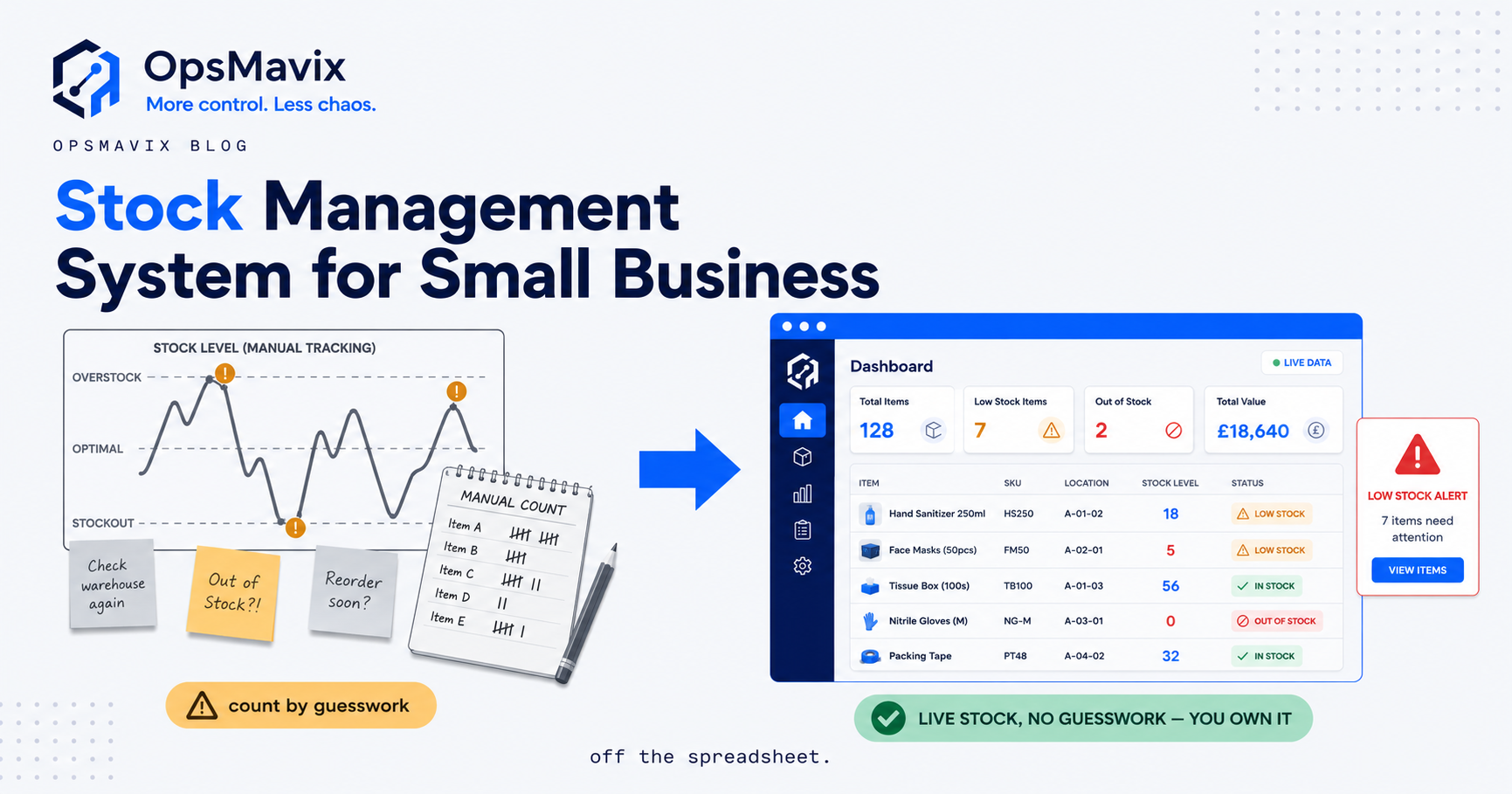
A stock management system is the single place a business tracks what it holds, what’s already promised to customers, and what needs reordering — so every decision runs off one live figure instead of a count someone updates by hand between other jobs. For a small business, that usually starts life as a spreadsheet: a tab per supplier, a column for quantity, a formula someone half-remembers writing. It works, right up until it doesn’t.
The breaking point rarely arrives as a crisis. It arrives as friction — a stockout on your best seller the week you were sure you had plenty, an order you couldn’t fulfil because the sheet said “12” and the shelf said “3”, a Sunday spent reconciling counts nobody trusts. Each incident is survivable on its own. Together they signal the same thing: the volume, the channels and the number of hands touching your stock have outgrown what a manual document can hold. A stock management system for small business isn’t about buying software for its own sake — it’s about getting your stock figure to tell the truth again, without over-buying a platform built for a company ten times your size.
Quick summary: A study led by Prof. Pak-Lok Poon found that 94% of spreadsheets used in business decision-making contain errors, according to Phys.org. When the document you reorder stock from is more likely than not to be wrong somewhere, “we’ll just keep it in the spreadsheet” stops being the cautious choice — it’s the expensive one that hides its costs inside cancelled orders and cash tied up in dead stock.
Contents
Signs Your Stock Spreadsheet Is Costing You {#signs}
The spreadsheet doesn’t send you a warning when it stops being reliable. The warnings come dressed as ordinary bad days. Here are the four that matter most.
Stockouts on the lines you can least afford them
You run out of the products that sell fastest. This isn’t bad luck — it’s built into how manual counting works. A slow-moving line survives a spreadsheet because sales are spaced far enough apart that you can update the count between them. Your bestsellers sell in clusters, so the sheet is always describing yesterday’s shelf. The faster a SKU moves, the more likely it is to be sold when the sheet still says it’s in stock. Velocity and stockout risk are the same curve, and the spreadsheet is blind to it.
Overselling and orders you can’t fulfil
You promise stock you’ve already sold. The moment you sell in more than one place — your website, a marketplace, a trade counter, a wholesale account — each channel reads its own copy of the count. Sell the last unit in one place and the others keep offering it until someone updates them by hand. The result is a cancelled order, an apology email, and a customer who won’t come back. If this is your main pain, closing that gap is its own discipline — see multi-channel inventory management for how a single stock pool removes the double-sell window entirely.
Dead stock quietly eating your cash
Money you can’t see is stuck on the shelf. When your count is a guess, you over-buy the lines you think are thin and under-buy the ones you think are deep. The over-bought lines don’t disappear — they sit there as dead stock, tying up cash, taking up space, and eventually needing a markdown to shift. Netstock’s 2024 benchmark found that excess stock had grown to 38% of SMBs’ inventory (Netstock). Dead stock is the most expensive symptom of a bad count precisely because nobody attributes it to the spreadsheet.
Manual counts nobody trusts
You do full stock-takes because you can’t trust the running figure. If the only way to know what you hold is to stop trading and count everything by hand, your “system” is your memory plus a document, and both drift. The stock-take isn’t the fix — it’s the tax you pay for not having a figure you can rely on the rest of the time.
If two or more of these are familiar, the spreadsheet isn’t failing because anyone is careless. It’s failing because it was never designed to be a live source of truth for a business your current size.
What a Small-Business Stock System Actually Needs {#what-it-needs}
“Stock system” gets used to mean everything from a barcode app to a warehouse platform with a six-figure price tag. For a small business, the useful question isn’t “what’s the most powerful tool?” — it’s “what’s the smallest set of capabilities that makes my stock figure trustworthy?” That list is shorter than most vendors want you to believe.
One live stock figure per SKU
Every channel and every person reads the same number. This is the foundation everything else sits on. One master quantity per SKU, updated the instant a sale, return or receipt happens, visible everywhere at once. Without this, you don’t have a stock system — you have several disagreeing counts wearing a nicer interface.
Committed vs available stock
The system separates what you have from what’s already promised. You might hold 40 units but have 25 committed to open orders — so your available figure is 15, not 40. A spreadsheet almost never models this, which is why businesses oversell even when the raw count looks healthy. Tracking committed stock is often the single biggest accuracy gain a small business makes.
Reorder points that fit how you buy
The system tells you what to reorder before you run out, at quantities that match your suppliers. This means reorder thresholds tuned to real lead times — and lead times are getting harder to predict, with Netstock reporting 72% of SMBs facing unpredictable delivery times from suppliers. A right-sized system bakes your actual buying rhythm into the reorder logic instead of forcing you into a generic template. If purchasing is where your leaks live, the companion discipline is covered in purchase order and inventory management.
A clear audit trail
Every stock movement is recorded — who, what, when, why. Received, sold, returned, adjusted, written off. When numbers drift (and occasionally they will), you need to trace the movement, not relitigate everyone’s memory. This is also what makes the once-a-quarter panic stock-take unnecessary: you reconcile continuously instead of catastrophically.
It fits your actual workflow
The system matches how your business really runs, not a textbook. Bundles that share components. A wholesale order taken over the phone. Stock held in two locations. A returns process with an inspection step before items go back on sale. These aren’t edge cases — they’re your business. A stock system that can’t hold your real workflow just moves the manual reconciliation somewhere less visible.
Notice what’s not on this list: demand forecasting AI, multi-warehouse wave picking, supplier EDI, financial consolidation across entities. Those are real capabilities — for businesses that have the problems they solve. Buying them before you do is how a small business ends up paying for complexity it will never switch on.
Off-the-Shelf vs Full ERP vs Right-Sized Owned {#three-routes}
Once you accept the spreadsheet has to go, there are three genuinely different roads out. Most guides pretend there are two. The third is where most growing UK small businesses actually belong.
Off-the-shelf stock apps
Ready-made tools you subscribe to and configure. These are quick to start and cheap to trial, and for a simple single-channel business they can be enough for years. The friction shows up at the edges: your bundle logic doesn’t quite fit, your wholesale flow needs a workaround, an integration you depend on gets deprecated, and the price climbs with every user and add-on. You mould your business to the software because the software can’t be moulded to you. For many, that trade is fine. For a business whose operations are the product — where how you fulfil is a competitive edge — it slowly becomes a ceiling.
Full ERP
One large platform that runs stock, finance, purchasing, CRM and more. An ERP is genuinely powerful and genuinely appropriate — for a business with the scale, headcount and process maturity to use it. For a small business, it’s usually a mismatch: long, expensive implementations, ongoing licence fees, a consultant on speed-dial, and 80% of the features permanently switched off. You pay for a cathedral to store a week’s stock. The canonical mistake here is buying ERP “to grow into” and spending two years and a five-figure sum growing into complexity you didn’t need.
Right-sized owned systems
A custom system built to fit your operation — that you own. This is the middle road that rarely gets named. Instead of renting someone else’s product or buying a platform built for enterprises, you get a system shaped around exactly how your stock actually moves — no more, no less — and you own the result rather than renting it indefinitely. It does the five things above properly, ignores the forty things you’ll never use, and grows by adding what you actually need when you need it. For businesses too messy for spreadsheets but not ready for a full ERP, this is usually the honest fit. This is what inventory automation means when it’s done right-sized rather than off-the-shelf.
Cost and Ownership Reality {#cost-ownership}
The real cost of a stock system is rarely the sticker price. It’s the shape of what you pay, for how long, and what you’re left holding at the end.
The three cost shapes
Off-the-shelf costs are ongoing and grow with you. A monthly subscription that looks small at two users looks different at eight, plus paid add-ons for the features you assumed were included. You never stop paying, and you never own anything — stop paying and access ends.
ERP costs are large and front-loaded, then ongoing. Implementation is the big number, but licences, support contracts and the specialist you now need on call are the recurring ones. The total cost of ownership is almost always higher than the quote, because the quote is for the software, not for making it fit your business.
A right-sized owned system is a defined build, then it’s yours. You pay to build the thing that fits, and then you own it. There’s no per-seat licence multiplying as you hire, and no vendor who can raise your rent or sunset the feature you depend on. Ongoing cost is support and the changes you choose to make, not a subscription you can never leave.
Ownership is the part nobody prices
When you rent, you’re a tenant in your own operations. The vendor sets the roadmap, the price and the shutdown date. When you own the system that runs your stock, the leverage sits with you: it can’t be discontinued out from under you, its data is yours, and it changes when your business changes — not when a product manager three time zones away decides. For an operation where stock accuracy is the difference between profit and apology, that ownership isn’t a luxury. It’s the point.
When to Move Off the Spreadsheet {#when-to-move}
You don’t need a system on day one, and moving too early is its own waste. The honest triggers are operational, not arbitrary revenue thresholds.
- More than one person touches stock. The instant two people update the count, “which version is right?” becomes a daily question. Shared truth beats shared documents.
- You sell across more than one channel. Each channel reading its own count is the overselling machine. One live pool is the fix, and it’s structural, not a matter of trying harder.
- You’re doing full stock-takes to feel safe. If a running figure you trust would make the panic count unnecessary, you’ve already outgrown the sheet.
- Reorder decisions feel like guessing. When you can’t see committed-vs-available and can’t trust the count, every purchase order is a gamble — over-buy and you create dead stock, under-buy and you stock out.
- Fulfilment is becoming your bottleneck. When getting orders out the door is capped by how fast you can reconcile stock rather than how fast you can pack, the operation itself is the constraint.
If you recognise three or more, the question isn’t whether to move — it’s how to move without over-buying. That’s a positioning decision as much as a software one.
Here’s a plain comparison of the three routes against a spreadsheet, on the factors that actually decide it:
| Factor | Spreadsheets | Off-the-shelf app / full ERP | Right-sized owned system |
|---|---|---|---|
| Live single stock figure | No — updated by hand, always lagging | Yes, within the product’s model | Yes, built to your exact model |
| Committed vs available | Rarely modelled | Sometimes / yes (ERP) | Yes, matched to your order flow |
| Fits your real workflow | Only what you can rig manually | You mould to the tool / heavy config | Tool is moulded to you |
| Multi-channel / multi-location | Manual, error-prone | Add-ons or enterprise tiers | Built in as you need it |
| Setup effort | Low upfront, high ongoing | Fast (app) / long, costly (ERP) | Defined build, scoped upfront |
| Cost shape | “Free” but hides labour cost | Growing subscription / large + ongoing | Build once, then own it |
| Ownership | You own a fragile document | You rent; vendor sets the terms | You own the system outright |
| Grows with you | No — breaks under load | To a ceiling / over-provisioned | Adds only what you actually need |
| Right for | Pre-revenue, single-channel, tiny | Simple ops / genuine enterprise scale | Too messy for sheets, not ready for ERP |
A Worked Example: Pennine Provisions {#worked-example}
An illustrative example based on the patterns above — figures for illustration.
The business. Pennine Provisions is a Yorkshire speciality-food wholesaler turning over roughly £850,000 a year, selling through its own website, a couple of marketplaces and a growing trade-account book. Two people run stock between packing orders and answering the phone. The system of record is a shared spreadsheet.
The pain. Bestsellers stocked out during promotions while slow lines gathered dust. Trade orders taken on the phone were keyed in hours later, so the website oversold in the gap. Every quarter, the pair shut down for a day to count everything, because the running figure had drifted too far to trust. This is exactly the accuracy problem the data describes: research cited by Unleashed found 58% of retail brands and D2C manufacturers run below 80% inventory accuracy (Unleashed) — and below 80%, the count stops being a tool and starts being a liability.
The over-buy they nearly made. A consultant quoted a full ERP roll-out to “sort it all out” — a five-figure implementation plus per-seat licences, most of its modules irrelevant to a two-person food wholesaler. It would have solved the stock problem by burying it inside a platform Pennine couldn’t run without paying someone else to.
The right-sized fit. Instead: one live stock figure per SKU across website, marketplaces and trade, committed-vs-available so the phone orders and the web stopped fighting, reorder points tuned to their real supplier lead times, and a wholesale flow that matched how trade actually ordered. Nothing they wouldn’t use. Owned, not rented.
The outcome. The quarterly shutdown count disappeared, because the running figure could be trusted. Overselling on the marketplace stopped because every channel read one pool. Cash that had been sitting in over-bought lines went into the bestsellers that had been stocking out. The win wasn’t “software” — it was a stock figure that finally told the truth, in a system they owned rather than a subscription that would climb with every hire. That last point matters for growing wholesalers specifically: see wholesale order management for how trade order flow ties into the same stock pool.
FAQ {#faq}
What is a stock management system for a small business?
It’s a single place that tracks what you hold, what’s already committed to customers, and what needs reordering — updated live as sales, returns and deliveries happen, so everyone works from one trustworthy figure. For a small business, the goal isn’t maximum features; it’s a count you can rely on without stopping to do a manual stock-take.
When should a small business move off spreadsheets?
When more than one person touches stock, when you sell across more than one channel, when you’re doing full stock-takes just to feel safe, or when reorder decisions feel like guessing. Any one of these is a yellow flag; three or more means the spreadsheet is now costing you more than a system would.
Do I need a full ERP?
Usually not. ERP suits businesses with the scale, headcount and process maturity to use most of it. For a small business, an ERP typically means a long, costly implementation and licences for features you’ll never switch on. The middle road — a right-sized system that does the essentials and ignores the rest — is the honest fit for most operations too big for a spreadsheet but too small for enterprise software.
How much does a stock system cost?
It depends on the shape more than the number. Off-the-shelf apps are ongoing subscriptions that grow with your headcount and add-ons. ERPs are large, front-loaded builds plus recurring licences and support. A right-sized owned system is a defined build cost, after which you own it — no per-seat rent multiplying as you hire. The cheapest-looking option (the spreadsheet) usually has the highest hidden cost in labour, stockouts and dead stock.
What’s the difference between off-the-shelf and a right-sized owned system?
With off-the-shelf, you mould your business to fit the software and rent it indefinitely; the vendor controls the price, the roadmap and the shutdown date. With a right-sized owned system, the software is built to fit how your operation actually runs, and you own the result — it changes when your business changes, and nobody can raise your rent or retire the feature you depend on.
How OpsMavix Can Help {#how-opsmavix-can-help}
OpsMavix builds right-sized operations systems for UK businesses that have outgrown spreadsheets but aren’t ready — and shouldn’t have to be — for a full ERP. We don’t sell you code or a platform to grow into. We map how your stock actually moves, find where it leaks time and money, and build a system that makes your stock figure tell the truth: one live count, committed-vs-available, reorder logic tuned to your real suppliers, and a workflow that matches how you genuinely operate.
The result is a system you own, not a subscription that climbs with every hire — sized to your business today, built to grow only where you actually need it. If your bestsellers keep stocking out while cash sits dead on the shelf, and the spreadsheet everyone patches by hand is quietly running your operation, the first step is simply seeing where the leaks are.
Sources {#sources}
- Phys.org — study led by Prof. Pak-Lok Poon finding 94% of business decision-making spreadsheets contain errors: https://phys.org/news/2024-08-business-spreadsheets-critical-errors.html
- Office for National Statistics — online sales rose to 29.4% of all retail sales in Great Britain (June 2026): https://www.ons.gov.uk/businessindustryandtrade/retailindustry/bulletins/retailsales/june2026
- Netstock — 2024 Inventory Management Benchmark Report: excess stock at 38% of SMBs’ inventory and 72% of SMBs facing unpredictable supplier delivery times: https://www.netstock.com/research/inventory-management-report/
- Unleashed Software — inventory management statistics: 58% of retail brands and D2C manufacturers run below 80% inventory accuracy (Fluent Commerce data): https://www.unleashedsoftware.com/blog/inventory-management-statistics/