
Retail Store Inventory Management System: A Buyer's Guide
A retail store inventory management system is the single place that tracks what you actually hold across the shop floor, the stockroom and every online channel, and keeps that number honest as you sell. This guide compares basic POS, off-the-shelf retail apps and full retail ERP against a right-sized owned system built for shops too messy for spreadsheets, not ready for a full ERP.
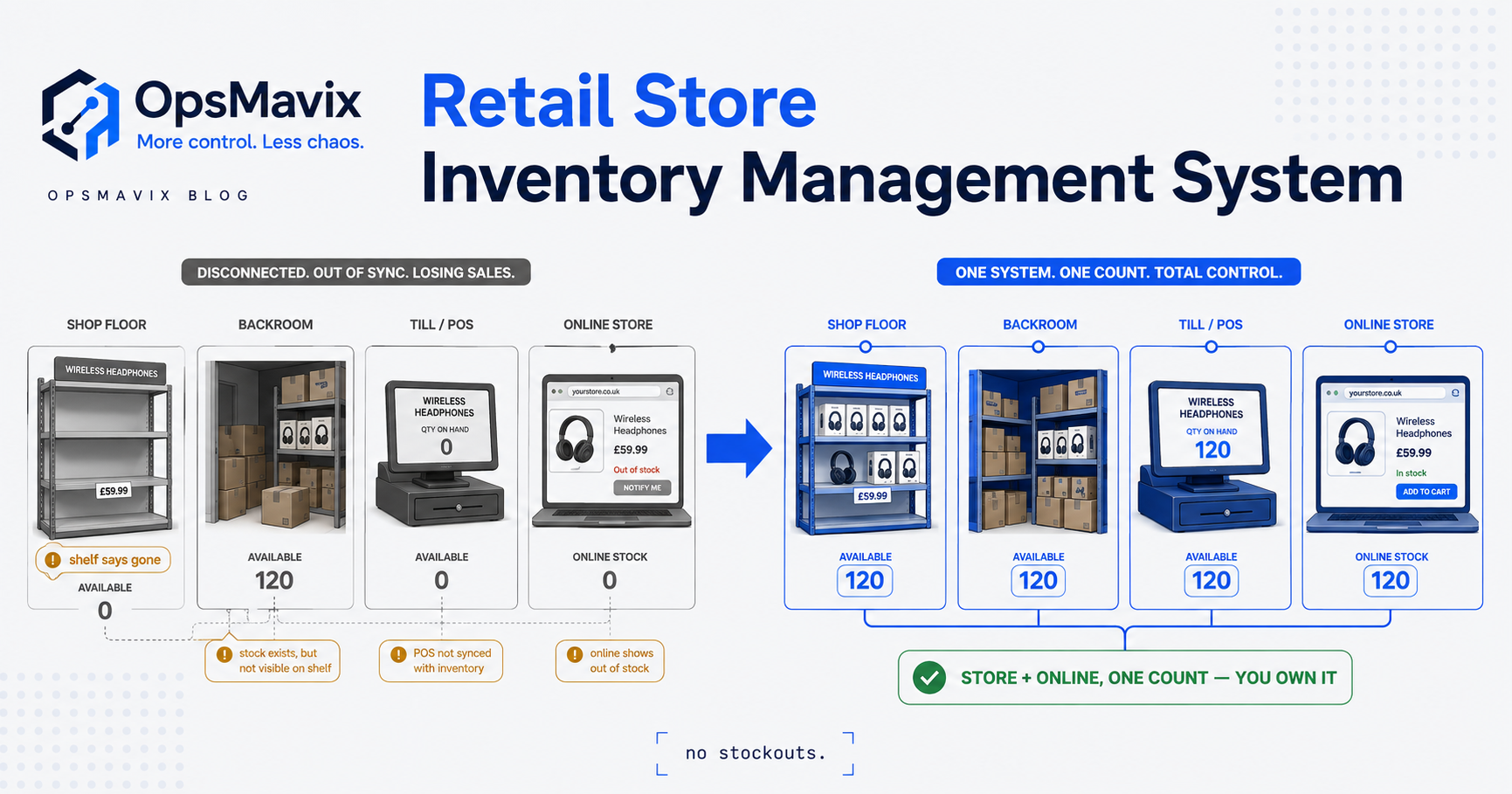
A retail store inventory management system is the single place that tracks every unit you hold — on the shop floor, in the stockroom, across additional locations, and on every online channel you sell through — and keeps that number honest from the moment stock lands to the moment it leaves. At its core it does one deceptively hard thing: it makes the quantity your till shows, the quantity your website shows, and the quantity actually sitting on the shelf agree with each other, in real time, without anyone keying it in twice.
Most retailers don’t set out to buy one. They set out to stop a specific pain: the customer standing at the counter wanting a product the system swears is in stock but nobody can find; the online order for an item that sold in-store an hour ago; the reorder placed off a count that was wrong before the delivery even arrived. Those aren’t separate problems. They’re all the same problem wearing different hats — a store selling in more than one place off more than one count. The shop floor sells from the shelf. The website sells from a spreadsheet or an app that lags behind the shelf. The stockroom sells from memory. Each is confident, each is slightly wrong, and the gaps between them are where the money leaks.
Quick summary: Shrinkage and stock error are not rounding errors — they are one of retail’s largest controllable costs. The total cost of retail crime in the UK reached £4.2 billion, of which £2.2 billion came directly from customer theft, across more than 20 million incidents in a single year, according to the British Retail Consortium’s 2025 Retail Crime Survey. You cannot control what you cannot measure, and you cannot measure loss on a shelf whose true count you never actually know.
Contents
- What a Retail Store Inventory Management System Actually Does
- Live Stock Across Store and Online
- The Real Cost: Stockouts vs Overstock
- Shrinkage Control Starts With an Honest Count
- Basic POS vs Retail ERP vs Right-Sized Owned System
- Integrations and Why Ownership Matters
- A Worked Example: The £9,000 Blind Spot
- FAQ
- How OpsMavix Can Help
- Sources
What a Retail Store Inventory Management System Actually Does {#what-it-does}
Strip away the marketing and a retail inventory system earns its keep on a small number of concrete jobs. Get these right and most of the daily firefighting disappears.
- One live count per SKU. A single master quantity that every place you sell reads from — till, website, marketplace, wholesale line. When a unit leaves the shelf, the number drops everywhere at once, not on the next manual update.
- POS-connected sales. Every till transaction decrements stock the instant it rings through, so your online availability reflects a sale on the shop floor seconds later — not tomorrow morning.
- Reorder triggers. Minimum levels per product that flag or auto-draft a purchase order when stock dips, so the decision to reorder comes from the real number rather than a gut feel or a monthly panic.
- Stocktakes that reconcile, not restart. Rolling cycle counts and full stocktakes that compare counted-to-expected and surface the variance — the difference between what you should have and what you actually have — instead of just overwriting the number and hiding the loss.
- Multi-location visibility. If you run more than one shop, or a shop plus a stockroom plus a fulfilment partner, the system knows where each unit physically sits and can move or reserve it without a phone call.
- Shrinkage signal. Because expected and actual are both tracked, unexplained shrink stops being invisible. You see which categories and which locations leak, which is the first step to stopping it.
None of that requires a hundred-module platform. It requires the specific handful of capabilities your shop actually runs on — which is exactly where the buying decision gets interesting.
Live Stock Across Store and Online {#live-stock}
The single hardest problem in modern retail is that you almost never sell in only one place any more. A shop with a website is already a two-channel business. Add a marketplace, a click-and-collect option, or a wholesale account and you have four counts trying to describe one shelf.
Here’s the failure in slow motion. You hold 3 units of a strong SKU. The shop floor shows 3. The website shows 3. That’s 6 units of promised availability against 3 real ones. Neither channel is lying — the website simply has no way to know a unit sold at the till until something tells it. In the window between the counter sale and the update reaching the website, the online number is fiction. Sell online during that window and you’ve taken an order you can’t fulfil, which means a cancellation, a refund, and a customer who now trusts you a little less.
The fix is architectural, not clerical. You stop each channel keeping its own count and point every channel — POS included — at one master figure. Sell the last unit at the till and the website shows zero before the next online shopper can add it to a basket. This is the same single-stock-pool discipline that underpins multi-channel inventory management: one pile, several shop windows, every window looking onto the same shelf.
For retailers where the online side is now doing serious volume, the sync has to run the other way too — an online sale must reach back and reserve the physical unit before someone buys it at the counter. That two-way, real-time link between shop floor and web is the whole game, and it’s covered in more depth under ecommerce inventory automation. The principle is simple; the value is in making it actually hold under Saturday-afternoon load.
The Real Cost: Stockouts vs Overstock {#stockout-overstock}
Inaccurate stock costs you in two opposite directions at once, and most retailers only feel one of them.
Stockouts are the visible pain. A customer wants a product, your system says you have it, and you don’t — or worse, you genuinely have it but it’s lost in the stockroom because the count is wrong. Either way you lose the sale, and often the customer with it. The damage compounds online, where an out-of-stock listing doesn’t just lose that order; it dents your marketplace ranking and trains the shopper to check a competitor first next time.
Overstock is the invisible pain, and frequently the bigger one. Every unit you over-ordered because your count was wrong is cash locked on a shelf, ageing, taking up space, and heading towards markdown. It never shows up as a dramatic event — it just quietly drags your margin and your working capital, month after month. You feel it as “cash is always tight” without ever tracing it to the true cause.
Both symptoms share one root: a count you can’t trust. And the combined bill is enormous. Poor stock planning costs UK retailers an estimated £15 billion a year, with 46% of retailers hit by stockouts during peak trading and 65% of in-store shoppers admitting they’ve abandoned a purchase when the product wasn’t available, according to EcommerceNews UK. Notice that the fix for both is the same fix: an accurate, live count you can reorder from with confidence. Get the number right and stockouts and overstock shrink together.
This is why chasing “more stock” or “less stock” as a strategy misses the point. The goal isn’t a bigger or smaller pile. It’s a true number, so the reorder decision stops being a guess. Everything else follows from that.
Shrinkage Control Starts With an Honest Count {#shrinkage}
You cannot control shrinkage you can’t see, and you can’t see shrinkage on a shelf whose true count you never actually established. This is the quiet reason accurate inventory pays for itself before you’ve prevented a single theft.
Shrinkage is the gap between what your records say you hold and what’s actually on the shelf — lost to theft, damage, admin error, supplier shortfalls and miskeyed deliveries. With the BRC putting customer theft alone at £2.2 billion a year, it’s a material line for any retailer. But most shops can’t even quantify their own shrink, because they overwrite the count at stocktake instead of reconciling it. If you replace the number rather than comparing counted-to-expected, the loss vanishes into the new figure and you learn nothing.
A proper retail inventory system reconciles. It records what you should have, compares it to what you counted, and hands you the variance by product, category and location. That variance is the map. It tells you the high-theft categories worth locking down, the locations where deliveries are being miskeyed, the SKUs where damage is quietly eating margin. Shrinkage control isn’t primarily a security-guard problem — it’s a measurement problem first, and measurement is exactly what an honest count gives you.
Rolling cycle counts make this practical without shutting the shop. Instead of one exhausting annual stocktake that’s out of date the moment it ends, you count a slice of the range each week, keeping the whole count fresh and catching drift while it’s small enough to explain. For a wider view of how counting discipline plugs into everything else a shop runs on, see operations management software.
Basic POS vs Retail ERP vs Right-Sized Owned System {#comparison}
When retail inventory gets painful, the market offers two answers and hides the third. Answer one: bolt an inventory add-on onto your POS or run a cheap retail app. Answer two: buy a full retail ERP. The third answer — a right-sized system you own, built to fit your shop — is the one nobody’s incentivised to sell you, and it’s often the correct one.
Basic POS and off-the-shelf apps are a genuinely good starting point. If you run one shop, a simple range, and no real online side, they may be all you ever need — and you should not overspend to look sophisticated. They start to strain when your reality gets specific: unusual bundles, trade pricing, a wholesale line, several locations, a website doing real volume, or reporting the app just won’t produce.
Full retail ERP sits at the other extreme. It can genuinely do everything — and there’s the catch. You bend your process to its assumptions, pay per seat and per module forever, wait weeks or months to go live, and typically use a fraction of what you’re renting. Buying a supertanker to cross a river is not sophistication; it’s just an expensive way to cross a river.
| Factor | Spreadsheets / basic POS | Retail app / full retail ERP | Right-sized owned system |
|---|---|---|---|
| Fit to your shop | Manual, breaks past one channel | You bend to the tool’s assumptions | Built around how you actually sell |
| Live store + online sync | Lagging or manual | Usually yes, if your setup is standard | Real-time, two-way, POS-connected |
| Odd lines (bundles, trade, wholesale) | Handled by hand | Often awkward or unsupported | First-class if they matter to you |
| Multi-location | Painful, error-prone | Supported but generic | Modelled to your exact locations |
| Reporting | Rebuilt by hand each time | Fixed to the vendor’s templates | The specific reports you reorder from |
| Cost model | Cheap but leaks money | Per-seat / per-module, forever | Build once, then you own it |
| Time to value | Immediate but fragile | Weeks to months, consultant-led | Scoped to the leak you actually have |
| Ceiling | Hit at channel two | Walls where it assumed a different business | Extend it because you own the code |
| Data ownership | Yours, but scattered | Lives in the vendor’s platform | Your database, your rules |
The honest read: there’s no universally right answer, only a right-sized one. Start with the cheapest thing that closes your actual leak. If a basic app carries you, use it. If you’ve outgrown it, the question isn’t “which giant platform?” — it’s “do I want to rent a business I could own?”
Integrations and Why Ownership Matters {#ownership}
A retail inventory system doesn’t live alone. It has to talk to your POS or till, your website or ecommerce platform, your marketplaces, your accounting, and often a supplier or wholesale feed. How those integrations are built decides whether the system serves you or traps you.
With an off-the-shelf platform, the integrations exist only where the vendor decided they should, work only the way the vendor modelled them, and can change or break on the vendor’s schedule. Your operational data — the record of everything you’ve ever bought, sold and held — sits inside their walls. The day you want to do something they didn’t anticipate, you file a feature request and wait, or you contort your process to fit what’s already there. You’re a tenant in your own operation.
An owned system inverts that. The integrations are built to how your specific tools actually behave, the data sits in your database, and when your business changes — a new sales channel, a new location, a trade-pricing tier, a bundle structure the market hasn’t invented yet — you extend the system instead of waiting on a roadmap. This is the entire argument for a right-sized owned build: not that it does more on day one, but that it never becomes the wall you hit. For the automation layer that keeps stock levels correcting themselves across all those connected tools, see inventory automation system, and for the order side of the same machine, sales order management software.
Ownership isn’t ideology. It’s the difference between a system that grows with the shop and a subscription that quietly decides how big your shop is allowed to get.
A Worked Example: The £9,000 Blind Spot {#worked-example}
Numbers make it concrete. The figures below are illustrative — not a claim about a specific client — but the shape is one retailers recognise on sight.
The retailer. A UK homeware and gift shop with a single physical store and a growing Shopify site. Turnover around £480,000 a year, roughly 30% of it now online. About 1,800 SKUs, with the top 150 driving most of the revenue. Average basket £34 in-store, £41 online.
The pain. The till and the website keep separate counts, reconciled by a member of staff exporting a spreadsheet twice a day. On quiet weekdays it holds. In the run-up to Christmas it doesn’t. Popular lines sell out on the shop floor mid-morning but stay “available” online until the afternoon export, and vice versa. Stockroom counts drift because deliveries get keyed in late. The annual stocktake overwrites the numbers rather than reconciling them, so nobody knows the true shrink.
The over-buy temptation. A consultant recommends a full retail ERP at roughly £2,500 a month plus a five-figure implementation — a platform that would take months to roll out, retrain every staff member, and deliver capabilities the shop would use maybe a fifth of. It would fix the sync, but at the cost of renting a system far larger than the business, forever.
The right-sized fix. Instead: one master count per SKU, the POS and Shopify both reading and writing to it in real time, a small safety buffer on the fast-moving top 150, reorder triggers off the true number, and rolling cycle counts that reconcile instead of overwrite. Built once, owned outright, shaped to this shop’s exact range and two channels.
The outcome. The double-sell window closes, so cancelled online orders and their refunds stop. Overstock unwinds as reorders finally come off an accurate count, freeing cash that was ageing on shelves. And for the first time the shop can see its shrink — the reconciled count surfaces a leaking category the owner had never spotted. Set against the roughly £15 billion a year UK retailers lose to poor stock planning, with 46% hit by peak-trading stockouts (EcommerceNews UK), a shop this size can reasonably carry a £9,000-a-year blind spot across lost peak sales, ageing overstock and unmeasured shrink — recurring every year until the count becomes honest. The right-sized build pays for itself out of one Christmas.
FAQ {#faq}
What is a retail store inventory management system?
It’s the single system that tracks every unit you hold across the shop floor, stockroom, any additional locations, and every online channel — and keeps that count accurate in real time as you sell. Its job is to make your till, your website and your actual shelf agree, so you stop overselling, stop over-buying, and can see your shrinkage instead of guessing at it. The best ones connect directly to your POS so an in-store sale updates online availability within seconds.
Do I need a full retail ERP, or is that overkill?
For most independent and growing UK retailers, a full ERP is overkill. An ERP is a large, general platform spanning finance, HR, procurement and far more; if your actual problem is that store and online stock don’t agree and your counts drift, you need accurate connected inventory — a fraction of what an ERP does. Many shops buy the whole platform, use a sliver, and pay for all of it every month. A right-sized system that covers your specific channels and lines is usually cheaper, faster to go live, and shaped to how you really trade.
How does the system keep store and online stock in sync?
By making every channel — including the till — read from and write to one master count per SKU, updated the instant a sale happens anywhere. Sell the last unit at the counter and the website shows zero before the next online shopper can add it to a basket; sell online and the physical unit is reserved before someone buys it in-store. On fast-moving lines a small safety buffer absorbs the seconds a marketplace can take to redraw a listing. The result is one honest number instead of several confident, slightly-wrong ones.
Can a retail inventory system actually reduce shrinkage?
Yes — indirectly but powerfully. It won’t stop a thief at the door, but it makes shrinkage visible, which is the prerequisite for stopping it. By reconciling what you should hold against what you counted, it surfaces the variance by product, category and location, so you can see exactly where stock is disappearing — theft, damage, miskeyed deliveries or admin error — and act on the specific leaks instead of guessing. Most shops can’t quantify their own shrink because they overwrite counts instead of reconciling them; fixing that is step one.
We only have one shop — is this still worth it?
If that one shop also sells online, almost certainly yes, because you already have two counts trying to describe one shelf. If you’re a single shop with no online side and a simple range, a basic POS with inventory may genuinely be enough — don’t overspend. The trigger for something more is specificity: a website doing real volume, multiple locations, wholesale or trade lines, bundles, or reporting your app won’t produce. When you hit that wall, the answer is a right-sized owned system, not the biggest platform on the market.
How OpsMavix Can Help {#how-opsmavix-can-help}
OpsMavix builds right-sized, owned operations systems for growing UK retailers and product businesses — shops that sell across a counter and a website, hold stock in more than one place, and have outgrown a spreadsheet or a basic app but have no business renting a full retail ERP they’d use a fraction of. Instead of selling you a bloated platform, we map how your store stock actually moves — where the till and the website disagree, where the count drifts, where stockouts and overstock and unmeasured shrink are quietly costing you — and build the specific system that closes those leaks: one live count across store and online, POS-connected, reordering off the true number, reconciling shrink instead of hiding it, owned outright by you and extended as you grow. It’s the practical layer between an off-the-shelf app that’s run out of road and an ERP that’s overkill. If your store stock is costing you cancelled orders, dead cash and losses you can’t even see, start by finding out exactly where it leaks: Book a Free Operations Leak Audit
Sources {#sources}
- British Retail Consortium — total cost of retail crime £4.2bn, customer theft £2.2bn, 20m+ incidents (2025 Retail Crime Survey): https://brc.org.uk/news-and-events/news/operations/2025/ungated/brc-retail-crime-survey-2025/
- EcommerceNews UK — poor stock planning costs UK retailers £15bn a year; 46% hit by peak-trading stockouts; 65% of shoppers abandon on unavailable stock: https://ecommercenews.uk/story/poor-stock-planning-costs-uk-retailers-gbp-15-billion-a-year