
Order Management System for eCommerce: What It Really Solves
An order management system for eCommerce is the layer that pools your stock and routes every order across Shopify, Amazon, eBay and Etsy from one live figure. This guide shows UK multichannel sellers what an OMS really solves, and how to buy one sized to your operation — because most sellers are too messy for spreadsheets, not ready for a full ERP.
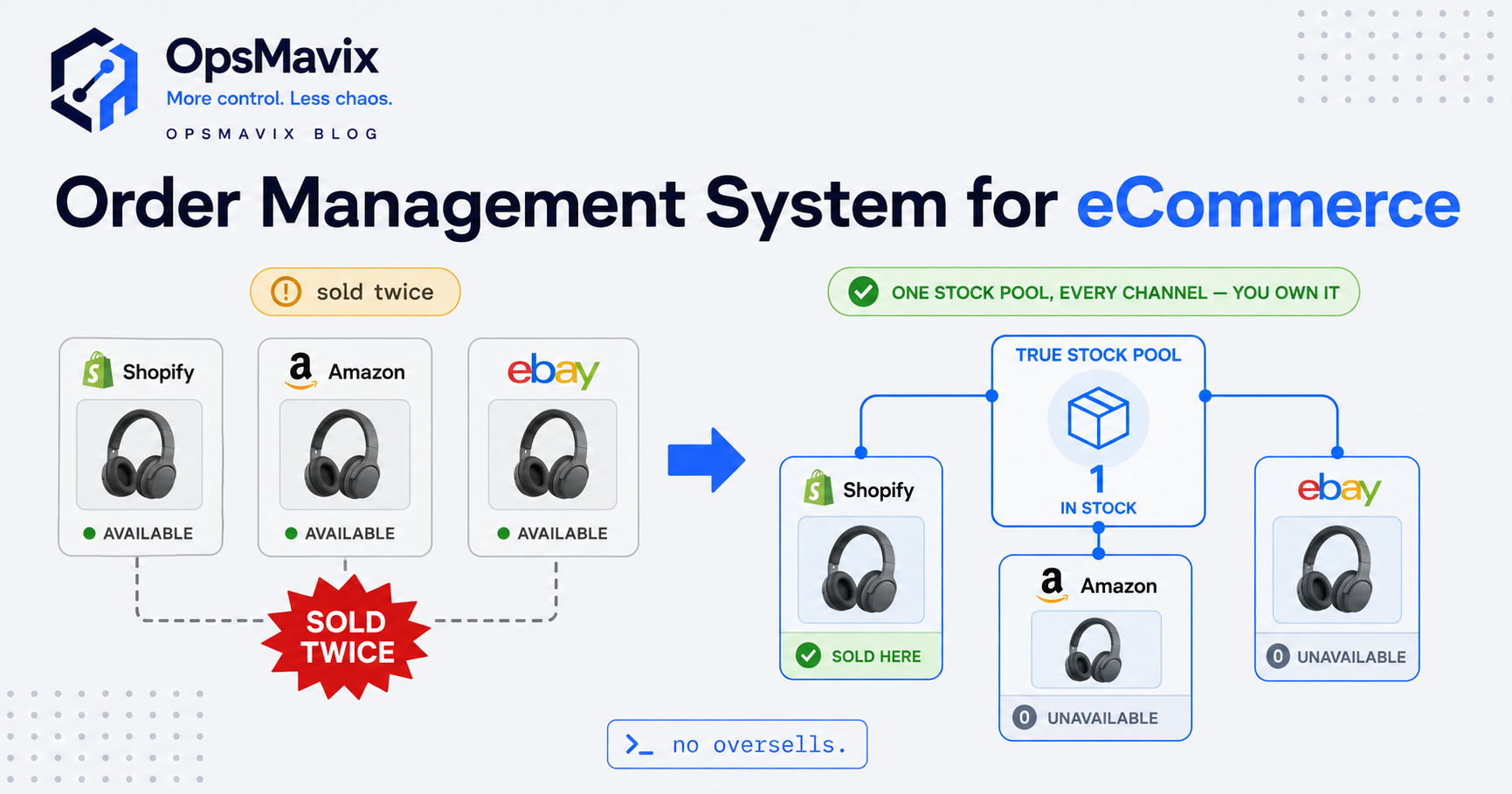
An order management system for eCommerce is the layer that sits between everywhere you sell and everywhere you fulfil, so that a single order — no matter which channel it lands on — flows through one consistent process from checkout to doorstep. At its core it does two jobs at once: it holds one true stock figure that every channel reads from, and it takes each incoming order and decides how it gets picked, packed, shipped, tracked and, when it comes back, returned. Everything else an OMS does hangs off those two jobs.
The need for one appears the moment you sell in more than one place. With a website and nothing else, your store’s own back end is your order management system — it knows what you have and what you’ve sold, because it’s the only thing selling. Add Amazon, then eBay, then Etsy, and you’ve quietly created four systems that each believe they own the stock, none of which talks to the others. Every channel counts down from its own copy of the number, and the gaps between those copies are where overselling, oversold cancellations and 1am spreadsheet reconciliation live. An OMS exists to collapse those four private truths back into one.
Quick summary: Retailers lost 7.4% of potential sales to stockouts and out-of-shelf products, according to NielsenIQ research reported by Veeqo. For a multichannel seller, a chunk of that loss isn’t the shelf being empty — it’s your channels disagreeing about whether it’s empty, so you either promise stock you can’t ship or hold back stock you could have sold.
Contents
What an eCommerce OMS Actually Does {#what-oms-does}
Strip away the vendor language and an order management system does five concrete things. Each one is a place your current setup is probably leaking time.
One stock pool across every channel. Instead of Shopify, Amazon, eBay and Etsy each holding a separate count, they all read from a single live figure. Sell one unit anywhere and every other channel’s available number drops immediately. This is the difference between “we have four units” being a fact and being four separate hopeful guesses.
Order routing. When an order lands, the system decides how it should be fulfilled — from which location, by which method, against which stock. A seller with one stockroom barely notices this. A seller with a warehouse, a retail counter and a third-party fulfilment partner cannot run without it, because the same SKU exists in three places and only one of them should ship this particular order.
Fulfilment orchestration. The OMS turns a paid order into a pick, a pack, a label and a tracking number, and pushes that tracking back to the channel the customer bought on so they get the update they expect. Done well, the customer never knows or cares which of your four channels they used — the experience is identical.
Returns. A return is an order run backwards, and it’s where cheap setups fall apart. A proper OMS knows which channel the item came from, puts the stock back into the single pool once it’s inspected, and triggers the refund on the right platform. Handled badly, returns are how “in stock” slowly stops meaning anything.
Reporting off one dataset. Because every order and every stock movement passes through one place, you can finally answer questions like “what’s my true margin on this SKU across all channels” without exporting four spreadsheets and praying they line up.
For a deeper look at the stock-sync half of this specifically, our guide to multi-channel inventory management covers the single-stock-pool principle in detail. The order-flow half — routing, picking and dispatch — is covered in order fulfilment software.
The Oversell Problem {#oversell-problem}
If you take one thing from this article, take this: overselling is not a stock problem, it’s a timing problem. You didn’t run out of stock. You promised the same unit twice because two channels both thought it was available in the seconds before either learned the other had sold it.
Here’s the mechanism. You hold three units of a bestseller. Shopify shows 3, Amazon shows 3, eBay shows 3. That’s nine units of promised availability against three real ones. None of the platforms is lying — they simply have no way to know a sale happened elsewhere until something tells them. The faster the SKU sells, the wider that fiction grows, which is why your best products oversell most: velocity and oversell risk are the same curve.
The cost isn’t only the awkward cancellation email. Overselling actively erodes trust — 66% of consumers say they’re less likely to trust a business after experiencing overselling, per Queue-it. On marketplaces it’s worse than lost trust: Amazon and eBay penalise sellers for cancellations and late dispatch, so a single oversold weekend can dent the account health that determines whether you’re visible at all next month.
The manual workaround — holding buffer stock on every channel so none can sell the last unit — solves overselling by creating its own leak. Buffer three units across four channels and you’re sitting on twelve units of deliberately unsellable inventory. You’ve traded cancelled orders for tied-up cash and phantom stockouts. That’s not a fix; it’s moving the leak somewhere the spreadsheet can’t see it.
Off-the-Shelf Tools vs Full ERP vs Right-Sized Owned {#three-routes}
Once overselling forces the issue, most sellers discover there are really three routes, and the two obvious ones are both slightly wrong for a growing UK operation.
Route one: an off-the-shelf multichannel tool. These plug into your channels and sync stock, and for a lot of sellers they’re genuinely enough. The trouble starts when your operation has a wrinkle the tool doesn’t model — a bundle that draws from three SKUs, a wholesale price tier, a made-to-order line, a returns rule specific to your category. Off-the-shelf software solves the average seller’s problem. The closer you get to your real workflow, the more you find yourself bending your operation to fit the tool, or paying for a tier of features you’ll never use to unlock the one setting you actually need. You rent it forever, and you adapt to it forever.
Route two: a full ERP. This is the over-buy, and it’s the more expensive mistake. A full ERP will absolutely handle your orders — alongside modules for manufacturing, finance, HR and procurement you don’t need, a months-long implementation, a consultant on retainer, and an interface your packing team quietly refuses to use. For a business doing seven figures across four channels, an ERP is a cannon aimed at a problem that needs a rifle. You’ll spend more configuring the bits you’ll never touch than you would have spent solving the actual leak.
Route three: a right-sized owned system. This is the middle path most sellers don’t know exists. Instead of renting the average or buying the everything, you have a system built to your operation’s real shape — one stock pool, your routing rules, your returns logic, your channels — and nothing else. It does exactly what you do, it’s yours, and it doesn’t carry a per-order tax or a feature-tier upsell. This is the layer for the seller who is too messy for spreadsheets and per-channel tools, but nowhere near ready for a full ERP.
Neither of the first two routes is wrong in every case. The point is that most growing sellers reach for one of them by default, without anyone showing them the third exists.
The Integrations Reality {#integrations}
Every OMS lives or dies on its integrations, and this is where the marketing and the reality diverge. “Connects to Shopify, Amazon and eBay” is true of almost everything on the market. What that phrase hides is how deeply it connects and what happens when a channel changes its rules.
A shallow integration syncs a stock number and an order. A deep one handles the messy parts: marketplace-specific SKU mapping, VAT and pricing rules per channel, bundle and kit logic, partial shipments, and the constant drip of API changes that Amazon and eBay push whether you’re ready or not. Off-the-shelf tools handle the common cases well and the edge cases — which are usually the ones specific to your business — poorly or not at all.
The honest position is this: there is no such thing as a zero-maintenance integration. Channels change their APIs; something always needs tending. The real question is who holds the pen when it does. With a rented tool, you wait for the vendor’s roadmap and hope your edge case is on it. With an owned system, the integration is built around your actual channels and someone can adjust it the week Amazon changes a rule, not the quarter after. For sellers whose orders also flow into wholesale or trade accounts, that flexibility is the whole game — see wholesale order management for how the same order layer stretches across retail and trade.
Why Ownership Changes the Maths {#ownership}
The quiet cost of a rented OMS isn’t the monthly fee. It’s that the fee is usually tied to something that grows — orders, SKUs, channels, users. You get punished, in other words, for exactly the success the tool was supposed to enable. Grow 40% and your “software cost” grows with it, for software doing the same job it did last year.
An owned, right-sized system flips that. You pay to build the thing that fits, and then it’s an asset you hold rather than a subscription that scales against you. When you add a fifth channel or double your order volume, the system doesn’t send you a bigger invoice for the privilege. There’s a real trade-off — an owned system is a build, not a same-day signup — which is why it’s the right answer for sellers past a certain size and complexity, not for a hobby store with fifty orders a month.
Ownership also means the system encodes your process instead of forcing you into someone else’s. The way you handle a return, split a shipment, or price for a wholesale buyer is a competitive asset. Renting software means renting somebody’s assumptions about how those things should work. Owning it means your operation’s hard-won cleverness stays yours. This is the same logic behind ecommerce inventory automation: automate the process you actually run, not the one a vendor guessed at.
Comparison Table {#comparison}
| Factor | Spreadsheets / per-channel | Off-the-shelf multichannel tool / full ERP | Right-sized owned system |
|---|---|---|---|
| Stock accuracy across channels | Guesswork, minutes-to-hours stale | Good for common cases; ERP overkill | Live, single pool, built to your channels |
| Overselling risk | High — every channel counts alone | Low, if your workflow fits the tool | Low — routing built to your real rules |
| Order routing | Manual decisions per order | Rigid preset rules / heavy ERP config | Your routing logic, exactly |
| Returns handling | Ad-hoc, stock rarely restored cleanly | Templated; edge cases fall through | Modelled on your category’s real returns |
| Edge cases (bundles, wholesale tiers) | Handled by memory and hope | Bend your process to fit, or pay up a tier | Built in from day one |
| Cost shape | Cheap now, expensive in lost sales | Monthly fee that scales against growth | Build cost, then an asset you own |
| Who fixes a broken integration | You, at midnight | Vendor roadmap / ERP consultant | Built around your channels, adjusted fast |
| Reporting | Four exports that never reconcile | Decent, but on the vendor’s model | One dataset, your definitions |
| Right for | Under ~50 orders/month, one channel | Average operations / large enterprises | Growing sellers with a specific shape |
A Worked Example: Harrow Home & Garden {#worked-example}
A composite of the UK sellers we see, not a specific client.
Pain. Harrow Home & Garden turns over around £1.4m a year across a Shopify store, Amazon, eBay and a growing Etsy line for their handmade range. Stock lived in a master spreadsheet the founder updated between packing runs. On a bank-holiday promotion they oversold a planter set across Shopify and Amazon in the same afternoon, ate an Amazon late-dispatch penalty, and cancelled eleven orders. Returns made it worse: with UK online return rates now climbing to around 20% (and up to 26% in fashion-adjacent categories), per OrderWise, a steady stream of returned goods was going back into a spreadsheet that had already moved on, so “in stock” and “actually on the shelf” drifted further apart every week.
Over-buy temptation. Their first instinct was a full ERP — a big-name platform a peer in a different sector swore by. Quoted a five-figure implementation plus an annual licence, and a four-month rollout, for a business whose actual problem was four channels disagreeing about one stock number. They’d have paid mostly for manufacturing and finance modules they’d never open.
Right-sized fix. Instead they had a system built to their operation: one live stock pool feeding all four channels, routing rules that shipped Etsy made-to-order items differently from warehouse stock, and a returns flow that put inspected stock back into the pool and refunded on the original channel automatically. No modules they’d never touch. No per-order fee waiting to grow with them.
Outcome. Overselling stopped, because no channel could ever sell below the true figure. The buffer stock they’d been holding “just in case” was freed back into sellable inventory. The founder got their weekends back from spreadsheet reconciliation, and — because every order now ran through one dataset — they could finally see true per-SKU margin across channels and cut two lines that had been quietly losing money.
FAQ {#faq}
What’s the difference between an OMS and inventory management software? Inventory management answers “what do I have and where.” Order management answers “an order just arrived — how does it get fulfilled.” They overlap heavily and the best setups do both from one place, which is why a right-sized owned system treats them as one problem rather than two tools you have to keep in sync.
Do I need an OMS if I only sell on Shopify? Probably not yet. If Shopify is your only channel, its own back end is effectively your OMS. The need appears the moment you add a marketplace, a wholesale account, a second fulfilment location, or a retail counter — anything that creates a second place claiming the same stock.
Will an off-the-shelf multichannel tool be enough for me? Often, yes — if your operation matches the average the tool was built for. You outgrow it when you have workflow specifics it can’t model (bundles, wholesale tiers, made-to-order lines, category-specific returns) and you find yourself either bending your process to the software or paying for a higher tier to unlock one setting.
Isn’t a custom-built system riskier than buying established software? The real risk is buying the wrong size. A full ERP is established and still the wrong tool for a four-channel seller. A right-sized owned system is lower risk in the ways that matter to you — it fits your process, doesn’t scale its cost against your growth, and its integrations are built around the channels you actually use, not a generic catalogue.
How does an OMS stop overselling specifically? By making every channel read available stock from one live figure instead of its own copy. When any channel sells a unit, every other channel’s number drops in the same moment, so no channel can ever promise stock that’s already gone. That’s it — the fix is architectural, not a matter of updating faster.
How OpsMavix Can Help {#how-opsmavix-can-help}
OpsMavix builds owned, right-sized operations systems for UK businesses that have outgrown spreadsheets and per-channel tools but shouldn’t be paying for a full ERP. For a multichannel eCommerce seller, that means one live stock pool across your website, Amazon, eBay and Etsy; order routing and fulfilment built to your real workflow; a returns flow that keeps “in stock” honest; and reporting off a single dataset instead of four exports that never agree.
We don’t start by selling you software. We start by finding where your current setup leaks — the oversold weekends, the buffer stock tying up cash, the hours lost to reconciliation — and then we build only what closes those leaks. No modules you’ll never open, no per-order tax that grows against your success. Just a system shaped like your operation, that you own.
If you’re too messy for spreadsheets and per-channel tools, but not ready for a full ERP, that middle is exactly where we work.
Sources {#sources}
- Veeqo — NielsenIQ research: retailers lost 7.4% of potential sales to stockouts and out-of-shelf products: https://www.veeqo.com/blog/the-hidden-costs-of-multichannel-selling-every-business-owner-must-know
- Queue-it — 66% of consumers say they’re less likely to trust a business after experiencing overselling: https://queue-it.com/blog/overselling/
- OrderWise — average UK online return rate has climbed to around 20%, up to 26% in fashion categories: https://orderwise.co.uk/en/blog/returns-and-ecommerce-five-facts-and-figures
- Retail Dive — shoppers encounter out-of-stocks in as often as one in three shopping trips: https://www.retaildive.com/news/out-of-stocks-could-be-costing-retailers-1t/526327/