
Order Fulfilment Software: What It Does & When You Need a Right-Sized System
Order fulfilment software manages the journey from order received to parcel delivered, across stock, picking, packing and dispatch. This guide explains the core functions, who genuinely needs a full platform, and the right-sized owned alternative for firms too messy for spreadsheets but not ready for a full ERP.
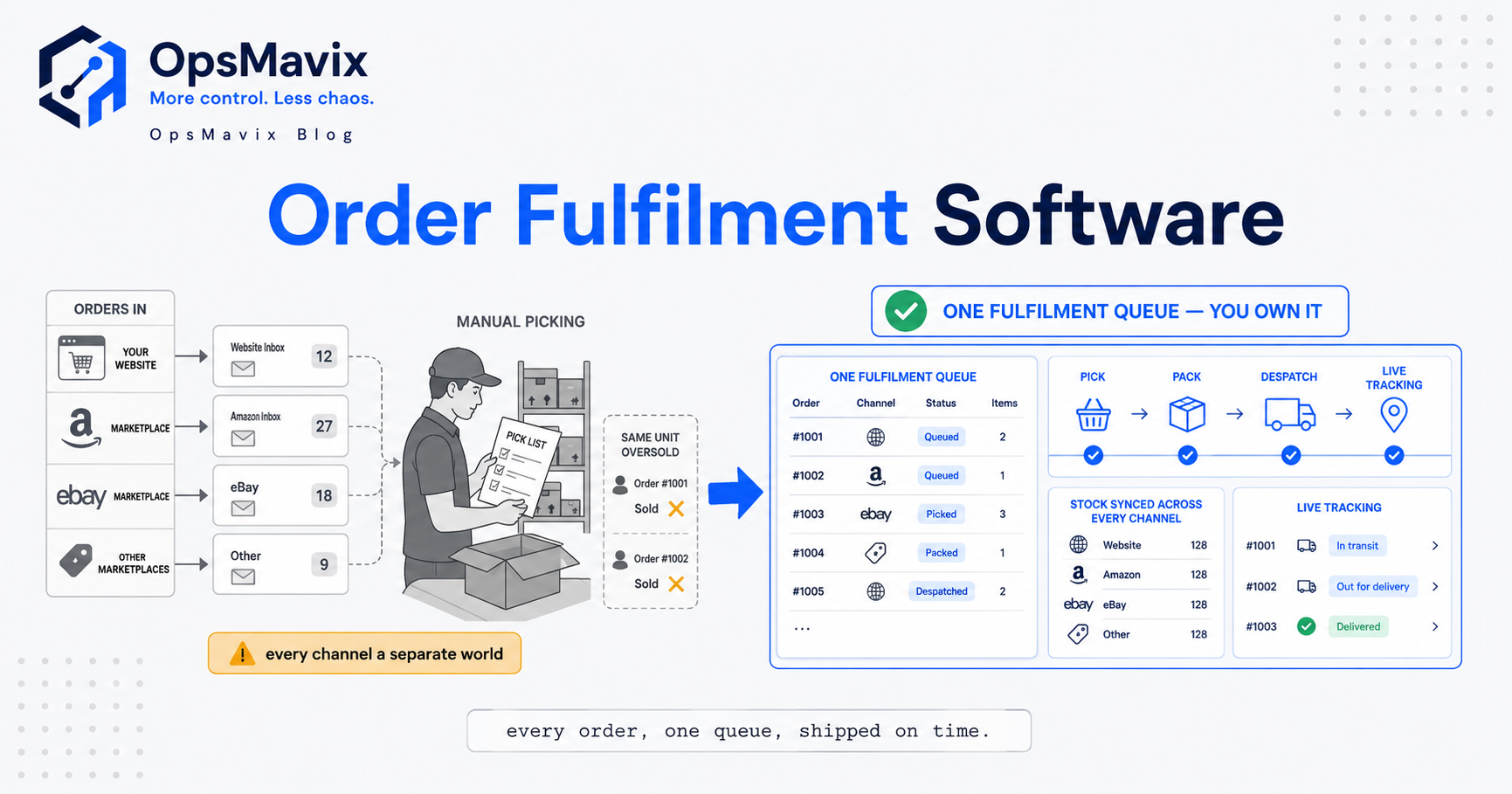
Order fulfilment software is the system that manages everything between a customer placing an order and the parcel arriving at their door, holding stock levels, picking lists, packing, dispatch and returns in one connected view instead of a stack of spreadsheets, courier portals and inboxes. In practice it means a sales order, the stock it consumes, the pick that follows and the tracking that goes back to the customer all reference the same data, so a change in one place updates the rest and nobody re-keys the same numbers three times.
Quick summary: In December 2025, 28.3% of all UK retail sales were made online, up from 28.0% in November (ONS Retail Sales, December 2025). More than a quarter of retail now flows through a fulfilment process, which is exactly why so many growing firms get sold a large platform when the real problem is two or three broken steps they could own outright.
Contents
- What order fulfilment software actually is
- The core functions of order fulfilment software
- Order fulfilment software vs OMS vs WMS vs ERP
- Spreadsheets vs full platform vs right-sized owned system
- Who genuinely needs a full fulfilment platform
- Signs you are over-buying
- The right-sized owned alternative
- Worked example: a £4m ecommerce-with-stock brand
- How to choose without over-committing
- FAQ
What order fulfilment software actually is {#what-it-is}
Order fulfilment is the sequence of steps that turns a placed order into a delivered parcel: receiving stock, picking, packing, shipping and handling returns (ShipBob UK). Do any of those steps badly and the customer feels it, through a wrong item, a late dispatch or an oversell that becomes an apology email.
Order fulfilment software is the technology layer that coordinates those steps. Its job is to hold one shared version of the truth: what you have in stock, what has been ordered, what has been picked and packed, and what is on its way back as a return. That single source of truth is the whole point, because most fulfilment pain is not a warehouse problem, it is a data problem: two systems disagree about how many units you have, so you promise stock you cannot ship.
The important thing to understand up front is that “order fulfilment software” is not one product. It is a category that runs from a simple pick-and-pack app bolted onto a webstore, all the way to a sprawling suite that plans demand, runs multiple warehouses and orchestrates a network of couriers and 3PLs. What you actually need depends entirely on where your fulfilment is leaking.
The core functions of order fulfilment software {#core-functions}
A full fulfilment platform typically claims to cover the following. It is worth knowing them by name so you can spot which ones you genuinely use.
- Order capture and orchestration. Pulling orders in from every channel (webstore, marketplaces, phone, trade accounts) into one queue, so nothing is fulfilled twice or missed.
- Inventory management. Tracking stock levels, locations and reorder points, and, critically, reserving stock the moment an order lands so you cannot sell the same unit twice.
- Picking and packing. Generating pick lists, batching orders, and guiding pack-and-dispatch, often with barcode scanning to cut errors.
- Shipping and carrier management. Buying labels, choosing the right courier and service, and pushing tracking back to the customer.
- Returns processing. Booking returns back in, updating stock and triggering refunds, so a returned item becomes sellable again instead of vanishing.
- Multi-location and 3PL routing. Deciding which warehouse or third party fulfils an order when you hold stock in more than one place.
- Visibility and analytics. The reporting layer that shows dispatch times, error rates, stock on hand and what is about to run out.
Most growing firms live and die by three of these: keeping one accurate stock figure across channels, getting orders picked and dispatched cleanly, and processing returns without losing track of stock. The rest are either handled outside the business (the courier’s own portal, a 3PL’s system) or simply not complex enough to justify dedicated software. Returns alone are a bigger operational load than most owners budget for; UK non-food online returns were forecast near 19.5% in 2025 (Eightx), meaning roughly one in five orders comes back and has to be re-processed.
Order fulfilment software vs OMS vs WMS vs ERP {#software-types}
These labels get used interchangeably and they should not be.
An order management system (OMS) sits at the front of the process. It captures and orchestrates orders from every sales channel, decides where each one should be fulfilled, and tracks it to delivery. It is the “traffic control” layer.
A warehouse management system (WMS) sits inside the four walls of a warehouse. It runs receiving, put-away, picking routes, packing and stock locations at bin level. A big 3PL needs one; a brand shipping a few hundred orders a month from one room usually does not.
An ERP (enterprise resource planning) is the wide system of record for the whole business, finance, HR, operations, in one database, and fulfilment is often just a set of modules inside it. If you are weighing a broad platform against something leaner, our guide to an operations control system covers that trade-off directly.
Order fulfilment software is the umbrella term that overlaps all three. In reality the lines blur: many platforms bundle OMS, WMS and ERP-style modules together, and the marketing rarely tells you which parts you will actually switch on. The label matters less than the question: which specific step in your fulfilment is costing you money right now? For the wider view of how fulfilment fits into procurement, planning and logistics, see our breakdown of supply chain management software.
Spreadsheets vs full platform vs right-sized owned system {#comparison-table}
Most growing firms sit awkwardly between spreadsheets that have run out of road and a full platform that is too much. Here is the honest comparison.
| Factor | Spreadsheets & channel portals | Full fulfilment platform / ERP | Right-sized owned system |
|---|---|---|---|
| Best for | Very low order volume, one channel | Large, complex, multi-warehouse operations | Firms “too messy for spreadsheets, not ready for a full ERP” |
| One stock figure across channels | No, each channel has its own view | Yes, but you fit your process to the tool | Yes, built around your actual process |
| Setup cost | Near zero | High (licences + implementation) | Moderate, one-off build |
| Ongoing cost | Hidden in wasted staff time and oversells | Per-user, per-module licences, forever | You own it; no per-seat rent |
| Time to value | Immediate, then degrades fast | Months to over a year | Weeks, focused on the real bottleneck |
| Double entry / re-keying | Constant | Reduced, if fully adopted | Eliminated for your core flow |
| Fit to your process | Total, but fragile and manual | Partial, you adapt to it | High, it is built to fit |
| Risk | Oversells, errors, key-person risk | Over-scoping, low adoption, lock-in | Scoped too narrow if pain is genuinely broad |
The pattern most owners recognise: spreadsheets and channel portals are free until the cost of oversells, wrong picks and admin time becomes the biggest hidden line item, and full platforms solve that but charge you for ninety functions to fix three problems.
Who genuinely needs a full fulfilment platform {#who-needs-it}
A full platform earns its keep when the complexity is real and permanent, not aspirational. Strong signals:
- Multiple warehouses or 3PLs where an order genuinely has to be routed to the closest or cheapest location. If you run more than one stock location, our guide to multi-location inventory management explains where the real difficulty starts.
- High order volume across many channels where manual order capture cannot keep up and batching, wave-picking and automation pay for themselves.
- Bin-level warehouse complexity with thousands of SKUs, zones and pick paths that a WMS is designed to optimise.
- A dedicated operations team whose full-time job is fulfilment and who will actually adopt and configure the tool.
- Deep marketplace and international shipping with tax, customs and carrier rules that a mature platform already handles.
If several of these are true, a proper platform is the right answer and you should evaluate it seriously. Fulfilment software exists at enterprise scale because enterprise operations need it. But that scale is exactly the point: most of it is built for operations far larger and more complex than a £3m–£15m brand shipping from one or two locations.
Signs you are over-buying {#over-buying}
You are probably over-buying if:
- Your pain is concentrated in one or two steps (usually keeping stock accurate across channels and getting orders out cleanly) but you are being sold a suite covering the whole chain.
- Most modules would sit unused. You do not run bin-level warehousing, you do not route between five warehouses, you ship through one or two couriers.
- You are being quoted per-user, per-month licences forever for software you will use at maybe 30% of its capability.
- Implementation is measured in quarters, and the plan requires you to reshape your process to fit the tool.
- The real problem is channels that disagree about stock, which is an integration and process problem, not a reason to rent an enterprise platform.
Over-buying is not just wasted money. Large platforms fail on adoption when the team quietly keeps using their spreadsheets alongside the new system, so you now pay for both and trust neither. That failure mode is common enough that it is worth designing against from the start.
The right-sized owned alternative {#right-sized-alternative}
There is a middle path between “make the spreadsheets work a bit longer” and “buy the enterprise platform”. Build a right-sized system that covers only the fulfilment steps actually costing you money, and own it outright.
This is OpsMavix’s positioning, and it is worth being clear about what we are and are not. We are not an order fulfilment software vendor and we do not sell generic custom code. We build an owned operations system for firms where a full platform or ERP is genuinely too much, focused on the outcome: one accurate stock figure across every channel, orders that go out clean, and control over your own operations.
A right-sized owned system typically starts by fixing the leak that causes the most damage: stock that disagrees between your webstore, your marketplaces and your warehouse. Hold one live stock figure that every channel reads from and reserves against, and oversells largely stop. Our guide to preventing overselling walks through why that single number matters more than any feature list. From there you connect the next step that is leaking, usually clean order capture and dispatch, then returns, then the reporting that shows dispatch times and stock on hand at a glance.
Because you own it, there is no per-seat licence rent, it is built to your process rather than forcing your process into someone else’s template, and it is scoped to weeks not quarters because it is not trying to boil the ocean. If part of your fulfilment runs through a third party, our guide to 3PL inventory management software shows how a right-sized system keeps your own stock truth in sync with theirs rather than surrendering it to their portal.
The trade-off is honest: if your complexity is genuinely broad and permanent, a right-sized system scoped too narrowly will leave gaps, and a full platform is the better call. The skill is telling the difference, which is exactly what a proper audit does before anyone builds anything.
Worked example: a £4m ecommerce-with-stock brand {#worked-example}
Take a product brand turning over £4m a year, roughly 600 active SKUs, selling through its own Shopify store plus two marketplaces, shipping from one small warehouse with three staff and two couriers.
The pain. Each sales channel keeps its own stock count, so when a popular SKU sells fast on the marketplace, the webstore does not know and keeps selling it. Oversells hit two or three times a week, each one a cancellation, a refund and an annoyed customer. Orders are exported to spreadsheets and re-keyed for picking, which is where the wrong-item errors creep in. Returns pile up in a corner and get booked back to stock late, so the numbers drift further. Someone spends most of a day a week just reconciling counts.
The over-buy option. A tier-one fulfilment/ERP platform is quoted. It covers multi-warehouse routing, bin-level WMS, demand planning and international customs, none of which this business needs, at a per-user monthly licence plus a five-figure implementation over two quarters. The multi-warehouse and demand modules would never be switched on.
The right-sized option. A system that does three things: holds one live stock figure that every channel reads from and reserves against the moment an order lands, pulls all orders into one clean dispatch queue so nothing is re-keyed, and books returns straight back to sellable stock. No demand-planning engine, no bin-level WMS, no per-seat rent. Built in weeks, scoped to the two real leaks.
The outcome that matters. Oversells stop because there is one stock figure, not three. The wrong-item errors fall because orders are not re-typed. The day a week of reconciling comes back. That is the difference between buying software and fixing the actual problem, and it is why the question is never “which platform” but “which fulfilment steps are bleeding”.
How to choose without over-committing {#how-to-choose}
A simple decision path:
- Name the leak. Write down the two or three fulfilment steps where errors, oversells or admin time actually cost you. Be specific and honest.
- Count the modules you would use. If a full platform’s value is concentrated in a couple of modules, that is a signal.
- Check the adoption risk. Will the team actually move off their spreadsheets and channel portals, or run both?
- Compare total cost over three years, licences plus implementation plus internal time, not the sticker price.
- Decide breadth vs depth. Broad, permanent, multi-warehouse complexity → platform. Concentrated pain and a desire to own the result → right-sized system.
FAQ
What is the difference between order fulfilment software and an OMS or WMS?
An order management system (OMS) captures and routes orders from every channel and tracks them to delivery. A warehouse management system (WMS) runs the physical warehouse, receiving, put-away, picking and packing at bin level. “Order fulfilment software” is the umbrella term that can include both, plus shipping and returns. Many platforms bundle them together, so the practical question is which specific step, order capture, picking, shipping or returns, is actually costing you money.
Do small businesses need order fulfilment software?
Rarely the full enterprise kind. Most small and growing firms feel pain in one or two steps, usually keeping stock accurate across channels and getting orders out without errors, and can fix that with a right-sized owned system rather than a multi-module platform. The trigger to move off spreadsheets is not size, it is when oversells, wrong picks and reconciliation time become one of your biggest hidden costs.
How does order fulfilment software stop overselling?
By holding one live stock figure that every sales channel reads from, and reserving stock the moment an order is placed so the same unit cannot be sold twice. Overselling almost always comes from channels that each keep their own count and drift apart. A single reserved stock figure is the fix, which is why it is usually the first thing worth building.
Is a right-sized owned system cheaper than a full fulfilment platform?
Usually over a three-year horizon, yes, because you pay a one-off build cost and then own it, rather than per-user, per-module licences that continue forever. It is not always cheaper up front, and if your complexity is genuinely broad, a platform can be better value. The real saving is scope: you pay to fix the steps that are leaking, not for a suite of functions you will never switch on.
What about returns, are they part of order fulfilment?
Yes. Returns are the final step of fulfilment and a heavy operational load, with UK non-food online returns forecast near one in five orders. Good fulfilment software books a return straight back to sellable stock and triggers the refund, so a returned item does not vanish from your numbers. Handling returns badly is one of the fastest ways for your stock figure to drift out of trust.
How OpsMavix Can Help
OpsMavix builds right-sized, owned operations systems for businesses that are too messy for spreadsheets but not ready for a full fulfilment platform or ERP. We are not a software vendor and we do not sell generic custom code, we sell the outcome: one accurate stock figure across every channel, orders that go out clean, returns that stay in sync, and control over your own operations, backed by a delivery guarantee. We start by finding out where your order fulfilment actually leaks, then build only what fixes it, connected to your real process, owned by you, with no per-seat rent. When you are ready to find the leaks in yours:
Sources
- ONS — Retail Sales, Great Britain, December 2025 (proportion of retail sales made online, 28.3% in December, 28.0% in November): https://www.ons.gov.uk/businessindustryandtrade/retailindustry/bulletins/retailsales/december2025
- ShipBob UK — What is Order Fulfilment, the five steps: receiving, picking, packing, shipping, returns: https://www.shipbob.com/uk/blog/order-fulfillment/
- Eightx — UK Ecommerce Return Rate Benchmark (UK non-food online returns forecast near 19.5% in 2025): https://eightx.co/blog/uk-ecommerce-return-rate-benchmark