
The Best Accounting Software for a Distribution Business (Honest Guide)
Searching for the best accounting software for a distribution business usually means you've hit a wall your ledger can't see over. Xero, QuickBooks and Sage keep the books beautifully, but they're blind to stock, purchasing and real order margin. This is the honest guide for distributors too messy for spreadsheets, not ready for a full ERP.
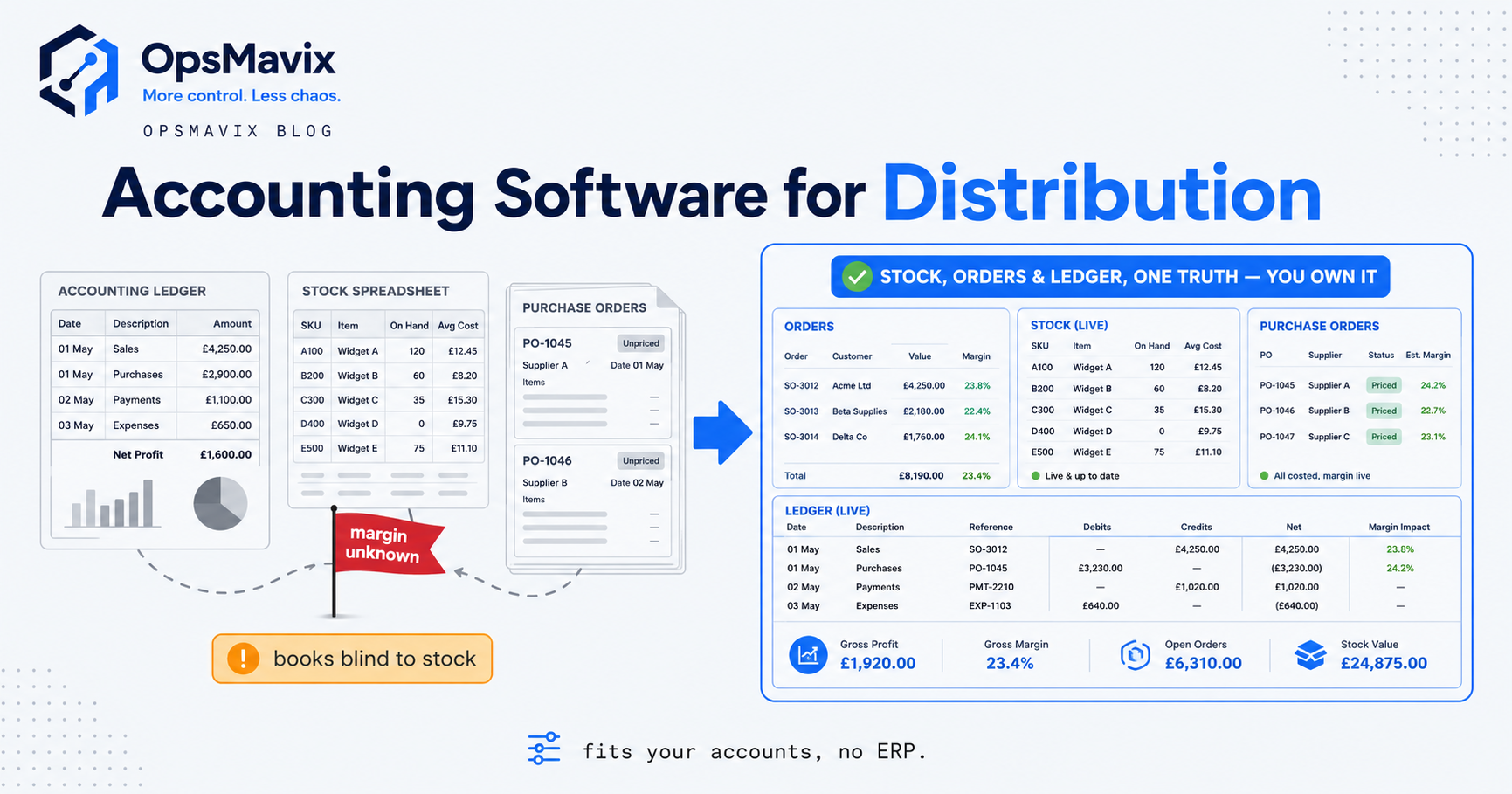
When a distributor goes looking for the best accounting software for their business, they’re rarely just after a better ledger. The books usually work fine. What’s actually broken is the gap between the books and the warehouse: the software that runs the accounts has no idea what’s on the shelf, what a purchase order really cost once freight landed, or whether the deal you just shipped made money. So the question sounds like an accounting question and is really an operations one.
That distinction matters, because it changes what you should buy. Mainstream accounting tools are excellent at accounts and useless at distribution reality, and no amount of comparing Xero against QuickBooks against Sage fixes a problem none of them were built to solve. This guide lays out the honest choices in front of a growing distributor, and where the smart money actually goes.
Quick summary: The wholesale and retail trade industry generated more turnover than any other UK sector in 2024, at £1,629.8 billion (ONS) — a colossal volume of stock moving through businesses whose accounting software was never built to control it. For a distributor, the best accounting software for the business is almost always your existing ledger left exactly where it is, with a right-sized layer around it owning stock, orders, purchasing and margin. The mistake is expecting one accounting tool, or one giant ERP, to do both jobs.
Contents
- What “best accounting software for a distribution business” really means
- What accounting software is genuinely brilliant at
- The stock, order and margin blind spot
- The three honest options, compared
- Integrations, and why ownership matters
- A worked example: the cost of the gap
- FAQ
- How OpsMavix Can Help
- Sources
What “Best Accounting Software for a Distribution Business” Really Means {#what-it-means}
There are two questions hiding inside that search, and answering the wrong one is how distributors end up with expensive software that solves the problem they didn’t have.
The first question is narrow and easy: what should keep my books? For a UK distributor that’s Xero, QuickBooks or Sage. They handle the ledger, VAT, Making Tax Digital, invoicing and bank reconciliation, and they do it well (GOV.UK). If this is genuinely all you need, pick on price and your accountant’s preference, and stop reading — you don’t have a distribution software problem.
The second question is the one that actually drove the search: what should run my distribution business? That’s stock across locations, purchase orders and their true landed cost, pricing tiers per customer, order margin, backorders and reordering. None of those are accounting jobs, and the accounting tools treat them as a light bolt-on. When people say the best accounting software for a distribution business “should handle inventory too”, they’re quietly asking a ledger to be a distribution system. It can’t, and forcing it is where the money leaks.
What Accounting Software Is Genuinely Brilliant At {#what-it-does}
Be fair to the tools before criticising them, because the criticism is narrow and specific. For a distributor, mainstream accounting software does a set of jobs you should not try to move anywhere else:
- The ledger and statutory accounts. Double-entry, trial balance, P&L, balance sheet — everything your accountant and Companies House need.
- VAT and Making Tax Digital. VAT-registered businesses must keep digital records and file through compatible software, and your accounting package is that software (GOV.UK). Don’t reinvent this in a stock tool.
- Invoicing and bank reconciliation. Money in, money out, matched to the bank.
- Debtors and creditors. Who owes you, who you owe, and the aged reports that drive credit control.
This is the book of record, and it’s the one part of your stack that already works. When a “distribution accounting” pitch tells you to migrate any of this into something bigger, treat it as a cost and a risk, not a feature. The problem was never your accounts. It’s everything the accounts can’t see.
The Stock, Order and Margin Blind Spot {#blind-spot}
Accounting software is built accounts-first. Its inventory features are a thin add-on that a real distributor outgrows fast, and the gaps are consistent across the mainstream tools:
- No live, multi-location stock. The ledger knows the value of inventory at period end, not what’s physically on each shelf right now. It can tell you stock was worth £180k in March; it can’t stop you overselling a line across two warehouses on a Tuesday.
- Landed cost is invisible. Freight, duty and handling that turn a £4.00 buy price into a £4.90 real cost rarely make it into the accounting item cost, so every margin built on that number is wrong.
- No real purchasing logic. No reorder points that raise a purchase order, no supplier lead-time awareness, no backorder handling. Reordering, where it exists, is informational only.
- Pricing tiers are crude. Distributors run customer-specific and volume pricing that accounting tools represent clumsily, so the true price and true margin drift apart.
- Order margin arrives too late. You find out whether a shipment made money at month-end, from the accounts, long after you could have done anything about it.
Inventory accuracy is where this bites hardest. One inventory study found that 58% of retail brands and D2C manufacturers run below 80% inventory accuracy (Unleashed) — and if your live stock is wrong, every downstream number the accounts inherit is wrong too. So the distributor does what nearly everyone in this position does: runs the “real” stock, orders and margin in a spreadsheet beside the accounts, with a person re-keying between the two. That spreadsheet is the leak. No audit trail, one broken formula from a silent error, owned by one person, every movement entered twice. The same disconnect shows up whether you frame it as wholesale accounting software or distribution operations — the ledger simply isn’t the place stock lives.
The Three Honest Options, Compared {#comparison}
Faced with that blind spot, a distributor has three real routes, not two. The market pushes the first and third hardest and quietly ignores the middle one, which is often the right answer.
- Cheap, generic accounting software (Xero, QuickBooks, Sage). A brilliant ledger, a weak stock bolt-on. Cheap, familiar, and honestly the correct choice if your distribution really is simple.
- A full distribution ERP. Does everything — finance, stock, purchasing, warehouse, CRM — in one platform. Powerful, and genuinely right for some businesses. Expensive, priced per seat and per module forever, and you bend your operation to fit its template. See distribution ERP software for the full honest picture.
- A right-sized owned system. Keep your accounting software as the ledger, and build one layer around it that owns stock, orders, purchasing and margin — shaped to how you actually run, integrated with the tools you already have, and owned outright rather than rented per seat.
| Generic accounting software | Full distribution ERP | Right-sized owned system | |
|---|---|---|---|
| Runs the ledger & VAT | Yes, brilliantly | Its own finance module (a migration) | Your existing Xero / QuickBooks / Sage, untouched |
| Live multi-location stock | No | Yes | Yes, built to your locations |
| Landed cost & true margin | No | Yes, within its model | Yes, costed your way |
| Purchasing & reorder logic | Manual / informational | Yes | Yes, to your lead times |
| Fit to how you actually work | N/A — it’s just the books | Great if you match the template | Shaped to your operation |
| Cost shape | Low monthly fee | Per seat + per module, forever | Right-sized build; you own it |
| Migration risk | None | Re-platform accounts + retrain team | None — the ledger doesn’t move |
| Best when | Your distribution is genuinely simple | You need to replace everything at once | Accounts work, stock and orders don’t |
The honest recommendation is to buy the cheapest thing that closes your actual leak. If your distribution is genuinely simple, generic accounting software plus a tidy process is enough, and anyone selling you more is selling you bloat. If you truly need to replace core finance, warehouse and planning together, an ERP is the right conversation. But most growing distributors are in neither camp: the accounts already work, it’s stock, orders and margin that are chaotic — and for them the right-sized owned system fixes the half that’s broken without paying to rip out the half that isn’t.
Integrations, and Why Ownership Matters {#integrations}
The reason the right-sized route works at all is integration. You don’t replace your accounting software; you connect to it. A well-built operations layer reads and writes through the accounting tool’s API — pushing sales invoices, supplier bills and stock valuation into the ledger automatically, so your accountant sees clean, timely numbers and never knows there’s a second system. Xero, QuickBooks and Sage all expose this. The book of record stays the book of record; the operations truth lives where operations happen; a clean feed keeps them in step without a human in the middle. That handover is the whole deliverable, and it’s the discipline behind any real inventory automation system or wholesale order management system.
Ownership is the other half, and it’s where rented software quietly costs you. An ERP or an all-in-one suite is a subscription: per-seat pricing on modules half your team never opens, price rises you don’t control, and a roadmap set by a vendor optimising for their average customer, not for you. When the template doesn’t fit your odd pricing tier or your one weird consignment arrangement, the side-spreadsheet creeps back — now beside a platform you’re paying five figures a year for. A right-sized owned system inverts that. It’s built around your normal way of working, so your “exceptions” are just features; approvals and controls like an invoice approval workflow are shaped to your team, not a template’s; and because you own it, there’s no per-seat creep and no vendor holding your operation hostage. You pay once to fix the leak, not monthly to rent a fix that half-fits.
A Worked Example: The Cost of the Gap {#worked-example}
The following is illustrative — not a claim about a specific client. Numbers are round for clarity; plug in your own.
Take a UK distributor turning over £6m, running roughly 90 stock and order movements a day — goods-in, picks, adjustments, price overrides — in a spreadsheet, then re-keying the relevant ones into Xero. Three leaks run in parallel:
- Re-keying. Say each movement takes about 90 seconds to enter and check. At 90 a day over 250 working days that’s around 560 hours a year. At £18/hour, roughly £10,000/year in pure admin, before a single error.
- Wrong margin from missing landed cost. Freight and duty add about 12% to landed cost but never reach the item price in the accounts. On £3.5m of goods sold, quoting off the pre-freight cost quietly gives away margin on the deals priced tightest. Even recovering 1% of that is £35,000 a year of margin that was invisible in the ledger.
- Oversells and stale stock. With live stock wrong more often than not, the business oversells popular lines and over-orders slow ones. Carrying and stockout cost here is genuinely hard to pin down, but on this size of business it’s rarely under £15,000/year — and it’s the leak the accounts only ever explain after the fact.
The re-keying line is the one you can measure. The margin line is the one that costs most and shows up last. A generic accounting tool sees none of it — it faithfully records the wrong numbers. A full ERP would close all three, at the price of migrating your finance and bending your operation to its shape. A right-sized owned system closes the same three by owning stock, landed cost and margin, and feeding clean figures back into the Xero you already run. The point of the numbers isn’t precision. It’s that the leak is bigger than any software subscription you’re weighing up, and it lives in the gap the accounting software can’t see.
FAQ {#faq}
What is the best accounting software for a distribution business?
For the accounts themselves, Xero, QuickBooks and Sage are all strong UK choices, and the “best” one is mostly down to price and what your accountant already knows. But if the reason you’re asking is that your books can’t see your stock, orders or real margin, no accounting tool will fix that — because that’s not an accounting job. The best setup for most distributors is a solid accounting tool for the ledger plus a right-sized operations layer around it.
Can’t I just use my accounting software’s built-in inventory?
For a simple buy-and-resell business with few SKUs, one location and one channel — yes, and you should. You’ve outgrown it once you hold stock in more than one place, need landed cost in your margins, run customer-specific pricing, or want reorder points that actually raise a purchase order. Past that line, the stock and order job belongs in a dedicated layer that reports clean numbers back to the accounts.
Do I need a full distribution ERP instead?
Only if you genuinely need to replace core finance, warehouse and planning all at once. That’s a real situation for some businesses, and if it’s yours, an ERP is the honest answer. But most growing distributors have working accounts and broken operations. Replacing everything to fix one half is expensive and risky, and it usually means bending how you work to fit the ERP’s template. If that sounds like you, read the honest comparison in distribution ERP software first.
Will a custom system replace my accountant or my VAT return?
No. Your accounting software and your accountant keep doing the accounts, VAT and Making Tax Digital filing exactly as now (GOV.UK). The operations layer never touches the VAT return — it just makes sure the sales, purchases and stock values landing in the ledger are correct and on time, so the numbers are real instead of reconciled guesses.
How do I know which of the three options is right for me?
Look at the shape of your mess. If distribution is genuinely simple, buy cheap accounting software and stop. If finance, warehouse and planning are all broken and need replacing together, look at an ERP. If your accounts work but stock, orders and margin are held together by spreadsheets, you need a right-sized layer around the accounts — that’s the common case, and it’s the one that gets oversold an ERP. More on the wider picture in wholesale distribution software.
How OpsMavix Can Help {#how-opsmavix-can-help}
OpsMavix builds right-sized, owned operations systems for growing UK distribution and wholesale businesses — the layer that sits around your accounting software and owns the stock, orders, purchasing and margin your ledger was never built to see. We don’t replace Xero, QuickBooks or Sage, and we don’t do your VAT; we integrate with them, so your accounts stay right and on time while your warehouse and your books finally agree. If you’re too messy for spreadsheets but not ready for — or not wanting — a full ERP, and you’ve been comparing accounting tools hoping one of them fixes distribution, start with the leak instead of the software: Book a Free Operations Leak Audit.
Sources {#sources}
- Office for National Statistics — Annual Survey of Goods and Services, UK: 2024 (wholesale and retail trade the largest UK sector by turnover, £1,629.8 billion)
- Unleashed — Inventory Management Statistics & Industry Benchmarks (58% of retail brands and D2C manufacturers run below 80% inventory accuracy)
- GOV.UK — Making Tax Digital for VAT (digital record-keeping and filing requirements for VAT-registered businesses)