
Wholesale Distribution Software: How to Choose a Right-Sized System (Without Buying a Bloated ERP)
Most wholesalers get sold a bloated, generic platform when they need one right-sized system they actually own. This guide breaks down what wholesale distribution software really has to do, where all-in-one ERP overshoots, and how to pick a system that fits your operation.
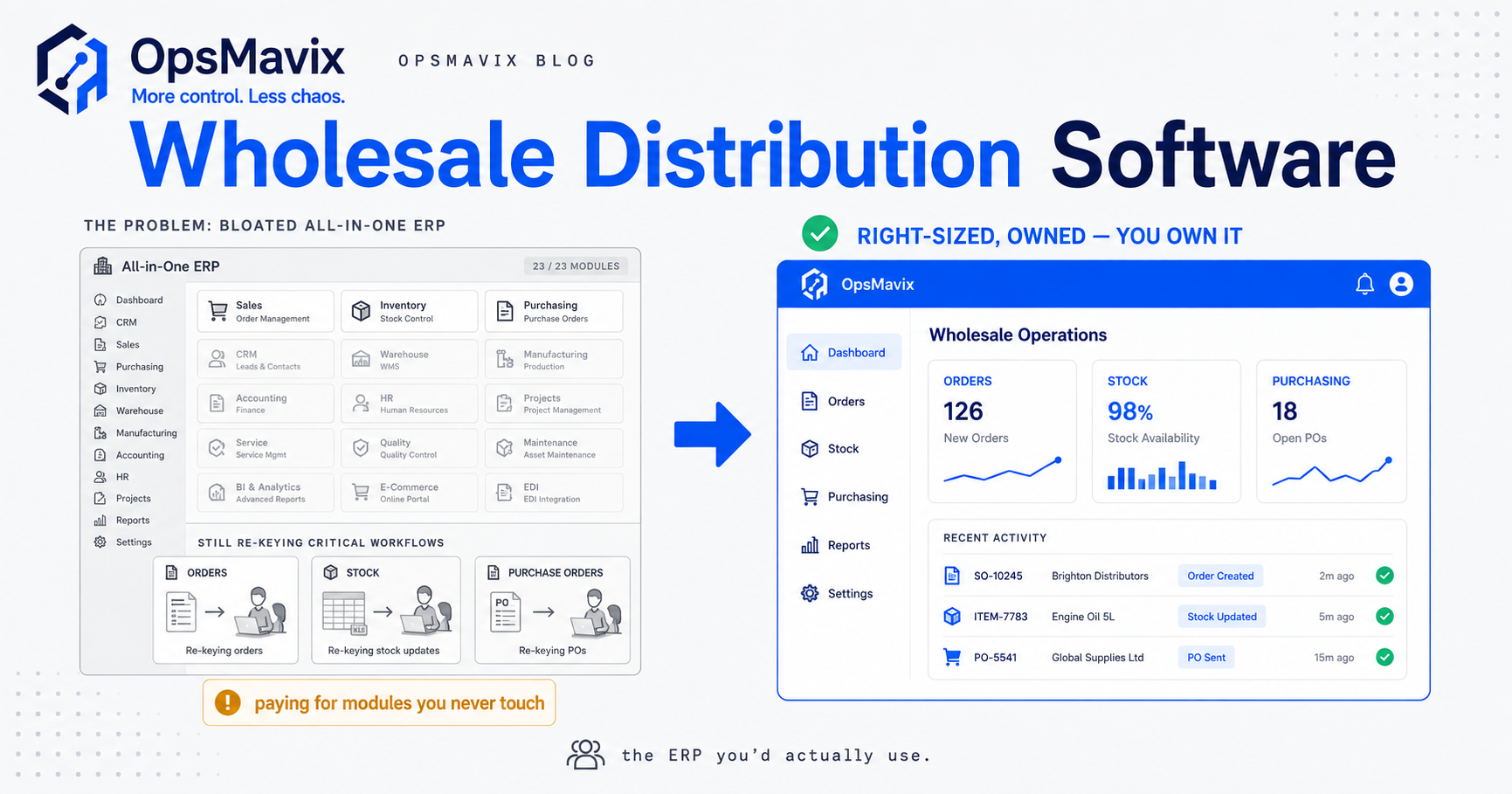
Wholesale distribution software is the system that runs the messy middle of a distribution business — the stock, the orders, the purchasing, the picking, and the reporting that sits between your suppliers and your customers. Get it right and the whole operation feels calm: you know what you hold, what is promised, and what is late. Get it wrong and you are back to spreadsheets, WhatsApp threads, and a warehouse manager who is the only person who actually knows where anything is.
Quick summary: The UK’s Wholesale and Retail Trade sector is enormous but runs on thin margins and manual admin — it accounts for 32% of all SME turnover in the UK, more than any other sector (GOV.UK, Business Population Estimates 2025). When margins are that tight, the wrong software — over-priced, over-featured, and rented forever — quietly eats the profit you are working so hard to protect.
Contents
- What wholesale distribution software actually has to do
- The trap: bloated generic platforms sold to businesses that don’t need them
- All-in-one ERP vs a right-sized owned system
- The core modules that matter (and the ones that don’t)
- Worked example: a £4m wholesaler stuck between spreadsheets and ERP
- How to choose without getting oversold
- FAQ
- How OpsMavix Can Help
- Sources
What wholesale distribution software actually has to do {#what-it-has-to-do}
Strip away the marketing and a wholesale or distribution business needs its software to answer a handful of unglamorous questions, reliably, every hour of the working day:
- What do we hold, and where? Real stock levels across every location, bin, or van — not last week’s count.
- What is promised but not yet shipped? Committed stock against open sales orders, so you stop selling the same units twice.
- What do we need to buy, and when? Reorder points, lead times, and purchase orders that reflect real demand, not gut feel.
- How does an order flow from quote to cash? Sales order, pick, pack, dispatch, invoice — with nothing falling between the cracks.
- What is the truth right now? One reporting layer your team trusts, instead of five spreadsheets that disagree.
That is genuinely it. Everything else a vendor bolts on — MRP for factories, multi-currency consolidation, demand-forecasting AI, a built-in CRM you will never configure — is either a nice-to-have or someone else’s problem. The discipline is knowing the difference. A tight operations control system is one that does the five things above brilliantly and resists the temptation to do forty things badly.
The failure mode is almost never “the software couldn’t do it.” It is “the software could do it, but nobody set it up, so the team went back to the spreadsheet.” Capability you don’t use is not a feature. It is weight.
The trap: bloated generic platforms sold to businesses that don’t need them {#the-trap}
Here is the pattern we see again and again with growing UK wholesalers. You outgrow spreadsheets. You go looking for “wholesale distribution software.” You end up in a sales cycle with a large ERP or supply-chain platform, and the demo is genuinely impressive — because it shows you a version of your business ten times bigger than the one you actually run.
Then the numbers arrive: per-user monthly licences, an implementation partner, mandatory modules you didn’t ask for, and a contract that renews forever. You are now paying enterprise prices for a distribution business turning over a few million pounds. And because the platform is generic, it is built to fit everyone, which means it fits no one without a small fortune in configuration.
Three things go wrong with the bloated-platform route:
- You rent it forever. The licence never stops. Every new hire is another seat. You could spend more over five years on subscriptions than the whole system was worth.
- You don’t own it. Your processes, your data model, your workflow logic — all live inside someone else’s product roadmap. If they change pricing, deprecate a feature, or get acquired, you inherit the consequences.
- You use maybe 20% of it. The rest is surface area: menus, modules, and settings that confuse your team and slow every task down. Complexity is not sophistication. For a wholesaler, it is friction.
The uncomfortable truth is that most distribution businesses in the “too messy for spreadsheets, not ready for a full ERP” band are being sold a full ERP anyway — because that is what the vendors have to sell. The right answer is usually smaller, cheaper, and owned.
All-in-one ERP vs a right-sized owned system {#comparison}
The choice is not “cheap and limited” versus “expensive and powerful.” It is “generic, rented, and heavy” versus “fitted, owned, and lean.” Here is the honest comparison for a growing UK wholesaler or distributor:
| Dimension | All-in-one wholesale/distribution ERP | Right-sized owned system |
|---|---|---|
| What it is | A large generic platform covering finance, MRP, CRM, HR, warehouse, and more | A focused system built around your actual order-to-cash and stock flow |
| Fit | You adapt your processes to the software | The software is shaped to your processes |
| Cost model | Per-user monthly licences + implementation partner, forever | Build cost once, then low running costs; you own the asset |
| Ownership | Vendor owns the product, roadmap, and often your data | You own the system, the data, and the logic |
| Time to value | Months of configuration before it earns its keep | Weeks to a working core that solves the loudest problem first |
| Feature use | Often ~20% used; the rest is friction | Close to 100% used; nothing you don’t need |
| Change requests | Raised as tickets, priced by the vendor, queued | Changed directly because it’s your system |
| Team adoption | Steep — training on features you’ll never use | Fast — it mirrors how the team already works |
| Risk | Lock-in; pricing and roadmap out of your control | You hold the keys; no forced renewals or surprise deprecations |
Neither column is “always right.” If you are a 500-person distributor with international finance consolidation, an enterprise ERP may genuinely be the correct tool. But if you are a £2m–£15m UK wholesaler drowning in spreadsheets, the right-sized owned system almost always wins on cost, speed, and — crucially — on whether your team actually uses it.
This is the OpsMavix position, stated plainly: we build right-sized, owned operations systems for growing product businesses, instead of selling you a platform that overshoots your operation and rents you the excess.
The core modules that matter (and the ones that don’t) {#core-modules}
If you are scoping wholesale distribution software, here is what to insist on — and what to be suspicious of.
Inventory and stock control (non-negotiable)
This is the spine. You need accurate, real-time stock across every location, with committed-versus-available visibility so you never promise units you have already sold. If you run more than one site, van, or storeroom, multi-location inventory management is where most of the pain lives — and where a fitted system pays for itself fastest. Watch for reorder points, low-stock alerts, and stocktake tools that a real warehouse person can actually operate.
Sales order and order management (non-negotiable)
The order-to-cash flow — quote, sales order, pick, pack, dispatch, invoice — has to be one clean pipeline with a clear status on every order. This is the difference between “where’s my delivery?” being a two-second lookup versus a twenty-minute investigation. A proper purchase order software layer sits alongside it so buying is driven by real commitments, not guesswork.
Overselling protection (quietly the most valuable)
The single most expensive everyday failure in wholesale is selling stock you don’t have. It burns customer trust, triggers refunds, and wrecks your reputation on marketplaces. Any serious system should make overselling structurally hard — reserving stock the moment an order lands. We wrote a full breakdown on how to prevent overselling because it is that common and that damaging.
Purchasing and supplier management (important)
Lead times, supplier prices, minimum order quantities, and reorder logic. Nothing exotic — just reliable. This is also where the wider supply chain management software conversation starts, but be careful: you rarely need a full supply-chain suite to run good purchasing. You need clean data and sensible rules.
The modules to be suspicious of
- Built-in CRM you will never configure — you probably already have a way to manage customers.
- MRP / bill-of-materials unless you actually manufacture. Distributors buy and resell; they don’t need factory planning.
- Demand-forecasting AI sold as a headline feature. Useful at scale, noise at £3m turnover with 400 SKUs.
- Full financial consolidation — your accountant and accounting package usually have this covered.
Every one of those is a legitimate tool for the right business. The trap is paying for all of them because they came bundled, then carrying the complexity forever.
Worked example: a £4m wholesaler stuck between spreadsheets and ERP {#worked-example}
Let’s make this concrete with a realistic (illustrative) scenario.
A UK homeware wholesaler turns over roughly £4m a year. They hold around 600 SKUs across a main warehouse and a small overflow unit. Orders come from a trade website, phone, and email. Stock lives in a master spreadsheet that two people update — usually. Overselling happens a few times a month, each time costing an apology, a refund, and sometimes a lost account.
They get two quotes:
Option A — all-in-one distribution ERP. Per-user monthly licences across eight users, plus an implementation partner to configure it, plus mandatory modules for finance and CRM they don’t need. The commitment is a multi-year contract with a recurring monthly bill that only grows as they hire. The demo is dazzling. The reality is a four-month rollout, heavy training, and a team quietly resisting the new tool.
Option B — a right-sized owned system. A focused build covering exactly their flow: real-time multi-location stock, committed-vs-available visibility, a clean sales-order pipeline, reorder alerts, and overselling protection that reserves stock on order. Built as an asset they own, with low running costs after the build, and changed directly whenever their process changes.
The decision isn’t only about the sticker price. It’s about three things:
- Total cost over five years. Rented licences compound. An owned system has a build cost, then modest running costs. Over five years, the owned route is very often the cheaper one — while the ERP bill keeps climbing with every seat.
- Adoption. The fitted system mirrors how the team already works, so people actually use it. The generic platform asks the team to learn forty features to use five.
- The loudest problem, solved first. The overselling leak — the thing costing real customers — gets fixed in weeks, not after a four-month configuration project.
We are not going to invent numbers for the savings, because your figures depend on your SKUs, your order volume, and your current mess. But the shape is consistent: right-sized and owned beats generic and rented for most businesses in this band, on cost and on whether the thing gets used at all.
How to choose without getting oversold {#how-to-choose}
A practical checklist for scoping wholesale distribution software as a growing UK business:
- Start from your five questions, not the vendor’s feature list. If a demo dazzles you with things you’ll never touch, that is a warning, not a selling point.
- Count the modules you’d actually use. If it’s a small fraction of what you’re paying for, you’re buying weight.
- Model five-year cost, not month one. Per-user licences look cheap until you add users and multiply by sixty months.
- Ask who owns the data and the logic. If the answer is “the vendor,” understand what happens if their pricing or roadmap changes.
- Insist on adoption evidence. The best system is the one your warehouse and office staff will genuinely use. Complexity kills adoption.
- Fix the loudest leak first. You don’t need everything on day one. You need the thing that’s costing you customers and hours fixed fast, then build from there.
- Beware the “future-proofing” pitch. Buying enterprise scale you don’t need “in case you grow” usually just means paying for empty capacity for years.
The goal is not the most powerful software. It is the smallest system that solves your real problems — one you own, that your team uses, that grows with you rather than billing you for growth you haven’t had yet.
FAQ {#faq}
What is wholesale distribution software?
It’s the system a wholesaler or distributor uses to manage stock, sales orders, purchasing, picking and dispatch, and operational reporting — the whole flow between suppliers and customers. Good software makes stock levels, order status, and reorder needs instantly visible so the business runs on facts instead of spreadsheets and memory.
Do I need a full ERP for my distribution business?
Usually not, if you’re a growing UK wholesaler in the few-million-pound range. Full ERPs bundle finance, MRP, HR, and CRM you often don’t need, sold on per-user licences forever. Most businesses in the “too messy for spreadsheets, not ready for full ERP” band are better served by a right-sized system focused on stock and order-to-cash — one they own rather than rent.
How much does wholesale distribution software cost?
It varies enormously, so be wary of anyone quoting a figure without seeing your operation. All-in-one ERPs typically charge recurring per-user monthly licences plus implementation, which compounds as you hire. A right-sized owned system is usually a build cost once, then low running costs — so the honest answer is “model five years, not one month,” and get your leaks mapped before you buy anything.
What’s the difference between an owned system and a subscription platform?
A subscription platform is rented: you pay per user every month, the vendor owns the product and roadmap, and you adapt your processes to fit it. An owned system is an asset you commission and keep: the data, the logic, and the workflow are yours, built around how you actually work, with running costs instead of ever-growing licences.
How do I stop my software overselling stock?
Insist that the system reserves stock the moment an order is placed and tracks committed-versus-available quantities across every location, so the same units can’t be sold twice. This is one of the most valuable protections in wholesale — see our guide on how to prevent overselling for the mechanics.
How OpsMavix Can Help {#how-opsmavix-can-help}
OpsMavix builds right-sized, owned operations systems for growing UK product businesses — wholesale, distribution, inventory, and ecommerce-with-stock — so you get exactly the system your operation needs instead of a bloated generic platform that overshoots it and rents you the excess. We start by finding where your stock, orders, and admin are actually leaking time and money, then build a focused system that fixes the loudest problem first and grows with you. Late payment alone costs the UK economy an estimated £11 billion a year; the point of a fitted system is to stop the quieter, everyday leaks before they add up the same way. If you’re weighing wholesale distribution software and don’t want to be oversold, start here: Book a Free Operations Leak Audit.
Sources
- GOV.UK — Business Population Estimates for the UK and regions 2025: statistical release
- GOV.UK — Late payments research: understanding variations in payment performance and practices across business sectors and sizes
- Office of the Small Business Commissioner
- Office for National Statistics — Non-financial business economy, UK (Annual Business Survey)