
Supply Chain Demand Planning Software: What It Does & Who Needs It
Supply chain demand planning software turns sales history and judgement into a forward view of demand, then converts that into replenishment signals, safety-stock levels and buy quantities. This explains what the software does, how it differs from a spreadsheet, and how a right-sized owned system delivers the planning that matters without a heavy enterprise suite.
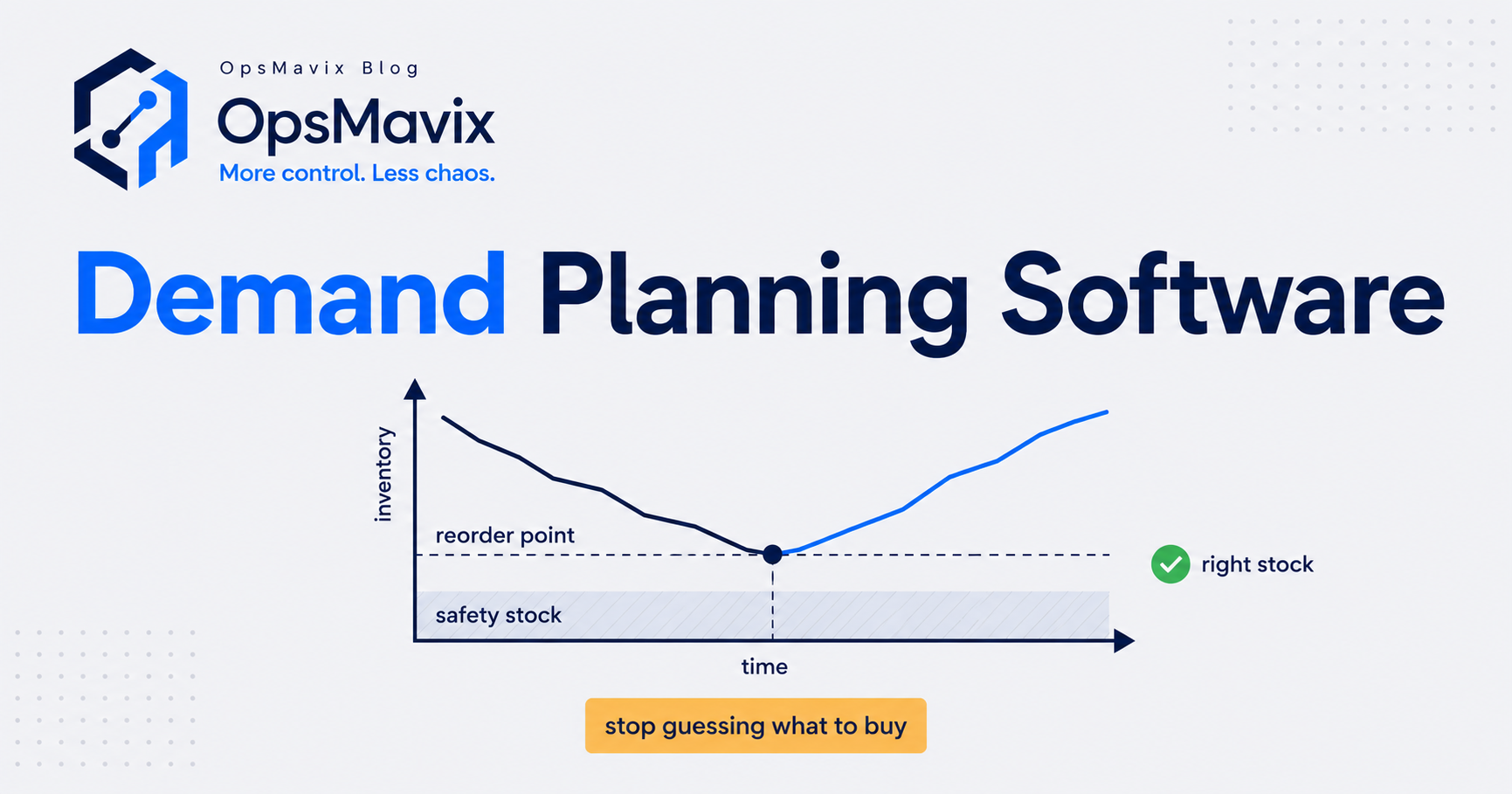
Supply chain demand planning software is a system that turns your sales history and human judgement into a forward view of demand, then converts that view into practical signals — what to reorder, how much safety stock to hold, and when to buy — so you carry the right stock instead of guessing. It sits between “what sold” and “what to buy next”, and its whole job is to make that link deliberate rather than reactive. It’s one function within the wider category of supply chain management software.
Quick summary: Demand planning is “the process of using forecasts to help highlight opportunities and threats; to tell us ahead of time what we expect sales of a product to be” (Institute of Business Forecasting). Good software does that continuously — statistical forecasting blended with human judgement, feeding safety stock, reorder points and the inputs to your S&OP meeting — so you cut both stockouts and overstock instead of trading one for the other.
Contents
- What demand planning software actually does
- Demand planning vs demand forecasting vs supply planning
- Statistical forecast plus human judgement
- From forecast to replenishment signals
- Safety stock: the buffer the forecast can’t remove
- Feeding S&OP: one set of numbers
- Why a spreadsheet stops coping
- Spreadsheet vs demand planning software vs full suite
- Worked example: reducing stockouts and overstock at once
- Who actually needs this (and who doesn’t yet)
- The right-sized alternative to a heavy suite
- FAQ
What demand planning software actually does
Strip away the vendor language and the software does four jobs, in order:
- Builds a demand forecast for each product (or product family), usually from sales history plus known future events — promotions, seasonality, a new customer, a discontinued line.
- Lets a human correct it. The statistical model doesn’t know you’re losing a big account next quarter; the planner does. The software captures that override and keeps a record of it.
- Turns the agreed forecast into stock decisions — reorder points, order quantities, safety stock and a projected stock position over the coming weeks.
- Flags the exceptions — the SKUs about to stock out, the ones drowning in cover, the forecasts that keep missing — so a planner spends time on the 20 items that matter, not the 2,000 that are fine.
That fourth job — management by exception — is what separates a planning system from a report. A spreadsheet shows you everything equally. A planning system tells you where to look.
Demand planning vs demand forecasting vs supply planning
These three get used interchangeably and shouldn’t be.
Demand forecasting is the narrow, quantitative step: producing a number for expected demand. Demand planning is the wider process wrapped around it — reviewing that number, applying judgement, agreeing it across sales and operations, and using it to drive decisions. Supply planning is the other side of the fence: deciding how to meet the demand you’ve planned for, through purchasing, production and inventory.
The Association for Supply Chain Management frames the split cleanly: demand planning focuses on forecasting customer needs, while supply planning “addresses managing inventory to meet those forecasted needs”, and the two are “separate processes” that have to be coordinated (ASCM). Demand planning software lives on the demand side but produces the numbers the supply side runs on. If you want the fundamentals of the forecasting step itself, see our guide to demand forecasting for a small business.
Statistical forecast plus human judgement
The defining feature of real demand planning — and the thing a bare forecast lacks — is that it deliberately combines two sources: a model and a person.
The statistical side reads history: trend, seasonality, average level, and how noisy the item is. It’s good at steady, repeating patterns and hopeless at anything it hasn’t seen. The judgement side fills that gap: a planner who knows a promotion is coming, a competitor has just gone bust, or a product is being phased out adjusts the number and, crucially, records why.
This blend is the standard definition of the discipline, not an optional extra. Good software makes the override cheap and auditable — you can see the baseline the model produced, the human adjustment, and the reason — so when the forecast is wrong you can learn which half failed. That feedback loop is impossible in a spreadsheet where last month’s assumptions have been typed over and lost. For the short-horizon version of this in practice, see our short-term demand forecasting example.
From forecast to replenishment signals
A forecast on its own changes nothing. The value appears when it becomes a signal — a specific instruction to buy or make something.
Demand planning software does this by projecting your stock position forward: it takes current on-hand, subtracts forecast demand week by week, adds expected deliveries, and watches for the point where projected stock drops through a threshold. That threshold is the reorder point — the level at which you place an order so replenishment arrives before you run out, accounting for supplier lead time. Set it from demand and lead time rather than a gut-feel round number and the whole thing becomes mechanical. Our reorder point system guide covers the arithmetic.
The software then attaches a quantity to the signal — an economic order quantity, a fixed batch, a “top up to target” figure, or a minimum-order-quantity constraint from the supplier — so the planner gets a proposed purchase order, not just an alert. In a mature setup this connects to the same logic an MRP system uses to explode demand down through a bill of materials, so a spike in finished-goods demand pulls component orders automatically.
Safety stock: the buffer the forecast can’t remove
No forecast is exactly right, and no supplier is perfectly on time. Safety stock is the buffer that absorbs both — the cushion that keeps you serving customers on the days demand runs hot or a delivery slips.
Demand planning software calculates safety stock from the variability it can measure: how much demand swings around the forecast, how unreliable lead times are, and the service level you’ve chosen to hit (a 95% service level needs more buffer than 90%). Set it deliberately and you hold enough to protect sales without freezing cash in stock you’ll never sell in time. Set it by feel — “keep about a month’s worth” across the board — and you overstock the steady items and underprotect the volatile ones simultaneously. The safety stock calculation guide walks through the method; the point here is that a planning system recalculates it as demand and lead times change, instead of leaving a number someone set two years ago.
Feeding S&OP: one set of numbers
Sales and operations planning (S&OP) is the monthly meeting where sales, operations and finance agree a single plan. It only works if everyone argues from the same demand number — otherwise sales forecasts optimism, operations plans for caution, and finance uses last year plus ten percent.
Demand planning software is where that shared number comes from. It produces the consensus demand plan that becomes the demand input to S&OP, so the meeting is about decisions — capacity, cash, priorities — not about whose spreadsheet is right. CIPS describes S&OP as the process that integrates demand forecasting with supply planning to “balance demand with available resources”, bringing sales, capacity, inventory and budgets onto the same assumptions (CIPS). Without a system, most SMBs never get there: the numbers are too scattered to agree on. That’s the real prize of the software — not a prettier forecast, but a meeting that ends in a decision.
Why a spreadsheet stops coping
Spreadsheets are where almost every business starts, and for a single planner with a few dozen lines they’re fine. They stop coping for specific, predictable reasons:
- No memory. Overwrite last month’s forecast and the assumption behind it is gone. You can’t measure forecast accuracy because you no longer have the forecast.
- No exceptions. Every SKU looks the same on the grid. Finding the twelve about to stock out means scanning thousands of rows by eye.
- Manual recalculation. Safety stock and reorder points don’t update themselves. When lead times change, someone has to remember to redo the maths — and usually doesn’t.
- One brain. The logic lives in one person’s head and one fragile file. When they’re on holiday, planning stops. When they leave, it’s gone.
- No link to action. The spreadsheet says “reorder”; someone still has to key the PO into another system, and the two drift apart.
None of this means spreadsheets are bad — it means they’re a modelling tool, not an operating system. The moment planning needs to happen every week, across hundreds of lines, by more than one person, the spreadsheet becomes the bottleneck it was meant to remove.
Spreadsheet vs demand planning software vs full suite
The honest comparison isn’t “spreadsheet bad, software good”. It’s three options with different costs and fit.
| Capability | Spreadsheet | Right-sized planning system | Full enterprise suite |
|---|---|---|---|
| Statistical forecast + judgement override | Manual, not retained | Yes, with audit trail | Yes, advanced |
| Auto reorder points / safety stock | Manual, static | Yes, recalculated | Yes |
| Exception flagging | None | Yes | Yes |
| Feeds S&OP with one agreed number | Hard | Yes | Yes |
| Multi-user, survives staff turnover | No | Yes | Yes |
| Setup time | Hours | Weeks | 6–18 months |
| Typical cost | Low | Mid | High + ongoing licences |
| Fits a “too messy for spreadsheets, not ready for ERP” SMB | Outgrown | Yes | Overkill |
The suite column isn’t wrong — it’s just aimed at a bigger, more complex business than most SMBs are. Paying for capability you can’t use, and a year-long implementation you can’t staff, is its own kind of waste.
Worked example: reducing stockouts and overstock at once
Numbers below are illustrative, to show the mechanism — not a client result.
A wholesaler holds 600 SKUs and plans in a spreadsheet. Two symptoms run side by side: their best-sellers stock out roughly twice a quarter (lost sales, annoyed customers), while total stock value keeps climbing because slow lines get reordered on the same “safe” rule as everything else.
They move to a right-sized planning system. Three things change:
- Forecasts get per-SKU treatment. Fast, steady lines get tight reorder points and modest safety stock. Volatile lines get more buffer. The blanket “hold a month” rule dies.
- Reorder signals fire on projected stock, not memory. The system watches on-hand minus forecast plus incoming and raises a proposed PO at the reorder point — so the best-sellers stop running dry.
- Slow movers surface as exceptions. Lines with months of cover get flagged for review instead of quietly reordering.
The mechanism is the point: the same system that raises protection on the volatile fast-movers lowers it on the slow ones. Stockouts and overstock aren’t a trade-off you split the difference on — they’re two failures of the same missing calculation, and one system fixes both because it treats each SKU on its own numbers instead of one rule for all.
Who actually needs this (and who doesn’t yet)
You probably need demand planning software if:
- you carry enough SKUs that no one can hold the picture in their head;
- stockouts and overstock happen at the same time, which means your rules aren’t SKU-specific;
- planning depends on one person and one spreadsheet;
- you want an S&OP process but can’t get everyone onto one number.
You probably don’t need it yet if you have a handful of stable lines, predictable demand and a planner who genuinely has it under control. Don’t buy a system to solve a problem you don’t have — the spreadsheet is fine until it visibly isn’t.
And you don’t need a full enterprise suite just because you’ve outgrown the spreadsheet. That’s the gap most SMBs fall into: told their only options are a spreadsheet or a six-figure ERP, they either limp on or overbuy. There’s a middle.
The right-sized alternative to a heavy suite
OpsMavix isn’t a supply chain software vendor and this isn’t a pitch for a product. The point is the shape of the solution: for most SMBs, the planning that matters is a focused slice — reliable forecasts, SKU-specific reorder points and safety stock, exception flags, and one agreed demand number for the S&OP meeting. That slice is deliverable as an owned system built on your data and your rules, without the cost, licence lock-in and year-long rollout of a full suite.
Owned matters. A system built around how you actually plan — your lead times, your suppliers, your seasonality — sits inside the inventory automation you already run, rather than forcing your process to bend to someone else’s software. You get the planning outcomes without the enterprise overhead, and you keep the thing you paid for.
FAQ
What is the difference between demand planning and demand forecasting?
Forecasting is the narrow step of producing a number for expected demand. Demand planning is the wider process around it — reviewing that number, applying human judgement, agreeing it across sales and operations, and using it to drive reorder points, safety stock and purchasing. Forecasting feeds planning; planning drives action.
Do I need demand planning software or is a spreadsheet enough?
A spreadsheet is fine for a few stable lines and one planner. You’ve outgrown it when you can’t measure forecast accuracy (because old forecasts get overwritten), can’t spot the SKUs about to stock out without scanning every row, or the whole thing lives in one person’s head. At that point the spreadsheet is the bottleneck, not the tool.
How does demand planning software reduce both stockouts and overstock?
It treats each SKU on its own numbers instead of one blanket rule. Volatile fast-movers get more protection so they stop running dry; slow movers get less so cash isn’t frozen in stock. Stockouts and overstock are two symptoms of the same missing per-SKU calculation, so fixing the calculation improves both at once.
What does demand planning have to do with S&OP?
Sales and operations planning needs everyone arguing from one demand number. Demand planning software produces that agreed number — the consensus demand plan — so the S&OP meeting is about decisions on capacity, cash and priorities rather than about whose spreadsheet is correct.
Isn’t this just what an ERP does?
A full ERP or enterprise suite includes planning, but it’s aimed at larger, more complex businesses and comes with the cost and implementation to match. Most SMBs need a focused slice — forecasts, reorder points, safety stock, exceptions and an S&OP input — which can be delivered as a right-sized owned system without the whole suite.
How OpsMavix Can Help
OpsMavix builds right-sized, owned operations systems for businesses that are too messy for spreadsheets but not ready for a full ERP. We don’t sell supply chain software and we don’t hand you generic code — we build the specific planning capability that changes your numbers: SKU-level forecasts blended with your team’s judgement, reorder points and safety stock that recalculate as conditions change, exception flags so planners work the items that matter, and one agreed demand number to run your S&OP on. It sits inside the inventory and operations systems you already use, it’s yours to keep, and it comes with a delivery guarantee. Start by finding out where your demand decisions actually leak. Book a Free Operations Leak Audit.
Sources
- Institute of Business Forecasting — What Is Demand Planning? — https://ibf.org/knowledge/posts/what-is-demand-planning-and-why-is-it-valuable-42
- Institute of Business Forecasting — What Is Sales & Operations Planning (S&OP)? — https://ibf.org/knowledge/glossary/sales-and-operations-planning-sop-240
- Association for Supply Chain Management (ASCM) — Demand Planning vs. Supply Planning — https://www.ascm.org/topics/demand-supply-planning/
- CIPS — How to do Demand Forecasting in the Supply Chain — https://www.cips.org/intelligence-hub/operations-management/demand-forecasting