
Purchase Order System for Small Business: Control Without ERP
A purchase order system for small business gets buying off email and spreadsheets — POs raised properly, approvals routed, and every invoice matched to its order and delivery before a penny leaves. This guide shows why the answer is usually a right-sized owned system, not a bloated procurement suite, for a business too messy for spreadsheets, not ready for a full ERP.
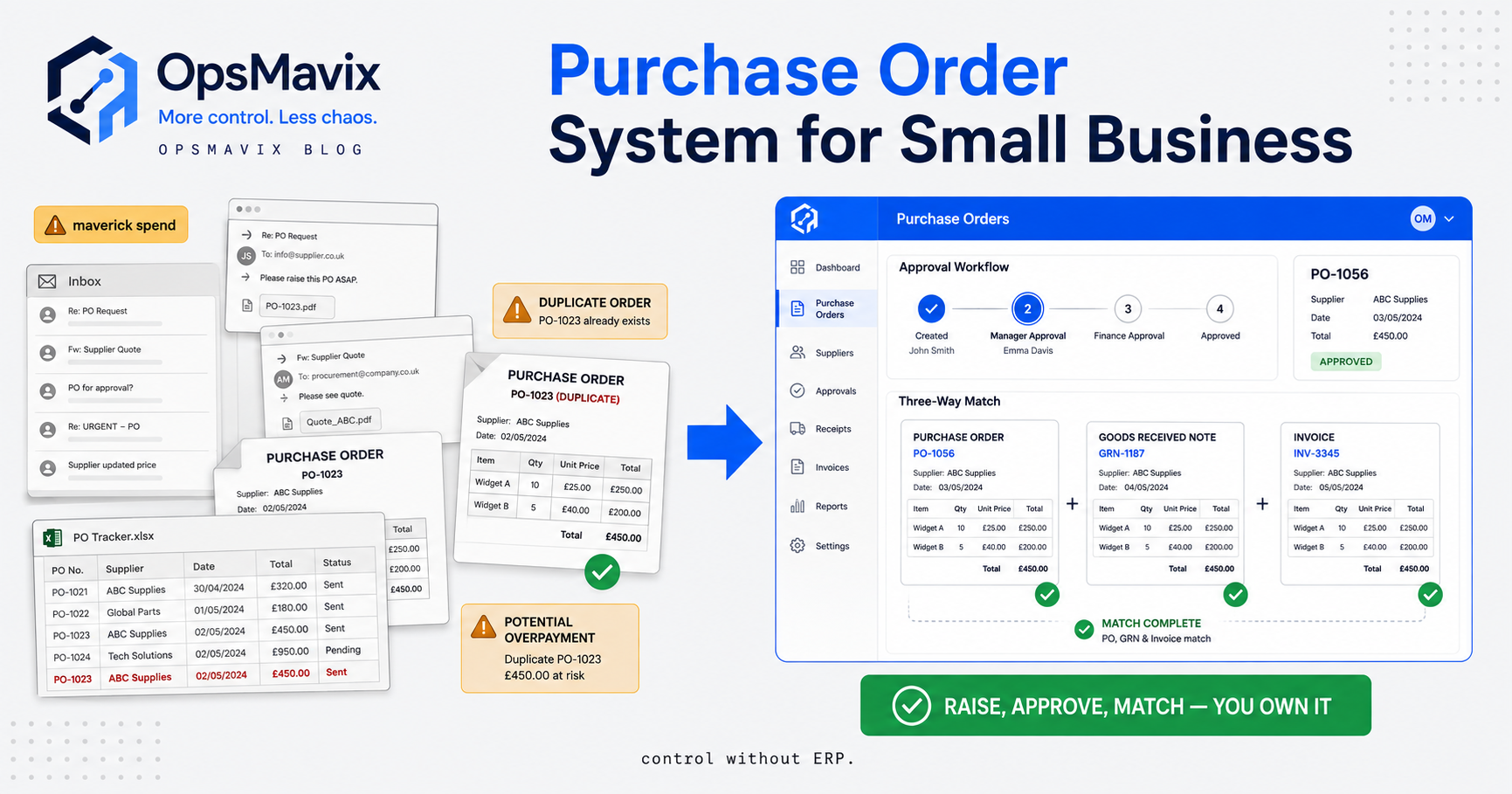
A purchase order system for small business is the software layer that controls how your company commits to spend — it raises a purchase order before an order is placed, routes it for approval against a budget, records what actually arrived, and checks the supplier’s invoice against both before it gets paid. Put plainly, it turns buying from a series of favours in an inbox into a controlled process where every pound committed is visible, approved, and reconciled against what you received.
Most small businesses don’t have this. Buying happens over email, WhatsApp and a spreadsheet someone updates when they remember. A manager tells a supplier “yes, send it” on a call; the PO number, if one exists at all, gets typed into an invoice weeks later to make the paperwork look tidy. Nobody can see the full commitment against a budget until the invoices land, by which point the money is already spent. A purchase order system replaces that fog with a single record: raise, approve, receive, match, pay — each step logged, each figure checkable, no commitment made in the dark.
Quick summary: Uncontrolled off-process buying — “maverick spend” — quietly erodes margin because it dodges negotiated prices and approvals. Research from The Hackett Group found organisations can lose up to 16% of negotiated savings when staff buy from unapproved suppliers outside the process. That is the exact leak a purchase order system closes: it makes the approved route the only route, so the discounts you negotiated actually get used instead of bypassed. This guide covers what a small-business PO system does, what the no-control version really costs, and why the right answer is usually a right-sized owned system rather than a full ERP or a heavyweight procure-to-pay suite.
Contents
- What a small-business purchase order system actually does
- The real cost of buying with no control
- Three-way matching: the check that stops overpayment
- Off-the-shelf vs full ERP vs right-sized owned
- Email and spreadsheets vs a P2P suite vs an owned system
- A worked example: the invoice that got paid twice
- Why “owned” matters for a system that guards your cash
- FAQ
- How OpsMavix Can Help
- Sources
What a small-business purchase order system actually does {#what-it-does}
Strip away the jargon and a PO system does one thing: it controls the moment your business commits money to a supplier, and everything that follows from it. That control breaks into five jobs, and a system worth having does all five without ceremony.
Raise a purchase order. Before an order goes to a supplier, someone creates a PO — supplier, items, quantities, agreed prices, delivery date, and the budget or job it belongs to. This is the point most small businesses skip, and skipping it is the root of nearly every downstream mess. A PO is not paperwork; it is the record of exactly what you agreed to buy, created before the buying, so there is something true to check the delivery and the invoice against later.
Route it for approval. The PO goes to whoever is allowed to approve that spend — often by value, so a £200 stationery order and a £15,000 machine part don’t need the same signature. Approval is recorded against a named person and a timestamp, so there is never a question of who authorised what. Done well, this is fast: an approver sees what they’re approving and clicks once. Done badly, it’s the reason people stop raising POs at all.
Check it against a budget. A good system shows committed spend, not just spent spend. The £15,000 part is committed the moment the PO is approved, even though the invoice won’t arrive for weeks — so the budget reflects reality as decisions are made, not a month later when it’s too late to change them. This is the single biggest thing a spreadsheet cannot do: a spreadsheet only knows what’s already been paid.
Receive against the order. When goods or services arrive, someone records what actually turned up — a goods-received note (GRN) — against the specific PO. Ordered 100, received 90? The system knows there’s a 10-unit shortfall before the invoice for 100 arrives. This receiving step is what turns “we think it came” into a fact the payment can be checked against.
Match and release for payment. The supplier’s invoice is checked against the PO (did we agree this price and quantity?) and the GRN (did we actually receive it?). If all three agree, it’s cleared to pay. If they don’t, it’s flagged and held. This is three-way matching, and it is the mechanism that stops you paying for things you didn’t order, didn’t receive, or already paid for. It connects directly to your invoice approval workflow — the PO system is what gives the approval step something objective to check against, instead of a manager squinting at an invoice trying to remember whether it looks right.
None of this is exotic — no AI, no dashboard you’ll never open, just five controls done reliably. That’s the tell for the whole category: the value of a purchase order system is unglamorous discipline applied consistently, and most businesses overpay for it because they get sold a platform when they needed a process.
The real cost of buying with no control {#cost-of-no-control}
The reason “we’ll just email suppliers” feels fine is that the cost of no control never arrives as a single bill. It arrives as a dozen small leaks that never appear as errors in any system — they surface only as a margin thinner than it should be and a bank balance that never quite matches the plan. Here’s where the money actually goes.
- Maverick spend. With no enforced route, people buy from whoever’s convenient at whatever price is quoted — bypassing the supplier you negotiated a better rate with, and quietly giving back a discount you already earned.
- Duplicate and over-payments. With no PO to match against, the same invoice gets paid twice, or an invoice for 100 units gets paid when only 90 arrived. Nobody’s careless — there’s simply no check to catch it.
- Missing goods, paid anyway. Without a receiving step, an invoice gets approved because it “looks right” and the manager assumes the delivery came. Short deliveries and never-arrived orders get paid in full because nothing compared the invoice to reality.
- No commitment visibility. Because only paid invoices show up, the budget looks healthy right up until three approved-but-uninvoiced orders land at once and blow it.
- Price creep nobody catches. A supplier nudges the unit price up 8% and it gets paid because there’s no agreed PO price to check against. Across a year and dozens of lines, that’s real money leaving silently.
The uncomfortable part is that a business can run like this for years and never see the total, because the losses are spread across headcount, time and error correction rather than appearing as one line item. It’s invisible until you put a control in front of it and watch what it catches in the first month.
Three-way matching: the check that stops overpayment {#three-way-matching}
If there’s one mechanism that justifies a PO system on its own, it’s three-way matching — because it’s the control that stops money leaving for things you didn’t order, didn’t receive, or already paid for. It’s worth understanding precisely, because it’s the heart of the whole thing.
Three-way matching compares three documents before any invoice is paid:
- The purchase order — what you agreed to buy, at what price and quantity, before the order was placed.
- The goods-received note (GRN) — what actually arrived, recorded at the door.
- The supplier invoice — what you’re being asked to pay.
The rule is simple: the invoice only gets paid if it agrees with both the PO and the GRN. Invoiced for a price higher than the PO? Held. Invoiced for 100 when the GRN says 90 arrived? Held. An invoice for a PO that already has a matched invoice against it? Held — that’s a duplicate caught before payment, not recovered painfully after.
The catch, and the reason so many businesses skip it, is that three-way matching only works if the two upstream steps are done honestly. If nobody raises a proper PO, there’s nothing to match the price against. If receiving is a rubber-stamp — “book roughly what the note says, days later” — the GRN is fiction and the match rubber-stamps a lie. So a PO system has to enforce the whole chain, not just the final check: get the raise and the receive right and the match becomes near-foolproof; skip either and it collapses into paperwork. For businesses holding stock, the receiving step that feeds three-way matching is the same event that should update stock — which is why a PO system and an inventory automation system are really two views of one controlled flow.
Off-the-shelf vs full ERP vs right-sized owned {#three-options}
So you’ve decided the inbox-and-spreadsheet approach is costing you. There are three real routes out, and choosing wrong is how small businesses end up either back where they started or paying for a platform ten times their size.
Off-the-shelf PO apps
The pitch: a cheap or free purchasing app you sign up for and start using this week. For the smallest, simplest operations these can genuinely be enough, and if one fits your process, use it. The trouble arrives as you grow: your approval rules, your budget structure, your job-costing, your supplier terms are all nearly what the app assumes but not quite — and because you can’t change the app, you change how you work to fit it. The tool that was meant to serve your process starts dictating it, and the one field or rule you actually need sits behind a feature request that never ships.
Full ERP and heavyweight procure-to-pay suites
The pitch: a single platform that does purchasing, finance, inventory, and everything else — “one system for the whole business.” For a genuinely large, complex operation, that breadth earns its keep. For a small business that needed controlled purchasing, it’s a size mismatch you pay for forever: months of configuration and consulting, a per-seat licence that never stops, modules you’ll never open priced in whether you touch them or not, and — the quiet killer — a process you now have to bend to fit the platform, because changing the platform costs a change request and a consultant’s invoice. The canonical trap is buying the system built for a 5,000-person firm because nothing was shaped like your 30-person one. This is the same mismatch we unpack in detail for operations management software — the pattern repeats across every operational area, not just purchasing.
Right-sized owned system
The pitch, honestly stated: a system scoped to exactly your raise → approve → receive → match flow, built to how you actually work, and handed to you to own outright. It fits from day one because it was built to fit — your approval thresholds, your budgets, your job codes, your suppliers. It has a build cost, then it’s a capability you keep rather than a licence that runs forever. There’s no surface you don’t use, because none was built. The honest caveat: it needs a builder who builds narrow and reliable rather than broad and fragile, and the goal is never to rebuild an ERP from scratch — that’s the same over-build error in a different costume. The goal is a focused control on your purchasing, built well, that’s yours. That’s the position for a business too messy for spreadsheets but not ready for a full ERP.
Email and spreadsheets vs a P2P suite vs an owned system {#comparison}
The three routes aren’t different amounts of the same thing — they’re different shapes. Here’s how they compare on the things that actually decide the outcome.
| Factor | Email + spreadsheets | Off-the-shelf P2P / full ERP | Right-sized owned system |
|---|---|---|---|
| PO raising | Ad hoc, often after the fact | Standardised, but to the tool’s template | Standardised to your fields and process |
| Approvals | A reply that says “ok” | Built-in workflow, fixed to their model | Built to your thresholds and roles |
| Budget check | Only visible once invoices land | Commitment tracking, if configured | Live committed-vs-budget from day one |
| Three-way match | Manual, if done at all | Supported, needs configuration to fit | Enforced on your exact flow |
| Fit to your process | You improvise around it | You bend your process to the tool | The tool is built to your process |
| Time to live | Already “live”, and leaking | Weeks to many months of setup | Weeks; built to fit, not configured into shape |
| Cost shape | Hidden, paid in leaks | Per-seat licence forever + implementation | One build cost; you own the result |
| Changes | Change the spreadsheet, break the audit trail | Change request → consultant → invoice → wait | A direct change to a system you control |
| Ownership | Yours but uncontrolled | Rented; stops when you stop paying | Owned outright, runs on your infrastructure |
The row that decides it is usually fit to your process. A P2P suite fits everyone approximately, which means it fits you approximately — and approximately is where the leaks live. An owned system fits exactly because it was built to, which is the whole point of building it.
A worked example: the invoice that got paid twice {#worked-example}
Consider Harrow & Vale Interiors, a fictional but typical 22-person furniture wholesaler in the Midlands turning over around £3.4m. Purchasing runs on email and a shared spreadsheet. Two people place orders; a third pays invoices; nobody raises formal POs.
The pain. A £6,800 order for oak table tops goes to a supplier by email. The supplier sends the invoice, then a fortnight later sends a statement with the same invoice on it, which accounts reads as a second bill and pays. £6,800 out the door twice. It surfaces three months later during a supplier reconciliation — recovering it takes weeks of emails and a credit note. Over the same year, a separate supplier’s unit price drifts up 9% across repeat orders, unnoticed because there’s no agreed PO price to check against; and a short delivery of 40 chairs against an invoice for 60 gets paid in full. None of it shows up as an error anywhere — it shows up as a margin that’s mysteriously thinner than the spreadsheet promised. This kind of leak isn’t rare or exotic: a March 2026 study by Xelix that analysed 481 million invoices found businesses lose around 0.35% of annual spend to preventable accounts-payable errors — duplicates, overpayments and missed credits — which across the market it put at £39 billion a year. On £3.4m of turnover, 0.35% is roughly £12,000 leaking annually, before you count the duplicate.
The over-buy temptation. Burned by the double payment, the owner books an ERP demo. The demo is impressive. The quote is £40,000 to implement plus a per-seat licence, four months of configuration, and a consultant to bend it to how the business runs. To stop a duplicate-payment leak and catch price creep, they’re being asked to buy — and then indefinitely rent — a platform built for a company ten times their size, and to change how they work to suit it.
The right-sized fix. Instead they commission a purchase order system scoped to exactly their flow: POs raised before every order with agreed prices, approval routed by value, live committed-spend against budget, receiving recorded at the door, and three-way matching that holds any invoice not agreeing with its PO and GRN. Built to their fields, their thresholds, their suppliers. Delivered in weeks, owned outright, no licence clock running.
The outcome. The duplicate payment becomes structurally impossible — a second invoice against an already-matched PO is held on sight. Price creep gets caught at the match, because every invoice is checked against an agreed PO price. Short deliveries are caught at receiving, before payment. The owner can see committed spend against budget as decisions are made, not weeks later. The leak that was quietly costing five figures a year is closed by a system that cost once and stays theirs.
Why “owned” matters for a system that guards your cash {#why-owned}
For a system whose entire job is controlling how money leaves your business, “owned” isn’t a slogan — it’s a set of concrete properties the rented route can’t offer.
- The control stays yours. Your approval rules, budgets and matching logic are how you keep spend disciplined — a real operational asset, living on your infrastructure and changeable by you, rather than a feature on someone else’s roadmap that could be repriced or deprecated.
- Changes are cheap and fast. When a new approval threshold or supplier rule is a direct change to a system you control rather than a request in a vendor’s queue, the control keeps fitting as you grow. Rented systems fit worse over time, because your process moves and theirs doesn’t.
- The bill stops. A build has a cost, then it’s a capability you keep. A per-seat licence never stops and scales with headcount whether the extra seats use the extra features or not — an odd trade for a control you’ll run for a decade.
The honest limit: an owned system needs a builder who’ll keep it narrow and reliable. Ask for a purchasing control, not a bootleg ERP — the restraint is what keeps a right-sized system right-sized.
FAQ {#faq}
What is a purchase order system for a small business?
It’s software that controls how your business commits and pays for spend. Before an order goes to a supplier, it raises a purchase order recording what you’re buying, at what price and quantity. It routes that PO for approval by value, tracks committed spend against a budget in real time, records what actually arrives against the order, and checks each supplier invoice against the PO and the delivery before it’s paid. The core job is making sure no money leaves for something that wasn’t ordered, wasn’t approved, wasn’t received, or was already paid for.
Do I need a full ERP to get purchase order control?
Usually not. A full ERP is built to fit every kind of business, so it includes far more than a purchasing control needs and costs accordingly — in licence, in months of configuration, and in bending your process to fit the tool. Many small businesses are too messy for spreadsheets but nowhere near the scale that justifies an ERP, and for them a right-sized system scoped to raise, approve, receive and match does the whole job at a fraction of the size and stays theirs to own.
What is three-way matching and why does it matter?
Three-way matching compares three documents before an invoice is paid: the purchase order (what you agreed to buy), the goods-received note (what actually arrived), and the supplier invoice (what you’re asked to pay). The invoice only clears if all three agree. It matters because it’s the specific mechanism that catches overcharges, short deliveries and duplicate invoices before payment rather than after — it’s the difference between preventing a leak and painfully recovering from one. It only works if proper POs are raised and deliveries are genuinely recorded, which is why the whole chain has to be enforced, not just the final check.
We’re small — isn’t a spreadsheet enough for purchase orders?
A spreadsheet can list orders, but it can’t do the two things that actually protect you: it can’t show committed spend before invoices land, and it can’t match a payment against an order and a delivery to stop overpayment. It also has no approval trail — anyone can change any figure and there’s no record. For a genuinely tiny, simple operation that might be tolerable. Once you have multiple people buying, real budgets, and suppliers whose prices and quantities need checking, the spreadsheet stops being a control and becomes the place the leaks hide.
How long does a right-sized purchase order system take to build?
Far less than a generic-platform implementation, because there’s nothing to configure into shape — it’s built to your flow from the start. Where a full ERP typically takes months of consulting to fit, a system scoped to your raise, approve, receive and match flow is a matter of weeks. The exact timeline depends on how many approval rules, budgets and suppliers are involved and how your current buying is recorded, which is what a scoping audit establishes before anything is built.
How OpsMavix Can Help {#how-opsmavix-can-help}
OpsMavix builds right-sized, owned operations systems for growing UK businesses — manufacturing, inventory and warehousing, wholesale and distribution, and services with real spend to control. We’re not an ERP vendor and we won’t sell you a platform built for a company ten times your size. We build the specific system that controls your purchasing — POs raised properly, approvals routed by value, live committed-spend against budget, receiving recorded at the door, and three-way matching that holds any invoice not agreeing with its order and delivery — so the leaks that cost you quietly today become structurally impossible, and we hand it to you to own outright. If you’re too messy for spreadsheets but not ready for a full ERP, that’s exactly the gap we build for. Start by seeing where your current buying actually leaks: Book a Free Operations Leak Audit.
Sources
- The Hackett Group (via Sievo) — organisations can lose up to 16% of negotiated savings to maverick spend: https://sievo.com/blog/maverick-spend
- Xelix — Financial Leakage Report 2026: businesses lose around 0.35% of annual spend to preventable AP errors (481 million invoices analysed; ~£39bn a year): https://xelix.com/resources/accounts-payable-insights/financial-leakage-report
- CFOtech UK — reporting on the Xelix financial leakage figures (£39bn a year): https://cfotech.co.uk/story/xelix-warns-ap-errors-leak-up-to-usd-53-billion-a-year