
ERP Software for the Manufacturing Industry: Do You Need It?
Full manufacturing ERP is powerful, expensive, and slow to land — and most SMB manufacturers do not need it yet. Here is how to tell whether you genuinely need one, and the right-sized owned alternative for firms too messy for spreadsheets, not ready for a full ERP.
ERP (Enterprise Resource Planning) software for the manufacturing industry is a single, integrated platform meant to run the whole business from one database — inventory, purchasing, production scheduling, quality, costing, sales orders, and finance. In manufacturing specifically, it usually adds MRP (material requirements planning), bills of materials, work orders, shop-floor tracking, and multi-site stock. The pitch is seductive: one system, one version of the truth, everything connected. For a large manufacturer with hundreds of staff and multiple plants, that is often exactly right.
The problem is that most growing SMB manufacturers get pushed toward full ERP long before they need it. The pain is real — spreadsheets that do not reconcile, stock counts nobody trusts, production plans living in someone’s head — so a salesperson quite reasonably answers “you need an ERP.” But the leap from a spreadsheet mess to a six-figure, multi-module ERP is enormous, and it is the wrong-sized answer for a lot of firms. This post is the even-handed version: what a manufacturing ERP actually does, the real cost and failure numbers, when you genuinely need one, and the right-sized owned middle path when you do not.
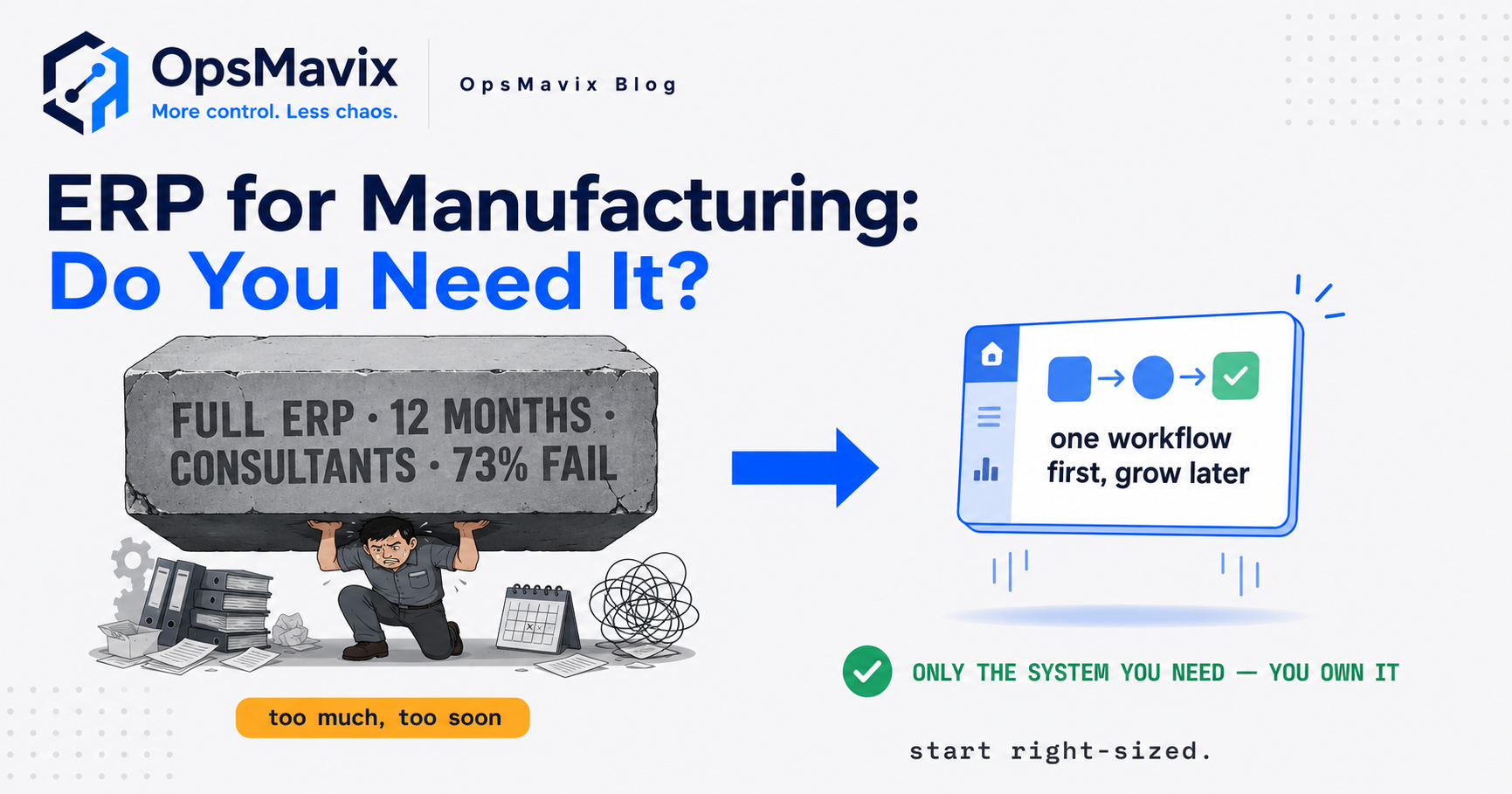
Quick summary: Full manufacturing ERP works, but it is high-risk for smaller firms. Panorama Consulting’s 2026 research found that 73% of discrete manufacturing ERP projects fail to meet their objectives, with average cost overruns reaching 215%. If you are a UK SMB manufacturer weighing an ERP quote, the honest answer is often “not yet” — start by owning the one workflow that is actually bleeding you, then grow toward ERP only if the business genuinely demands it.
Contents
- What a manufacturing ERP actually does
- The real cost, time and failure reality
- When you genuinely need a full ERP
- The “too much” trap for SMB manufacturers
- The right-sized owned middle path
- Spreadsheets vs full ERP vs owned system
- Worked example: a UK manufacturer weighs a quote
- FAQ
- How OpsMavix Can Help
- Sources
What a manufacturing ERP actually does {#what-it-does}
A full ERP tries to be the single system of record for the entire company. In a manufacturing context, the modules that matter most are:
- MRP and production planning — turning demand into material and capacity requirements, generating work orders and purchase suggestions.
- Bills of materials and routings — the recipe and the steps for every product you make.
- Shop-floor and work-order tracking — what is in progress, at which station, and how long it took.
- Inventory and warehouse — stock levels, locations, lot and serial traceability, multi-site transfers.
- Purchasing and supplier management — POs tied to demand, goods-in, supplier performance.
- Costing and finance — actual vs standard cost, margin per job, the general ledger.
- Sales and CRM — quotes, orders, and customer records feeding the same database.
The genuine value is integration. When a sales order flows straight into a production plan, which drives a purchase order, which updates stock, which posts a cost to finance — with no re-keying — you remove a whole class of errors and delays. That is a real prize. It is just an expensive and disruptive one to win, and you do not have to win all of it at once.
The real cost, time and failure reality {#the-reality}
Manufacturing ERP is one of the hardest software projects a business can take on. Before you sign anything, look at the published numbers rather than the sales deck.
The cost is not just the licence
For a UK small business (roughly 10–30 staff), a 2026 pricing guide puts realistic year-one ERP totals at £15,000 to £48,000, rising to £67,000–£200,000 for medium firms and £200,000–£500,000+ for larger ones. And the licence is the small part — implementation, data migration, training, and internal staff time typically dwarf the subscription. Data migration in particular is the cost almost everyone underestimates.
The time and disruption are real
Manufacturing implementations run long because they touch everything — MRP, BOMs, the shop floor, finance — and every one of those has to be configured to how you work. Go-live is rarely the end; the months after go-live are where operational disruption bites, because the whole company has switched systems at once.
The failure rate is the part nobody quotes you
This is the number that should give any SMB pause. Industry research widely cited from Gartner finds that approximately 55% to 75% of ERP projects fail to meet their objectives. In manufacturing specifically it is worse — Panorama’s 2026 figure of 73% failing to meet objectives, with overruns averaging 215%, is not an outlier. “Failure” here rarely means the software does not switch on; it means the project blew its budget, ran late, or never delivered the outcome that justified it.
None of this makes ERP wrong. It makes ERP a big decision that deserves an honest “do we actually need this?” before the deposit, not after.
When you genuinely need a full ERP {#when-you-need-it}
Full ERP earns its cost and risk when the business is genuinely complex. Be honest with yourself against this list — if several are firmly true, ERP may be the right call:
- Multiple sites or legal entities that must consolidate stock and finance.
- Deep, multi-level MRP — sub-assemblies, long lead-time components, complex dependent demand you cannot plan by eye.
- Regulated traceability — full lot/serial genealogy for audit, recall, or compliance across the whole operation.
- Hundreds of staff and SKUs, where no single person can hold the operation in their head.
- A finance team that needs real-time, integrated actual costing across every job and site.
- You have already outgrown a right-sized system and are hitting its edges daily.
If that is you, the right move is a well-governed ERP project with strong internal ownership and a partner who has done it in your sector. This post is not anti-ERP. It is anti premature ERP.
The “too much” trap for SMB manufacturers {#too-much-trap}
Most SMB manufacturers are sold the answer to a problem they do not have yet. The trap works like this:
- The pain is genuine — untrusted stock, plans in someone’s head, missed dispatches.
- A vendor scopes the whole company, because that is what ERP is.
- You now own a six-figure programme, dozens of modules, and a year of change, to solve what was really two or three broken workflows.
- You pay for — and must maintain — capability you will not use for years, if ever.
The tell is simple: if 80% of your pain comes from 20% of your operation, buying a system that touches 100% of it is over-buying. You inherit the cost, the risk, and the failure odds of a full ERP to fix a problem that a focused system would have solved in weeks. That is the “too much” trap, and it is the single most common reason SMB manufacturers end up in the failure statistics.
The right-sized owned middle path {#right-sized}
There is a large, under-served gap between a spreadsheet and a full ERP — the space for firms “too messy for spreadsheets, not ready for a full ERP.” A right-sized owned system lives there. Instead of buying the whole platform on day one, you build and own the specific system your operation actually needs, starting with the one workflow that is bleeding you.
How it works in practice:
- Start with the one workflow that hurts most — usually production tracking or inventory. Fix that, prove the value, then move to the next.
- You own it. It is your system, built around your process — not a rented platform you must bend your operation to fit.
- It is right-sized. You pay for the capability you use, not a hundred modules you will not touch.
- It grows with you. Each piece connects to the last, so you build toward ERP-level integration incrementally — without a big-bang go-live, and without betting the company on one project. If you genuinely reach full-ERP complexity later, you get there having already fixed the fundamentals.
This is deliberately the opposite of the ERP model: outcome first, one workflow at a time, owned not rented. It is not a generic ERP and it is not trying to be. It is the practical operations layer that removes the leak without the six-figure gamble. For a closer look at where firms usually start, see our guides on production management systems and distribution ERP alternatives.
Spreadsheets vs full ERP vs owned system {#comparison}
| Factor | Spreadsheets | Full manufacturing ERP | Right-sized owned system |
|---|---|---|---|
| Typical year-one cost | Near-zero (hidden in lost time) | £50k–£200k+ for a mid-sized UK firm | Scoped to the workflow you fix first |
| Time to value | Instant, then degrades | Many months to go-live | Weeks per workflow |
| Project risk | Low upfront, high ongoing | High — most fail to meet objectives | Low — small, staged, provable |
| Scope | One person’s view | Entire company at once | The workflow that is bleeding you |
| Data trust | Breaks as you grow | Single source of truth (once live) | Single source for what it covers |
| Fits how you work | Yes, badly | You bend to fit the system | System built around your process |
| Ownership | You own the mess | You rent the platform | You own the system |
| Grows with you | No — you outgrow it | Over-built for years | Incrementally, toward ERP if needed |
| Best for | Very early / very simple | Multi-site, deep-MRP, regulated | SMBs between the two |
Worked example: a UK manufacturer weighs a quote {#worked-example}
Northgate Components (illustrative) is a 40-person precision parts manufacturer in the Midlands. Stock counts never match the system, production priorities live in the operations manager’s notebook, and two late dispatches last quarter cost them a repeat customer.
- Pain: No trusted view of stock or work-in-progress; planning is manual and fragile; the business runs on one person’s memory.
- Over-buy: A vendor quotes a full mid-market ERP at around £120,000 in year one — squarely inside the £67,000–£200,000 range published for medium UK firms — covering finance, CRM, MRP, quality, and multi-site modules they do not need. It would take the better part of a year and pull their best people off the floor to implement.
- Right-sized: Northgate instead builds an owned production-tracking and stock system covering exactly the two workflows that are bleeding them — real-time work-in-progress on the shop floor, and a stock count everyone trusts. Scoped to the problem, not the company.
- Outcome: Trusted stock and a live production view in weeks, not a year. The £120k and the change-management chaos of a full ERP are deferred until — and unless — the business genuinely grows into that complexity. If it does, they get there on solid foundations rather than mid-crisis.
Northgate did not “avoid ERP.” They refused to buy 100% of a platform to fix 20% of their operation. That is the whole discipline.
FAQ {#faq}
Do I need a full ERP? Probably not yet, if you are a growing SMB manufacturer whose pain concentrates in a few workflows. You genuinely need full ERP when you have multiple sites or entities to consolidate, deep multi-level MRP, regulated end-to-end traceability, or you have already outgrown a right-sized system. Short of that, a full ERP is usually more system, cost, and risk than the problem requires.
Is a right-sized owned system just a cheaper ERP? No. It is a different model. An ERP is a broad rented platform you configure and bend your operation to fit. A right-sized owned system is built around your specific process, covers the workflows you actually need, and belongs to you. It can grow toward ERP-level integration over time — but it starts by fixing the one thing that hurts, not the whole company at once.
Why do so many manufacturing ERP projects fail? Usually because the scope is too big to absorb in one go, the data migration is underestimated, and the whole company switches systems simultaneously. Published research puts the failure-to-meet-objectives rate at roughly 55%–75% generally, and higher for discrete manufacturing. Staging the work and owning it — rather than a big-bang go-live — is how you stay out of that statistic.
How much should ERP realistically cost a UK SMB? Published UK 2026 figures put year-one totals around £15,000–£48,000 for a small business and £67,000–£200,000 for a medium one — and the licence is the smallest part. Implementation, data migration, training, and internal staff time are where the real money and disruption sit. Always budget for total cost of ownership, not the subscription line.
Can I start small and still get to full ERP later? Yes — that is the point of the right-sized owned path. You fix the highest-pain workflow first, prove the value, then connect the next piece. Each stage builds toward integrated, ERP-level operations without betting the company on a single project. If you truly reach full-ERP complexity, you arrive with your fundamentals already working.
How OpsMavix Can Help {#how-opsmavix-can-help}
OpsMavix builds owned, right-sized operations systems for UK SMB manufacturers who are too messy for spreadsheets but not ready — or not suited — for a full ERP. We do not sell you a platform and leave you to bend your business around it. We start with a free Operations Leak Audit to find where your operation is actually losing time and money, then build a system around the one workflow that is bleeding you most — usually production tracking or inventory automation — and grow from there.
The result is a system you own, sized to your operation, that fixes the leak without the six-figure gamble or the failure odds of a full ERP. If you genuinely need enterprise-scale complexity, we will tell you — honestly — before you spend a penny.
Sources
- Godlan (citing Panorama Consulting 2026 ERP Report) — 73% of discrete manufacturing ERP projects fail to meet objectives; average cost overruns of 215%: https://godlan.com/erp-implementation-failure-statistics/
- Rand Group (citing Gartner) — approximately 55% to 75% of ERP projects fail to meet their objectives: https://www.randgroup.com/insights/services/solution-implementation/what-percentage-of-erp-implementations-fail/
- Blue Lotus 360 — UK ERP Pricing Guide 2026: year-one totals £15,000–£48,000 (small), £67,000–£200,000 (medium), £200,000–£500,000+ (larger): https://bluelotus360.com/uk/erp-pricing-guide/
- The HBP Group — UK ERP cost ranges: small business £15,000–£50,000 year one, mid-sized £50,000–£250,000: https://thehbpgroup.co.uk/blog/what-is-the-price-of-erp