
Construction Supply Chain Management Software: What Builders Need
Generic supply chain software is built for warehouses and repeat orders, not for getting the right materials to the right site on the right day. Here is what construction firms actually need from supply chain management software, and the right-sized owned alternative to a heavy platform.
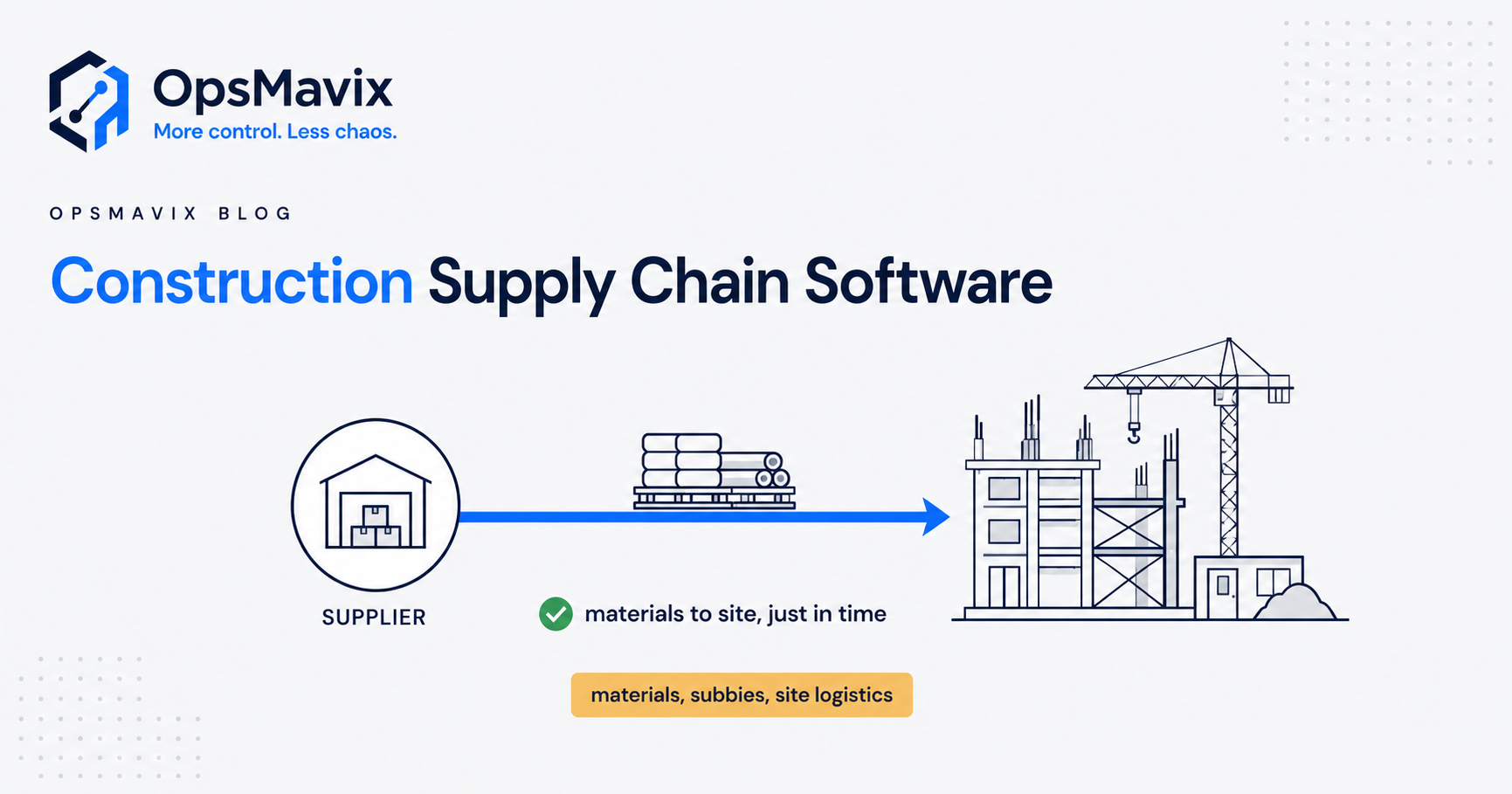
Construction supply chain management software is a system for planning, ordering and tracking the flow of materials, plant and subcontract labour from supplier to site, so the right things arrive at the right place on the right day and the cost of each item lands against the right job. Unlike a generic supply chain platform built around a warehouse and repeat orders, it has to cope with one-off bills of materials per project, deliveries to a muddy site with no storage, subcontractors who supply their own materials, and a cost base judged job by job rather than SKU by SKU.
Quick summary: Most contractors do not have a supply chain visibility problem they can buy their way out of with a big platform — they have a coordination problem between procurement, the programme and the site, and it shows up as waste, standing time and cost overruns. Construction generates around 59.4 million tonnes of construction and demolition waste a year in the UK (DEFRA), and a large share of that is over-ordering, damage and re-work that never needed to happen — which is why a right-sized system that ties materials to the programme usually beats a heavy generic SCM tool.
Contents
- What construction supply chain management software is
- Why generic SCM software fails on site
- The core things a builder actually needs it to do
- Generic SCM platform vs construction reality (table)
- Materials procurement and the bill of materials
- Suppliers and subcontractors are two different problems
- Site logistics: just-in-time to a site with no storage
- Waste, over-ordering and how it hits job cost
- A worked example: materials to site on a £2m job
- The right-sized owned alternative
- How to choose without getting oversold
- FAQ
- How OpsMavix can help
What construction supply chain management software is
Supply chain management (SCM) software plans and tracks the movement of goods from supplier to point of use. In manufacturing or retail that means forecasting, warehouse stock and replenishment against stable, repeating orders. Construction is different in almost every dimension: your “product” is a one-off building, your bill of materials changes with every project and variation, your storage is a temporary compound or nothing at all, and a big slice of your cost is subcontract labour rather than physical stock.
So construction supply chain management software is really about coordination against a programme, not stock optimisation. The questions it answers are: what does this job need, when does the programme require it on site, was the purchase order raised against the right cost code, and did what arrive match what was ordered — all tied to the profit on that contract.
If you want the general foundations first, our pillar guide on supply chain management software covers the concepts that apply across every sector.
Why generic SCM software fails on site
Buy a general SCM platform and you will spend the first three months trying to make construction fit a shape it was never cut for. The assumptions are wrong from the start.
Generic SCM assumes a warehouse you control, so it can optimise stock levels and reorder points. Construction has a site you barely control, often with nowhere to put pallets and a real risk of theft and weather damage. Generic SCM assumes repeat SKUs with a purchase history to forecast from; construction has a fresh bill of materials per job. Generic SCM treats a delivery as a transaction; on site a mistimed delivery means operatives standing idle at day rate.
The result is a platform your buyers half-use for purchase orders while the actual coordination — “is the plasterboard turning up before the plasterers?” — still happens in a WhatsApp group and a printed programme. You have paid for software and kept the risk.
The core things a builder actually needs it to do
Strip away the vendor feature list and the real job is short:
- Materials planning per job. Turn the drawings and programme into what needs ordering and when, against a cost code.
- Purchase orders tied to the job. Every PO raised against a contract and cost code, so committed cost is visible before the invoice arrives.
- Delivery scheduling to the programme. Book materials to land when the work is ready for them, not weeks early to sit and get damaged.
- Goods receipting and matching. Confirm what actually arrived against the PO, so short and wrong deliveries get caught on the day, not at month end.
- Supplier and subcontractor visibility. Know who owes you what and who you owe, including subcontract labour and materials.
- Cost flow-through. Every committed and actual cost lands on the job cost report automatically.
Notice what is not on that list: seasonal demand forecasting, safety-stock optimisation, multi-echelon warehouse balancing. Those are the expensive parts of a generic platform, and most contractors never touch them.
Generic SCM platform vs construction reality (table)
| What generic SCM assumes | What construction actually is | What the software must do instead |
|---|---|---|
| Stable, repeating SKUs | One-off bill of materials per job | Plan materials per project from the programme |
| A warehouse you control | A site with little or no storage | Schedule deliveries just-in-time to site |
| Forecast from order history | No history for a bespoke building | Order against drawings, take-off and programme |
| Cost tracked by SKU | Profit judged job by job | Tie every PO and delivery to a cost code |
| Suppliers only | Suppliers and subcontractors | Manage both, including subcontract materials |
| A delivery is a transaction | A late delivery = idle labour and plant | Link deliveries to the works and the crew |
The pattern is clear: the value in construction is in connecting materials to the programme and the job cost, which is exactly the part generic platforms leave you to bolt on yourself.
Materials procurement and the bill of materials
Procurement is where the money is won or lost. It starts with the take-off — turning drawings into quantities — which becomes the bill of materials. Get quantities wrong and you either over-order (waste and tied-up cash) or under-order (emergency runs to a merchant at retail price, plus delay).
Good construction supply chain software raises purchase orders against that bill of materials and, crucially, against a cost code on the job. That single discipline — no PO without a job and code — turns procurement from a black hole into something you can forecast: you see committed cost the moment an order is placed, weeks before the invoice lands. For a deeper look at the ordering side, see supplier and order management software.
The Chartered Institute of Building notes that a more consistent procurement process across the sector would “help decrease overall cost, facilitate a more integrated supply chain and result in a decrease in waste” (CIOB). That integration is the whole point — and it does not require the biggest system on the market, just a consistent one.
Suppliers and subcontractors are two different problems
Generic SCM knows about suppliers. Construction has two supply chains running at once, and they behave differently.
Suppliers deliver materials against POs — merchants, manufacturers, plant hire. This is closest to classic supply chain: order, deliver, receipt, invoice, pay.
Subcontractors supply labour, and often materials too, under the Construction Industry Scheme. Under CIS, contractors must deduct money from most subcontractor payments and pass it to HMRC — 20% for registered subcontractors, 30% for unregistered, and 0% for those with gross payment status (HMRC). A subcontractor who is also supplying materials blurs your supply chain and your labour cost into one payment that still has to be split for CIS. Any construction supply chain system has to handle that reality, or it hands the mess back to your bookkeeper.
Site logistics: just-in-time to a site with no storage
This is the part no warehouse system understands. On a live site there is frequently nowhere to store materials safely. Order too early and pallets sit in the mud, get damaged, get nicked, or block the access the next trade needs. Order too late and you pay operatives to stand around.
The answer is just-in-time delivery sequenced to the programme: materials arrive shortly before the trade that needs them, in the order the works happen — sourcing, deliveries and waste management handled together rather than as separate afterthoughts.
Doing this well needs the materials plan, the delivery schedule and the programme to be the same data. When they live in three different tools — a buying spreadsheet, the merchant’s portal and a printed programme on the cabin wall — coordination depends on someone reconciling them by hand. That is where the standing time and double-ordering creep in.
Waste, over-ordering and how it hits job cost
Waste is not just an environmental line item; it is margin walking off site. The UK generates roughly 59.4 million tonnes of construction and demolition waste a year, of which around 55 million tonnes is recovered (DEFRA). Recovery is good, but the cheapest waste is the material you never over-ordered in the first place.
Over-ordering happens for rational-in-the-moment reasons: pad the quantities so you never run short, order a full pack when you need two-thirds, buy early because the price might rise. Each is defensible; together they quietly erode the job. When materials are ordered against a bill of materials and receipted against POs, the gaps become visible and you can ask why one job consistently orders over take-off. Without that thread, waste is invisible until the skip bill and the final account tell you the margin has gone.
The fix is the same one that fixes job costing: tie everything to the job. If profitability is your live worry, tracking project profitability without spreadsheets covers the reporting side that materials data feeds into.
A worked example: materials to site on a £2m job
Take a mid-size contractor running a £2m residential job. The frame is up; first-fix and plasterboard are next.
How it goes wrong without a joined-up system. The buyer orders plasterboard from the take-off spreadsheet and rounds up to be safe — 1,150 boards against a real need of about 1,000. The merchant offers a slot, so delivery lands 10 days early. There is no dry storage, so 80 boards are damaged and go in the skip. The boards also arrive before first-fix electrics are done, get stacked in the rooms the electricians need, and two operatives lose most of a day working around them. Nobody logs the short-delivered insulation until the plasterers stop.
Rough cost of that one sequence:
- 150 surplus/damaged boards at roughly £10 each = £1,500 in materials and skip.
- Two operatives idle for a day at, say, £180 each = £360 in standing time.
- Half a day of programme slip that ripples into the plasterers’ start.
Multiply that by every material package on the job and the leak is real money — and none of it appeared on a report until the final account.
How it goes with a right-sized system. The board order is raised against the job and plasterboard cost code from the bill of materials — 1,000 boards, no padding, committed cost visible immediately. Delivery is booked for the day after first-fix sign-off, in two drops so nothing sits. Goods are receipted against the PO; the short insulation delivery is chased that morning, not two weeks later. The result is less waste, no standing time, and a job cost report that matches reality while the job is live — because the materials plan, delivery schedule and programme were the same data.
The right-sized owned alternative
Here is the honest position. Most UK contractors are small firms — there were 370,770 VAT and PAYE-registered construction businesses in Great Britain in 2024 (ONS), the overwhelming majority micro and small. They do not need a multi-echelon supply chain platform. They need materials tied to the programme and job cost, deliveries sequenced to site, and one place to see committed versus actual cost.
That is a right-sized, owned system: built around your take-off, suppliers, programme and cost codes — not a generic platform you rent and bend to fit. It does exactly the coordination that leaks money, without the licence and configuration weight of features you will never use. If you are weighing a bigger stack, our guide to construction ERP software explains where a full ERP genuinely earns its keep and where it is over-buying.
The point is not “smaller is always better”. It is that the value in construction supply chain software is coordination, and coordination is cheap to get right when the system is shaped around how your jobs actually run.
How to choose without getting oversold
A few questions cut through the sales pitch:
- Does it plan materials against the programme, or just record orders? Recording POs is table stakes; sequencing to the works is the value.
- Does every PO and delivery land on a job cost code automatically? If not, you are still reconciling by hand.
- Does it handle subcontractors and CIS, not just suppliers? Construction has two supply chains.
- Will your team actually use all of it? If you will use 30% of a platform, you are paying 100% to license the other 70%.
- Do you own it or rent it? Owned systems bend to your process; rented platforms make your process bend to them.
If the honest answer is “we need three or four of these things done reliably”, you almost certainly do not need a heavy generic SCM platform.
FAQ
Is construction supply chain management software the same as construction ERP?
No. Supply chain software focuses on the flow of materials, plant and subcontract labour to site. A construction ERP is broader — accounting, job costing, CIS payroll, plant and document control as well. Supply chain functions are often one part of an ERP, but you can run right-sized supply chain coordination without buying a full ERP.
Do small contractors really need dedicated supply chain software?
Not a generic platform, no. But almost every contractor benefits from tying materials orders to the programme and the job cost, so committed cost is visible and deliveries are sequenced to site. That can be a right-sized owned system rather than a heavy platform — the goal is coordination, not stock optimisation.
How does it help reduce construction waste?
By ordering against a real bill of materials instead of padded quantities, sequencing deliveries just-in-time so materials are not damaged in storage, and receipting goods against POs so over-ordering becomes visible per job. Given the sector generates around 59.4 million tonnes of construction and demolition waste a year, cutting over-ordering is both a cost and a sustainability win.
Can it handle subcontractors and CIS?
It should. Construction runs two supply chains — suppliers of materials and subcontractors who supply labour and often materials under the Construction Industry Scheme. Any system worth having has to route subcontract costs correctly, including the CIS deductions of 20%, 30% or 0% depending on the subcontractor’s status.
What is the difference between materials procurement and site logistics?
Procurement is deciding what to order, from whom, at what price, and raising the purchase order. Site logistics is getting it to site at the right time, in the right sequence, and receipting it. Both need to share the same data — the bill of materials and the programme — or the two drift apart and coordination breaks down.
How OpsMavix Can Help
OpsMavix builds right-sized, owned operations systems for construction firms that are too messy for spreadsheets but not ready for — or over-served by — a full ERP. Instead of renting a generic platform and bending your jobs to fit it, we build the coordination that actually leaks money: materials planned against your programme and take-off, purchase orders tied to job cost codes, deliveries sequenced just-in-time to site, goods receipting that catches short and wrong deliveries on the day, and a live view of committed versus actual cost per job — including subcontractors and CIS.
You own the system, it does exactly what your jobs need, and it ties into your wider job-costing and reporting through a project operations dashboard. We sell the outcome — less waste, no standing time, no cost surprises at final account — and back the build with a delivery guarantee.
Start by finding out where the money is actually leaking. Book a Free Operations Leak Audit.
Sources
- DEFRA / GOV.UK — UK statistics on waste (construction and demolition waste generation and recovery): https://www.gov.uk/government/statistics/uk-waste-data
- CIOB — Procurement policy position (consistent procurement, integrated supply chain, waste reduction): https://www.ciob.org/industry/policy-research/policy-positions/procurement
- HMRC / GOV.UK — What is the Construction Industry Scheme (CIS deduction rates): https://www.gov.uk/what-is-the-construction-industry-scheme
- Office for National Statistics — Construction statistics, Great Britain: 2024 (370,770 registered construction firms): https://www.ons.gov.uk/businessindustryandtrade/constructionindustry/articles/constructionstatistics/2024
- Insolvency Service / GOV.UK — Commentary: company insolvency statistics (construction sector insolvency context): https://www.gov.uk/government/statistics/company-insolvencies-september-2025/commentary-company-insolvency-statistics-september-2025